Hog Wild

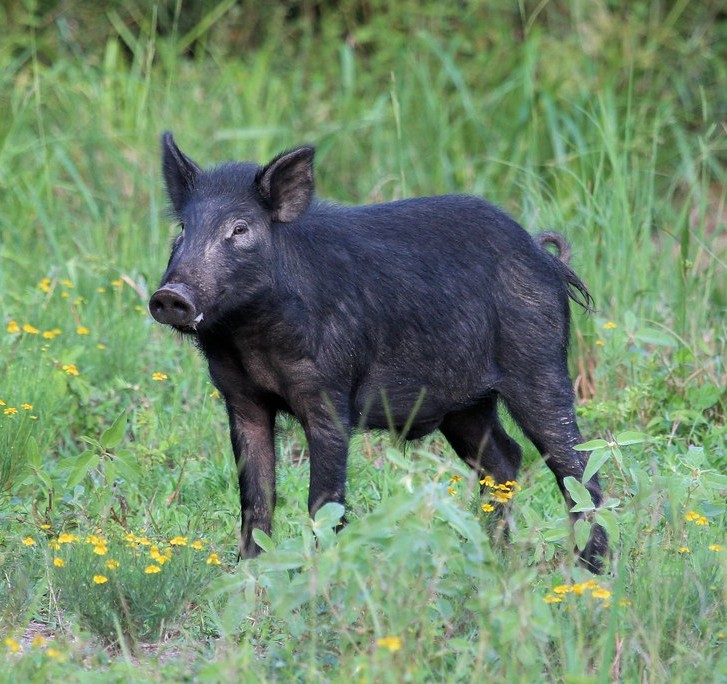
A handsome young Pineywoods Rooter

Florida is a rich kaleidoscope of wildlife. Some, like the invasive pythons in our Everglades, are unique to our state; the rest are mostly just more abundant than in other states. Deer are everywhere, as are rabbits. Squirrels and wild turkeys keep the hawks, eagles and vultures well fed. Mockingbirds, cardinals and crows could use an air traffic control system. We even have a family of armadillos living behind us in the vacant lot. For the most part they put on a show for us like having a real time David Attenborough documentary parading past our back door nonstop (without the deep British voice, of course).

But the wild hogs, a gift to us from the Spanish settlers that took charge here hundreds of years ago, stop the show when they show up.

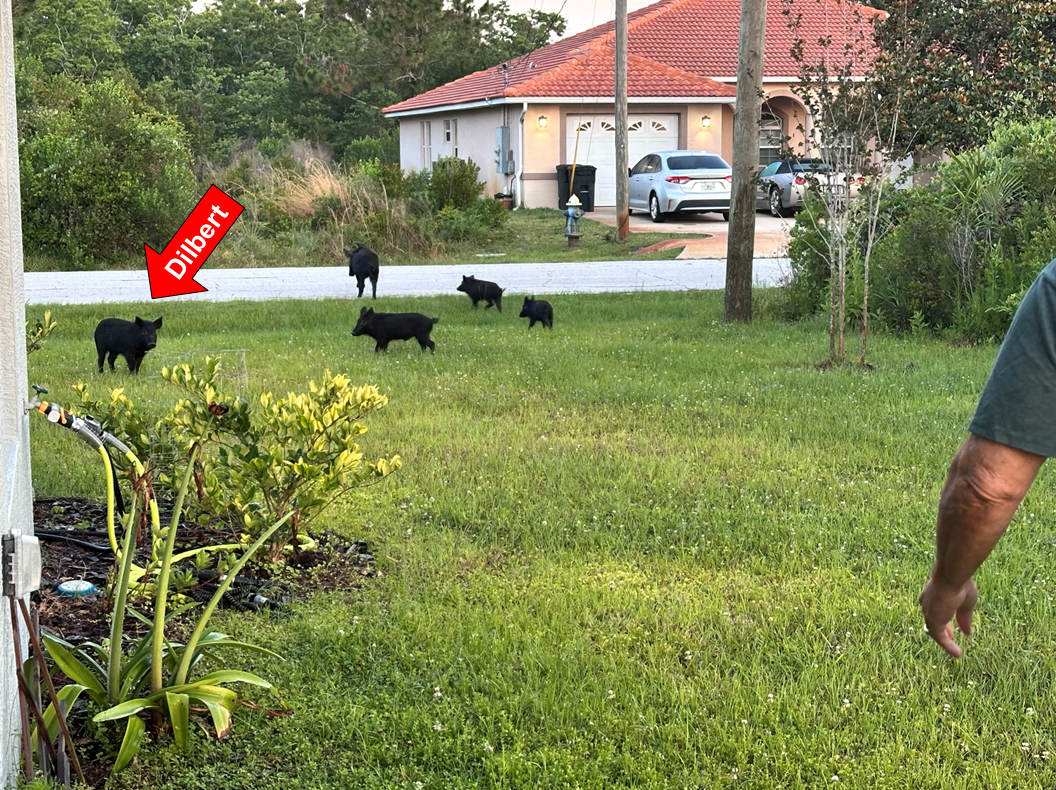
At first, they were adorable. A mother appeared with a litter of 4 piglets, all solid black with long skinny snouts and curly tails. There are a few types of feral hogs in these parts, and these were Pineywoods Rooters. Apparently sometimes these are kept as show hogs to enter into county fair contests, and Momma hog and her litter must have known this as she started putting on a daily appearance in our neighbors back yard where they could be easily seen from the street, and they got a regular audience over a couple of weeks. They were all skinny, a result of our overly dry winter not producing enough of their natural diet, the big fat grubs that live 3-6 inches down in the soil, especially under our well-tended lawns. The neighbor on the corner took pity on the little family and fed them.

Ouch.

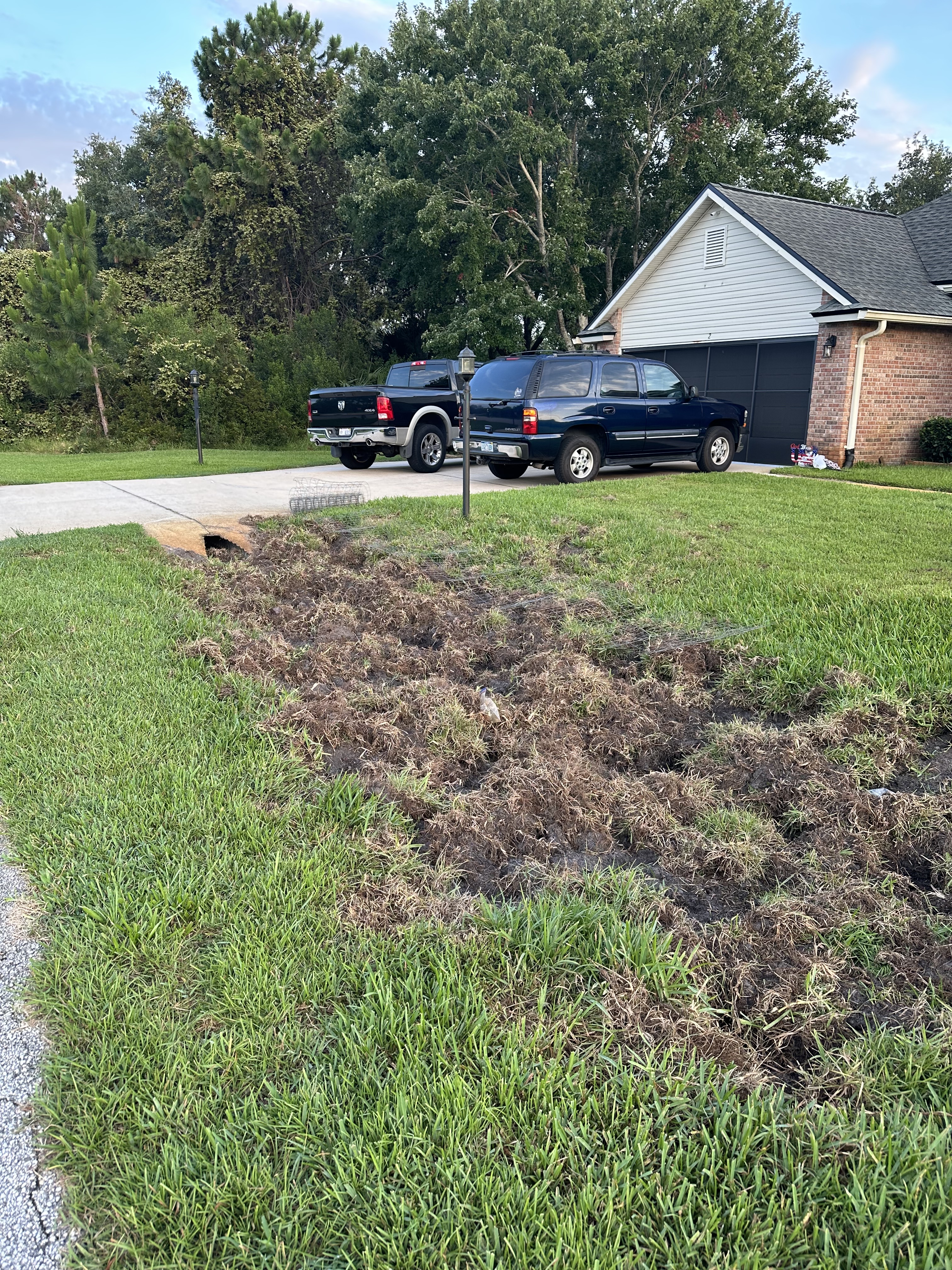
He became their first victim as a reward for his compassion. That long skinny snout, the “Rooter” part of their anatomy, is a perfect tool for plowing up moist ground to a depth of about 3-6 inches, which exposes the bounty of grubs that live under there. It’s a hog buffet, and momma hog took the opportunity to teach the young’un’s how to find it. Hogs are very efficient at this; their feeding field looks like the work of a professional farmer. Except that our neighbor isn’t a farmer, and he spends more time on his lawn than I spend sleeping.
The hogs became swina-non-gratis and this presented a problem. In deference to the longstanding urban myth, they don’t speak Latin (pun intended) and so didn’t get the memo. And trying to move 100’s of pounds of hogs away from a food source is risky business. For all their cuteness, they harbor an incredible amount of nastiness. Thank God the boars abandon the sow after mating or there could have been trouble only the Sheriff (or anyone with an AR15) could have solved. And that wouldn’t bode well for momma and her brood.

The hogs kept hanging out at the corner house buffet but ventured farther each night in search of more grubs. They found a bird feeder about 200 yards down the street and dug in. They rooted up a bunch of large square pavers in another back yard, rendering a scene reminiscent of the pictures we see of Gaza on a daily basis. They dug what looked like city-engineered drainage ditches randomly throughout the neighborhood. Enough became enough.

We had been traveling for a week and a half while all this hog carnage was taking place and were stunned at seeing it on our return. As yet, our pristine yard hadn’t been touched, maybe because I regularly spread a pesticide that kills the grubs with the intention of keeping the armadillos from turning my yard into a practice putting green with their similar type of hole digging for the same food. But then it started.

Another neighbor texted me that he had seen “the pigs” in our yard a couple of times at night. Then a few “test plows” appeared. They were looking for grubs but not finding. I got a text one evening and ran to get my Bryna pepper ball gun (proudly manufactured in Fort Wayne, Indiana!), a relatively quiet, CO2 powered “less lethal” self-defense pistol that shoots ½” round balls filled with tear and pepper gas.

The white balls are “kinetic”, or solid plastic; the blues are pepper spray; the gray/yellows are tear and pepper spray mixed.

I loaded mine with “kinetic deterrent” rounds of solid plastic that definitely leave a mark traveling at 300 ft. per second. I chased them out of the yard waving the pistol like a Mexican bandido and shouting up a storm. The largest of the litter, a male, wasn’t terribly impressed by my tirade and stood his ground. I didn’t relent and he finally gave up when I got too close for comfort and fled into the forest. I respected the little bastard for that and decided to name him Dilbert. Don’t ask and don’t judge.
“Ha, that’ll fix ‘em.” I know that pigs are smart, and the sight of a crazy, screaming bearded man with a gun would signal the status of UNWELCOME clearly to them. Sure, it will. “We won’t see them again in our yard” I assured Wendy. Right? Damn right!

I got another text. The were in the side yard. I again grabbed the Byrna. This time I emptied the 5-round magazine at them as I chased them, hitting Momma twice. A few hog squeals and clattering hooves as they disappeared into the forest across the street was what I earnestly hoped would be the last we saw of them.

The next morning, another text, and I’m thinking “Why don’t I just give the Byrna to my neighbor?” I ran out and sprayed another magazine at them to buy a little more time, but it was time to call in the cavalry. It’s illegal to hunt or shoot inside the city limits, and too many neighbors had been witness to this whole spectacle to take covert action (I said don’t judge me!), so we obviously needed a Hog Trapper.

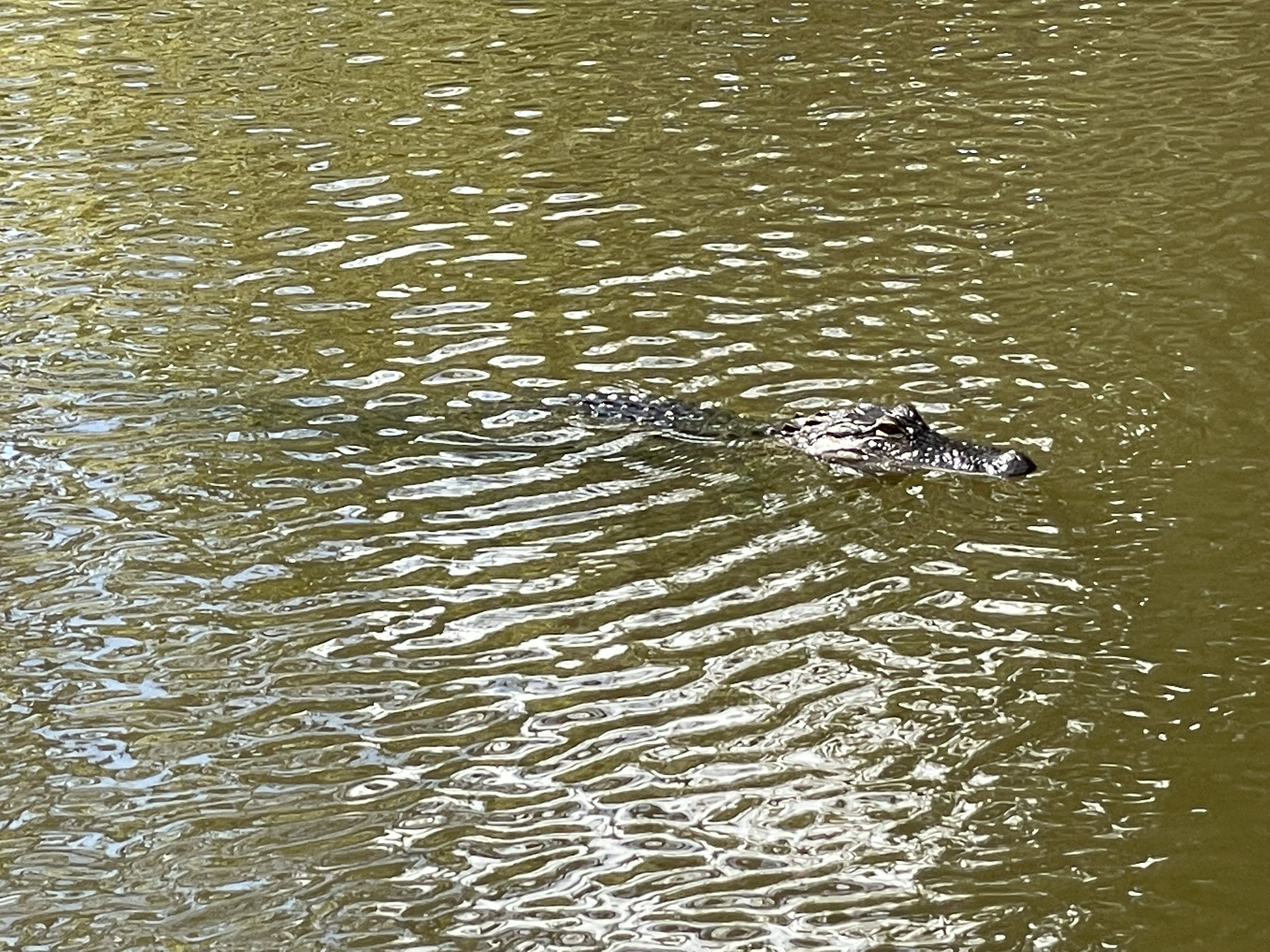
Like almost every other city in America we have Pest Control here in Palm Coast. But the definition of “pest” seems to be reserved exclusively to dogs and cats. If you get a snake up in your lanai, “call the snake guy”, a private firm that will take your (probably non-venomous) menace away for a price (or call me, if it’s a Black Racer I’ll come take it for free and put it in my yard). Same thing for armadillos, or bobcats, or bears, or gators, especially gators. Gators, it turns out, have value, and some of the private trappers will come get those bad boys out of your garage or off your front porch for free. They get paid by selling hides and meat, or occasionally selling a particularly spectacular specimen to one of our many Gator Farms. But we don’t have gators, we have hogs.

Hogs are meat. Why wouldn’t some enterprising trapper come and take them for free and turn them into bacon?
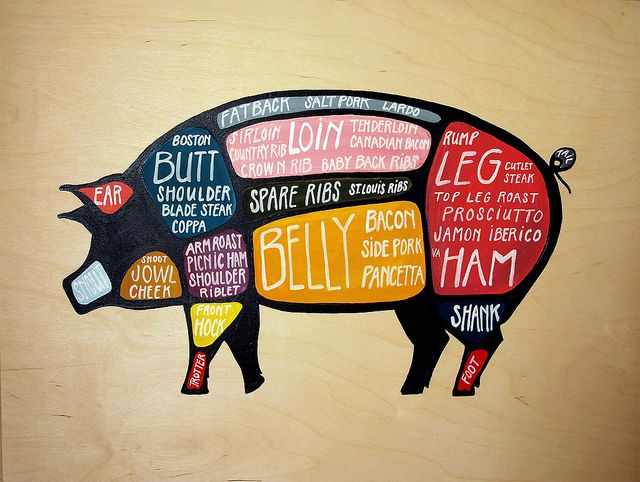
No offense intended to the Mayor of Boston, I’m sure the nomenclature is purely coincidental.

I got my answer from real experience, and I think I’d much rather snare and cage up a gator than a hog any day, even with one arm tied behind my back. Once you snare a gator snout, you render the dangerous end of the deal inert. Then it’s just a matter of muscling a great big lizard into a pickup.

But there isn’t only one nasty end of a hog, and their snouts won’t stay shut when you snare them. And if they get loose, they hold a grudge, bigly. Little Dilbert’s grow up into Big Bad Hogs, but a momma with a litter is far more dangerous.

I easily found a trapper, state certified for his methods and humane treatment, on the Florida Fish & Wildlife website. One of the best in the state works right here in our county.
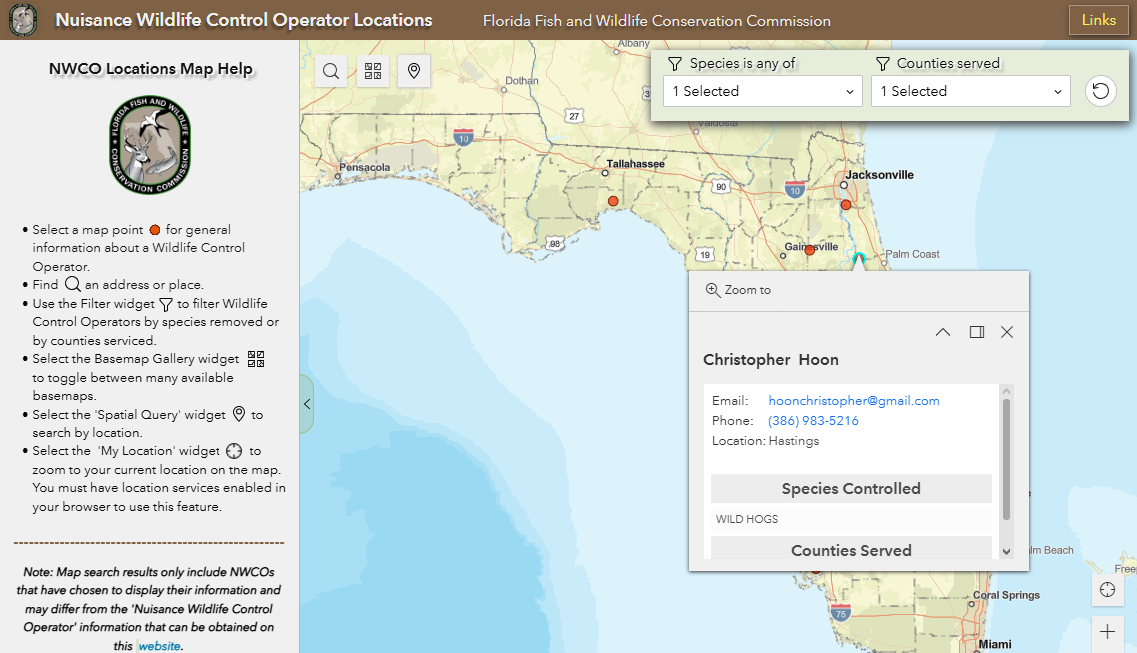
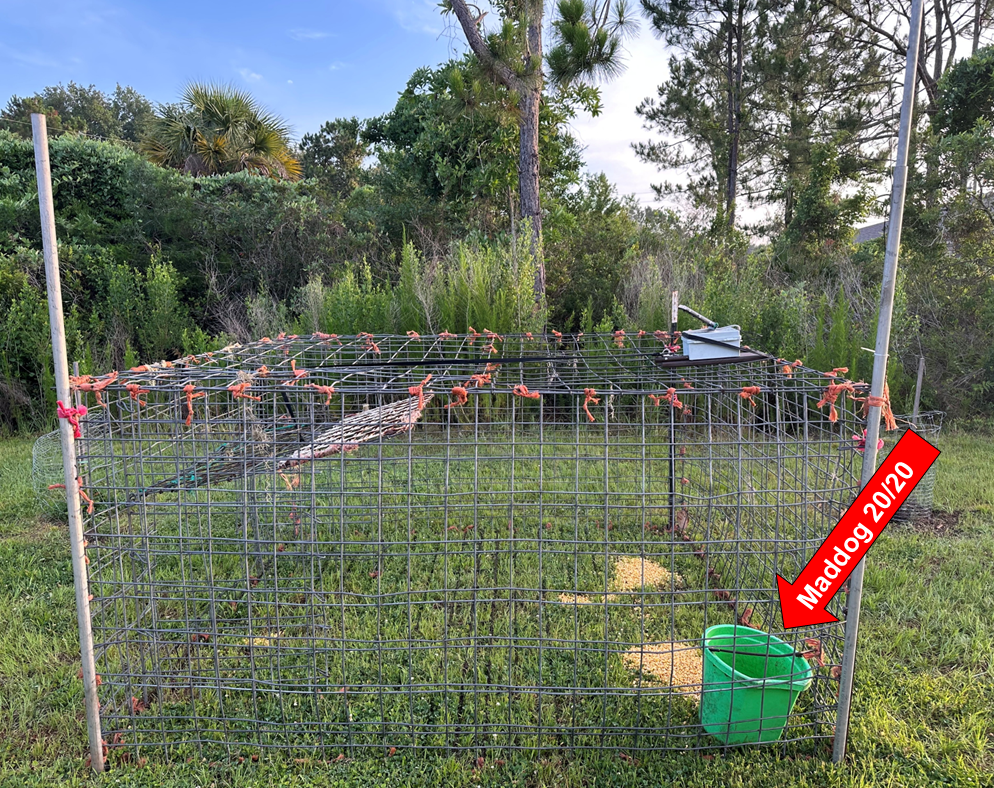
Chris “Hog Man” Hoons, a local native, has been trapping hogs in the 5 county area for almost 40 years. He builds his own traps (“them for-purchase things ain’t worth crap”) and mixes his own bait, dried corn with “just a little honey” and his secret ingredient, MD 20/20. “Maddog 20/20” should be easily recognized by any Boomer from their teenage years. It’s a highly alcohol fortified sweet wine that puts a body out like a light before ½ the bottle is gone. And the hogs love it. His other weapon is that he’s “a patient man, willin’ to let the hogs do all the heavy work”. I personally witnessed lots of heavy work in the process of setting up the trap, and again when he came back to load the hogs from the trap into a transport cage on his trailer to take them away. It leaves me wondering just how much heavy work those hogs had to do, besides recovering from the 1970’s style hangover they acquire from the bait

Oh, I seem to have skipped the parts about setting the trap and the hogs ending up in there. I called Chris and left a message and he quickly called me back. He had already been talking to another neighborhood man, Dan, whose birdfeeder had been victimized, and who was also friends with the neighbor on the corner, Richard, who had been running the hog daycare in his backyard. Dan was trying to negotiate with Chris to put a trap in Richard’s yard where it seemed like a slam-dunk that there would be bacon in the pan before nightfall (that’s Hog Man talk for, you know, catching hogs). But Richard wasn’t home, unfortunately called away on a road trip to Indiana for a family funeral. I had a ready solution, with my backyard being less than 100 yards from the daycare. I offered to Chris to let him put the trap there. I negotiated the deal with Chris’ wife Mary, $450, and we set an appointment for him to come the next evening and set it up. The $450 sounds kinda pricey, but it’s going to be split 3 ways and is good for “as many hogs as will go into the trap over a 30 day period”. It seemed more than adequate for our needs, especially considering it would cost at least 3 times that to repair our lawns should the curly-tailed oinkers remain on the rampage.

The trap setup is pretty straightforward. It’s basically a large cage with heavy wire on all 4 sides and top and bottom, which is especially important. Remember those plow-snouts? They are also very useful to tunnel out of a trap without a bottom, like those store-bought pieces of crap.

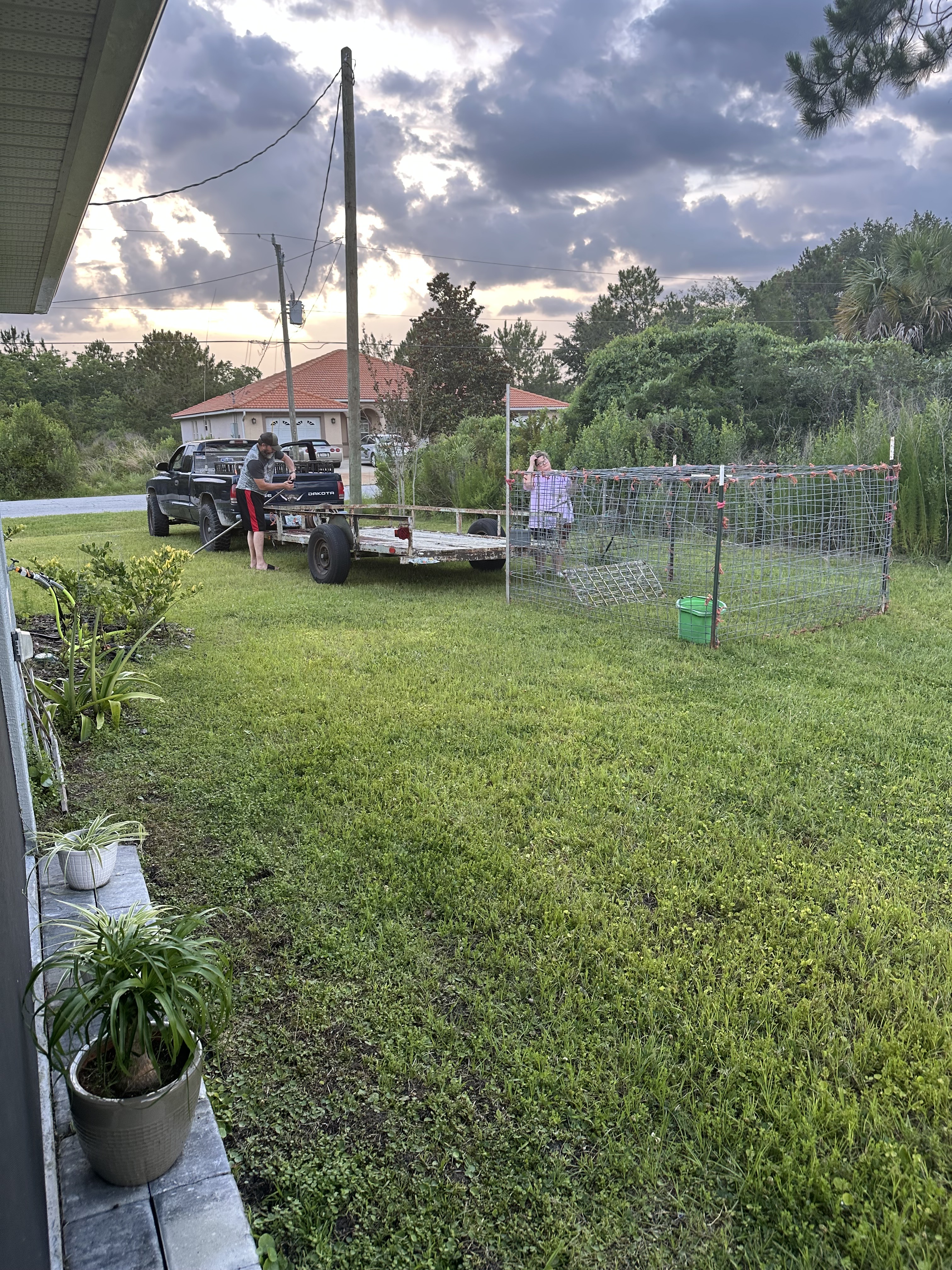
Chris backed his trailer into my back yard and set the trap down, anchoring all four corners with stakes. He rigged up a solar-powered cellular trail cam with a motion sensor to “watch” the door, and a cellular activated release hook that held the door open until Chris determined, using his cell phone to spy on the trap through the trail cam, that the hogs were inside. He triggers the mechanism to drop the door, and voila, “bacon in the pan”.
We were excited to get some bacon in the pan, but by next morning there was zip. Nothing in the pan. I put out a text “Pig Report” to all the principals, and got back pictures from Dan’s backyard trail cam that 4 hogs had been in his backyard that night feasting on bird seed. That’s not fair! We have corn, and honey, and Maddog 20/20! Maybe now that the birdseed buffet is closed, we’ll get lucky the second night.
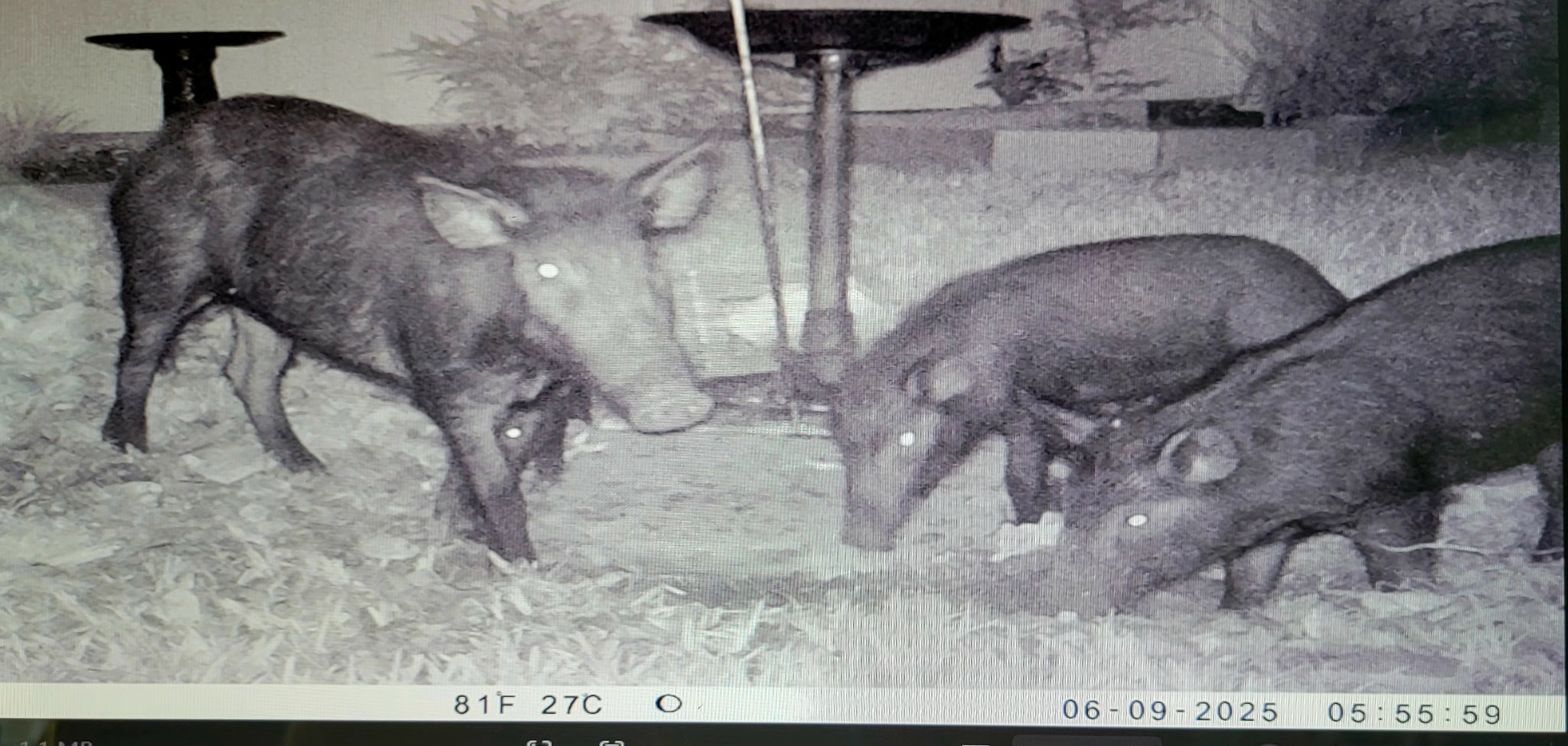
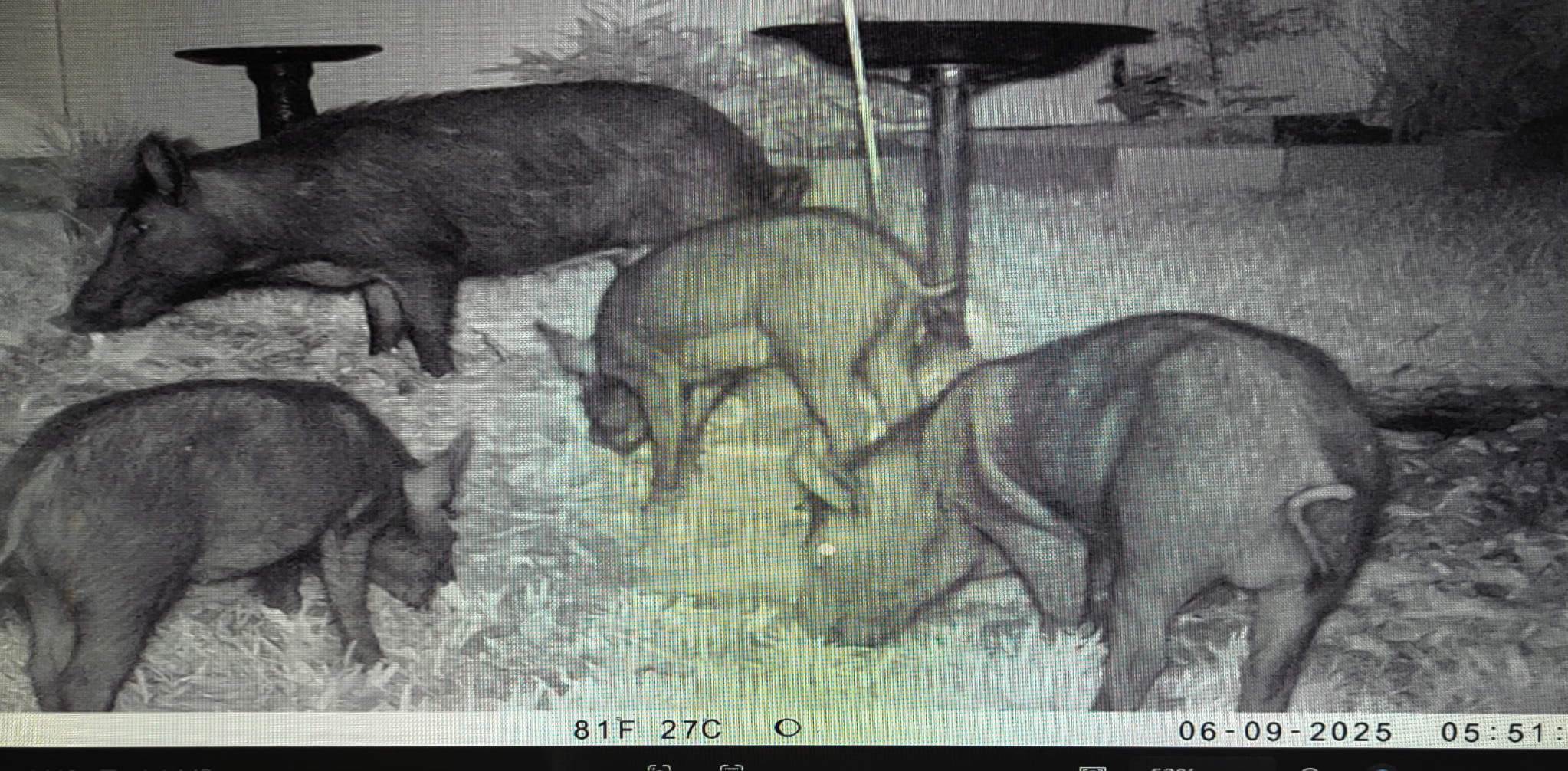
Nope. On our second morning we awoke sans bacon. On our third morning too, just like that line from Creedence Clearwater’s “Midnight Special”, “ain’t no food upon the table, ain’t no pork up in the pan”. Dan’s trail cam had recorded nothing. We were wondering if maybe the hogs had moved on to greener pastures when we got a report that they were back frolicking in Richard’s daycare diner down on the corner.

Dan’s wife, Sharon, had provided us with a baggie of dry corn to dribble a small trail of treats leading to our trap, and Wendy decided tonight was the night. At dusk we walked down the street to Richard’s, and there were 2 piglets in the daycare. I rattled the corn bag and they instantly came running like a couple of hungry 100 pound feral cats. So, I took this cue and walked back to our backyard, feeling and looking a lot like the Pied Pig Piper. One of the 2 was a large male, and he started getting pretty aggressive about wanting that corn. I kept kicking him away until we got to the trap and he smelled the magic bait mixture, which convinced him to lead his sister into the trap.

The Pied Pig Piper works his magic!

Well, we got 2 of the 5, now what do we do? I called Chris. “Just leave them be”, the patient Hog Man says, “momma will be along with the others shortly”. He is watching all this unfold over the trail cam.

And sure enough, here she comes with another piglet, which immediately heads to the bait buffet in the trap. Momma thinks something’s fishy though, and takes her time walking around the trap for several minutes, until she can’t resist the smell of the MD 20/20. She heads cautiously in to partake, and the door falls shut. Chris figures 4 out of 5 is a good haul and assures me the missing piggie will probably show up during the night and push through the trap door to join the others.
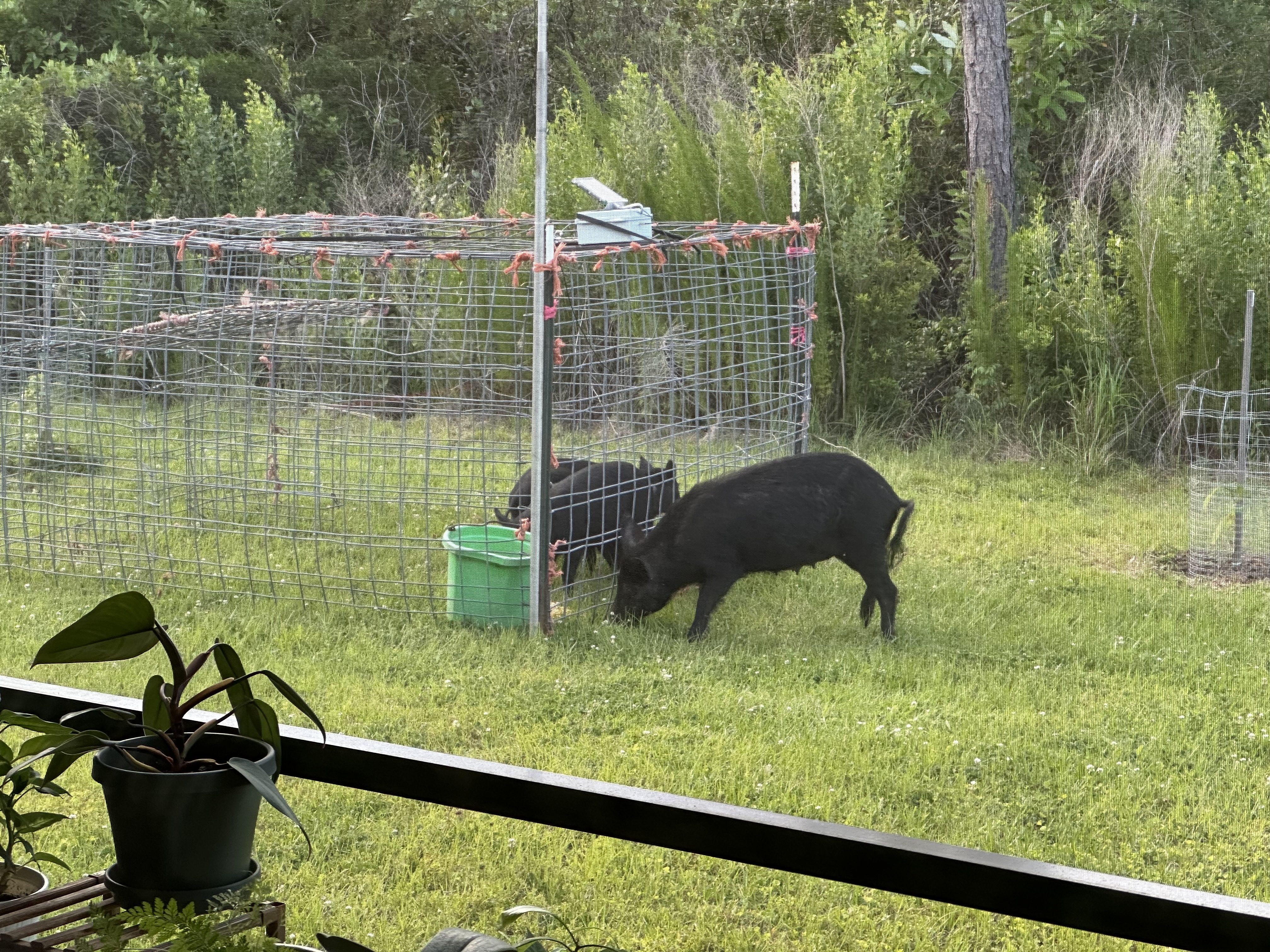
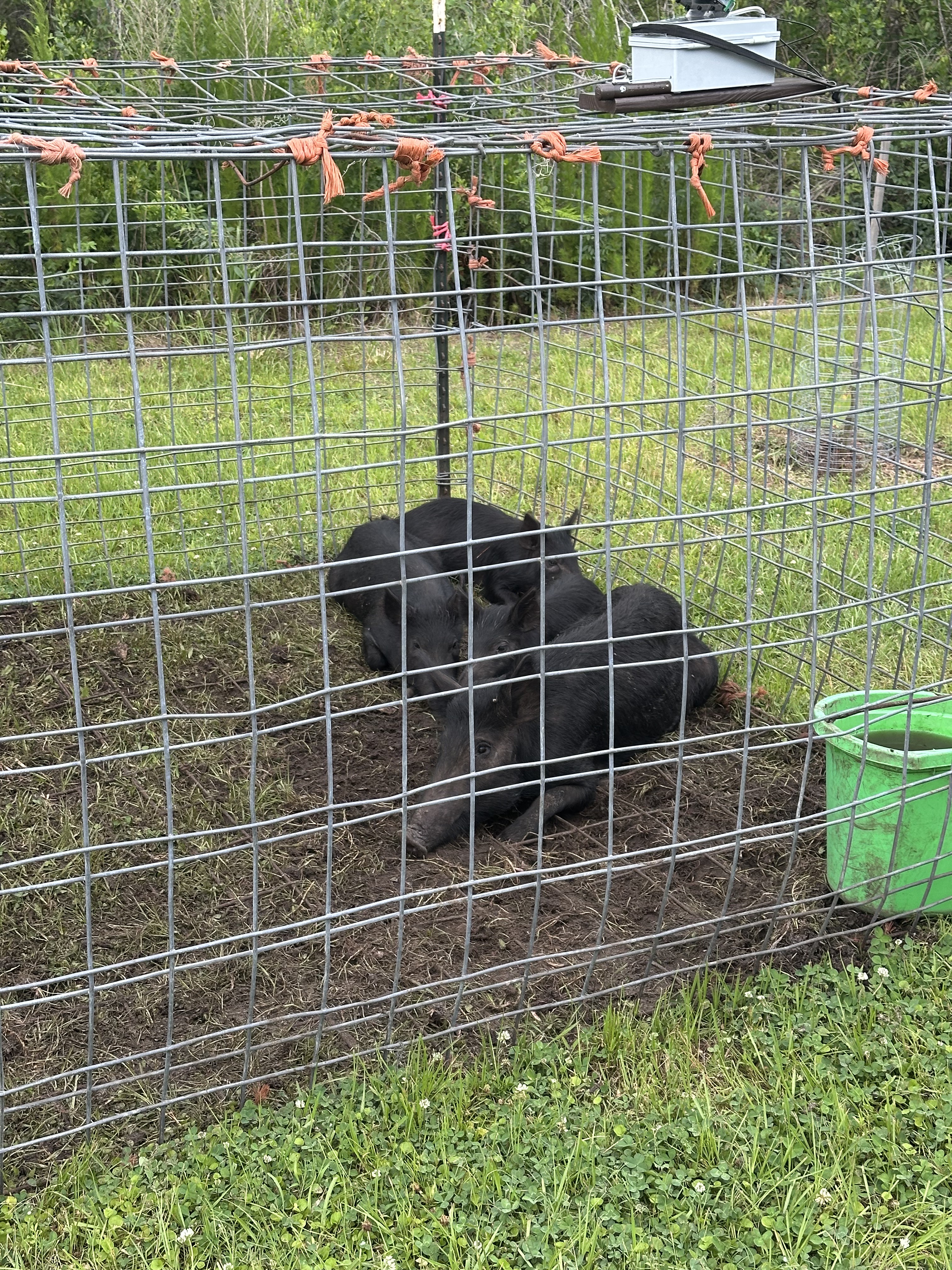
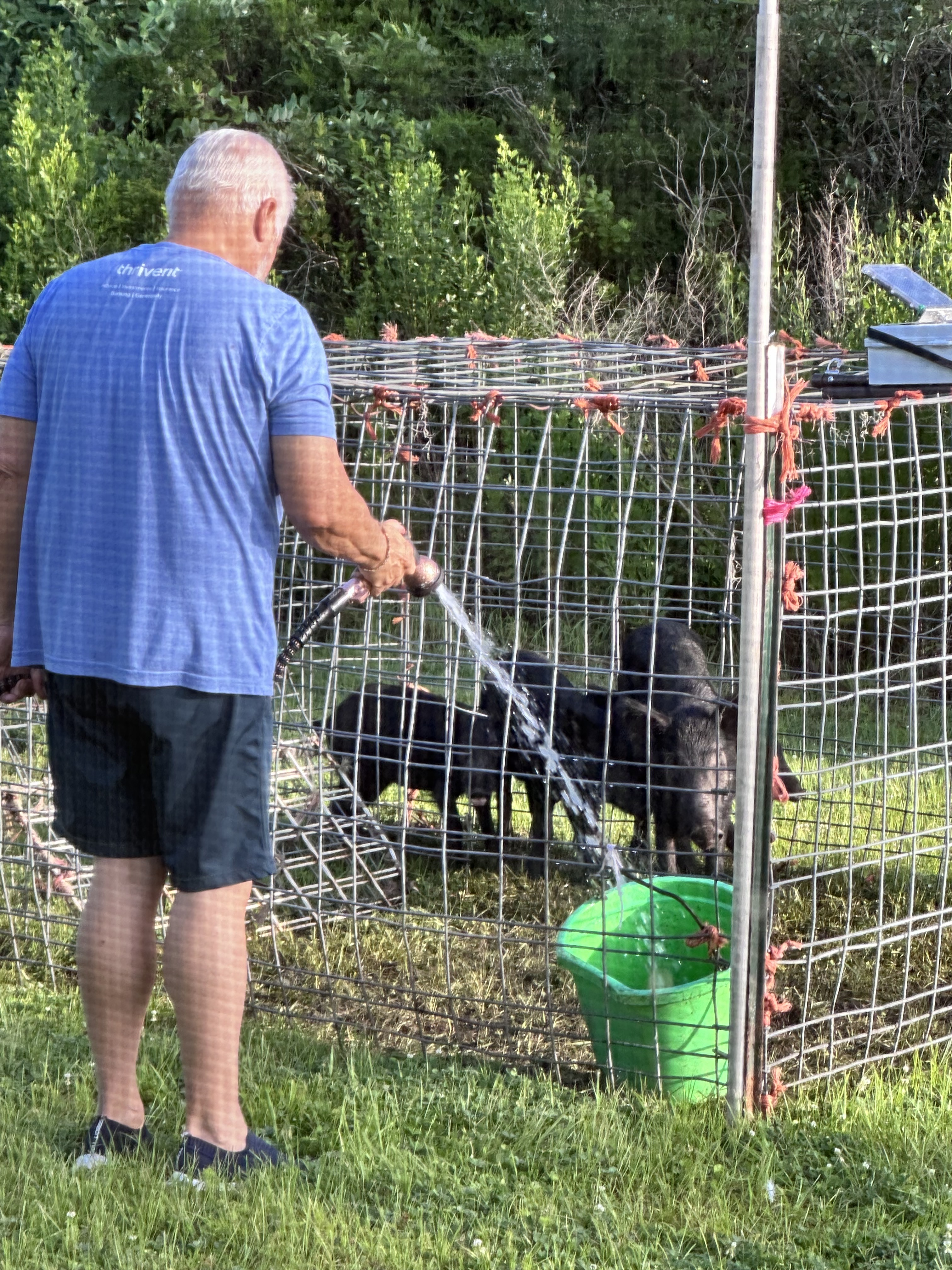
Morning comes and no lost piggie. Chris is scheduled to bring his cage and transfer them at noon, and he asks us to hose them down “every now and then” because hogs don’t sweat, the Florida sun is hot, and the hogs are black. We water our piggies hourly, and they love it, squinting and grunting as the cool spray drenches them. They don’t look like sausage so much when they’re smiling at you instead of trying to bite your hand off. We give them the baggie of corn and they gobble it up. It’s pretty obvious they are skinny and hungry and we later find out from Richard that the smallest of the litter hasn’t been seen for a while and has likely died in the forest. For all our talk about pit roasts and bacon, it’s sad and we hope Chris hurries to take them away.

After a much longer day of servicing traps and transporting hogs than he wished, Chris showed up in the late afternoon to haul the brood away and reset the trap. He first assembles the loading ramp.
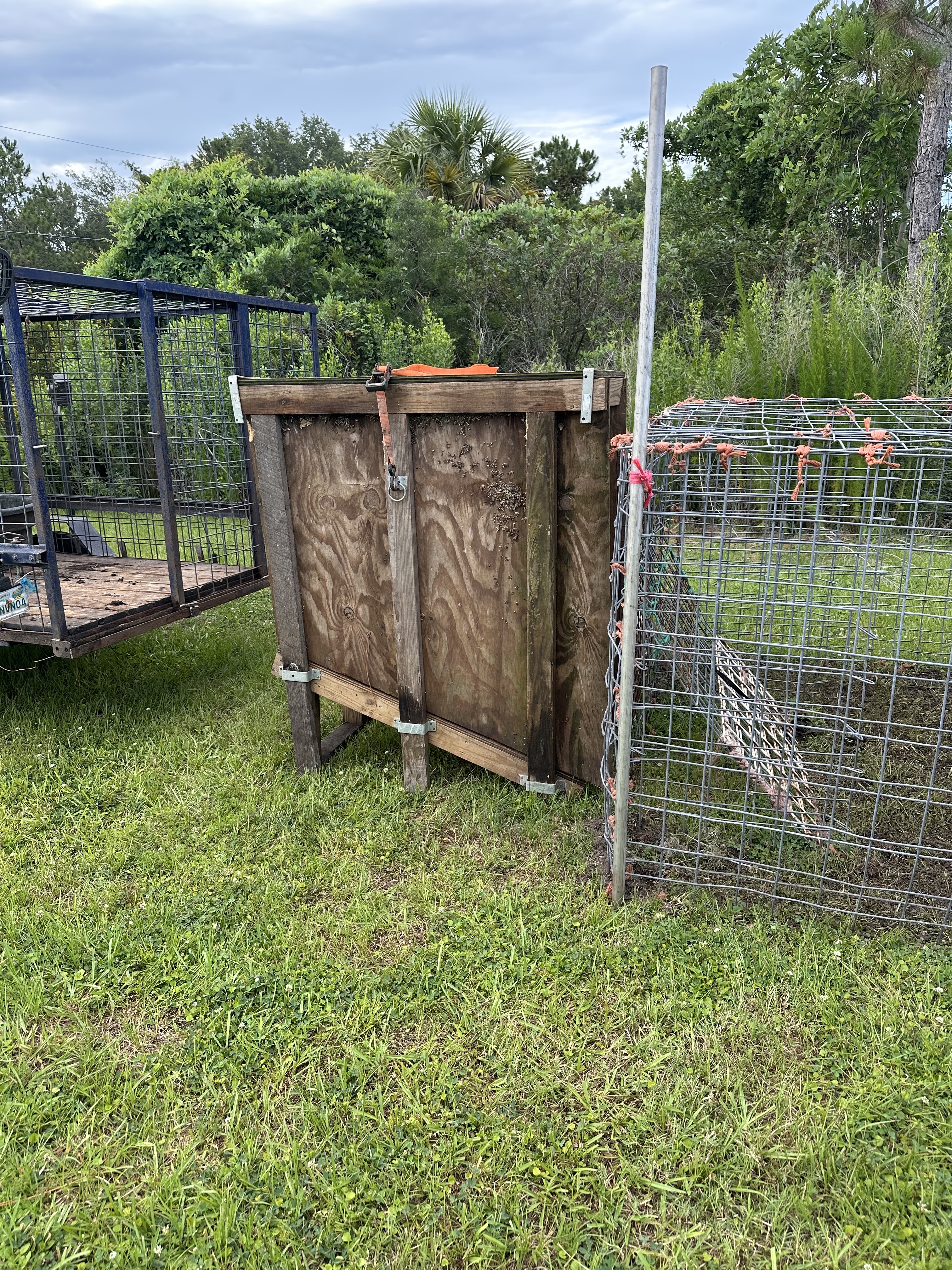
Transferring the hogs from the trap to the transport cage on the trailer is no easy job. The piglets are all lined up behind mommy for protection, and she is trying to decide which one of us outside the trap she wants to chew the arm off of first. Chris backs the transport trailer up to the ramp, opens the doors on both ends, and starts prodding mommy hog to get up the ramp. She is having none of that and starts charging and snapping at anything put into the trap to coerce her.

Momma Hog is having NONE of this poking stuff

Eventually Mary convinces Chris to give up this tactic and he fashions a noose out of a rope. He manages to snag her upper jaw good enough to lead her into the chute and then drags her up into the trailer. The babies instantly follow as if they were one hog, united in support of their leader Mom, and the drama is suddenly over.
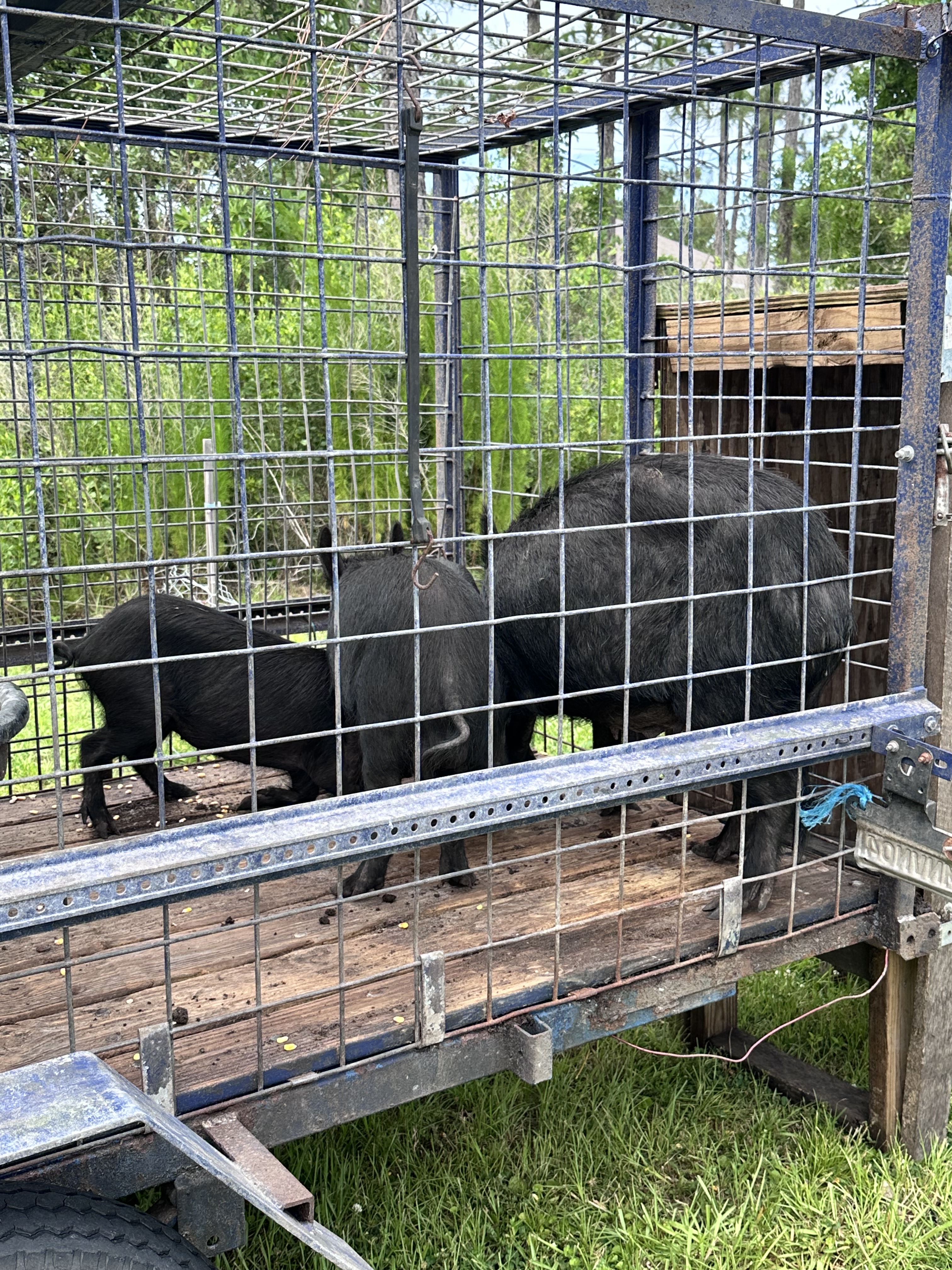
We all thought there might be another older litter terrorizing the other end of the neighborhood because Dan had seen hogs on his backyard trail cam, so we left the trap set to see if we can get them too.

The hog trailer disappears into the night, the piggies on their way to a pen in Hastings where they will get antibiotics and corn feed and Mary will remove the three big ticks on mommas ear. Chris and Mary have kept a few of their catches as pets over the years and Mary has been looking on one of these fondly, so who knows?

After a few more days of an empty trap, we came to believe that the hogs seen on Dan’s trail cam were the same that I had lured into the trap, and Chris agrees and comes to take the trap down. It will get placed somewhere else in town because this place, like most of Florida, used to be a huge swamp, and the hogs have been here hundreds of years longer than we have. Palm Coast will continue to rapidly build new housing, and our neighboring swine population will continue to get squeezed down in their territory until there simply won’t be any more bacon to hunt. Before he arrives, a few more visitors come to check out the bait, but we aren’t in the market, so they snack and then move on.
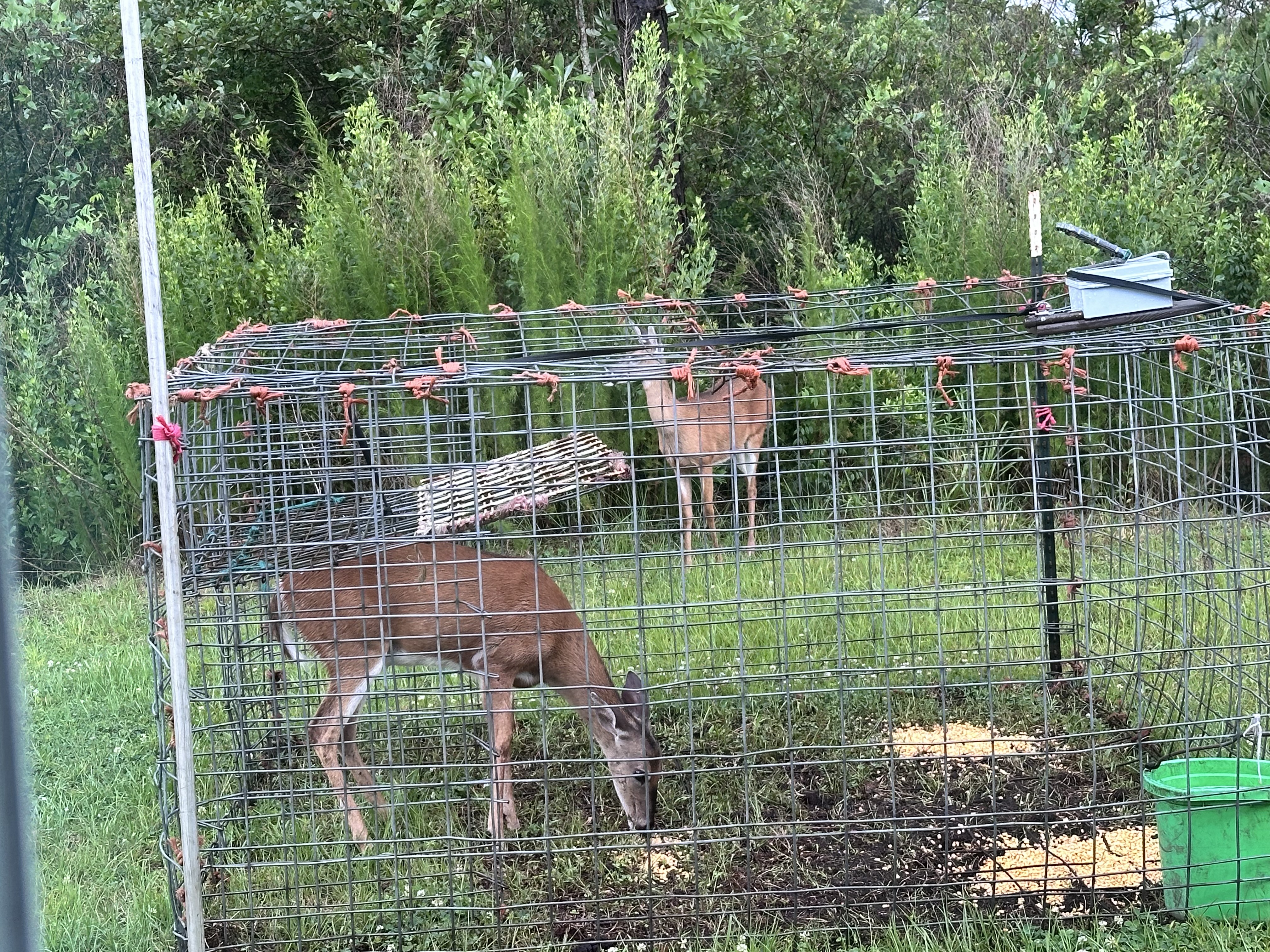
Oh deer, this would have been too easy, but we have NO idea what regulations cover this.

Don’t forget to put your email in the box up top to subscribe! And check out our last 3 posts, Pura Vida Uno, Dos and Tres (in that order) to see what’s up in Costa Rica.

Posted in Florida Bound | Tagged , , , , , , , , , | 5 Comments

Pura Vida Trés: Manuél Antoñio

Arrival to the hotel was fun. We had to drive through Quepos to get to Manuél Antoñio. Quepos is an old fishing town, built in the flat land surrounding the harbor, with not surprisingly narrow roads, many of which have been converted to one-way streets to accommodate the increase in traffic that tourism brings. Manuél Antoñio, however, is built on the hillsides of the national park peninsula, with much narrower and more “rustic” streets that aren’t easily converted to one way. It’s like Grand Theft Auto but in real life. There aren’t any posted speed limits because raw physics controls your actual maximum rate. I’m good with math, but I’ll never figure how a 7’ wide transit van and a 5’ wide car can pass side-by-side on an 11’ wide road.

This is a wide spot in the road to the hotel. Let’s see, (11′ road – 2′ dude width – 7′ wide transit van) = 2′ for a passing car? Boston mode ON (explained later).

The road gets narrower and narrower until it comes to the very long famously steep (check the TripAdvisor reviews!) driveway to the hotel that drops alarmingly off to the left. We have climbed the tall mountain ridge that is Manuél Antoñio, slithered across the narrow top, and now enter a 1 mile long goat path that immediately drops at about a 30-degree angle back down to the beachfront hotel, about 7’ wide with hairpin turns and an occasional wide spot. We take the attitude that there was no extra charge for this thrill ride and that many before us have taken it. The thought passes my mind that we will need to make this transit a few more times during our stay here, and we resolve to just smile and enjoy it.

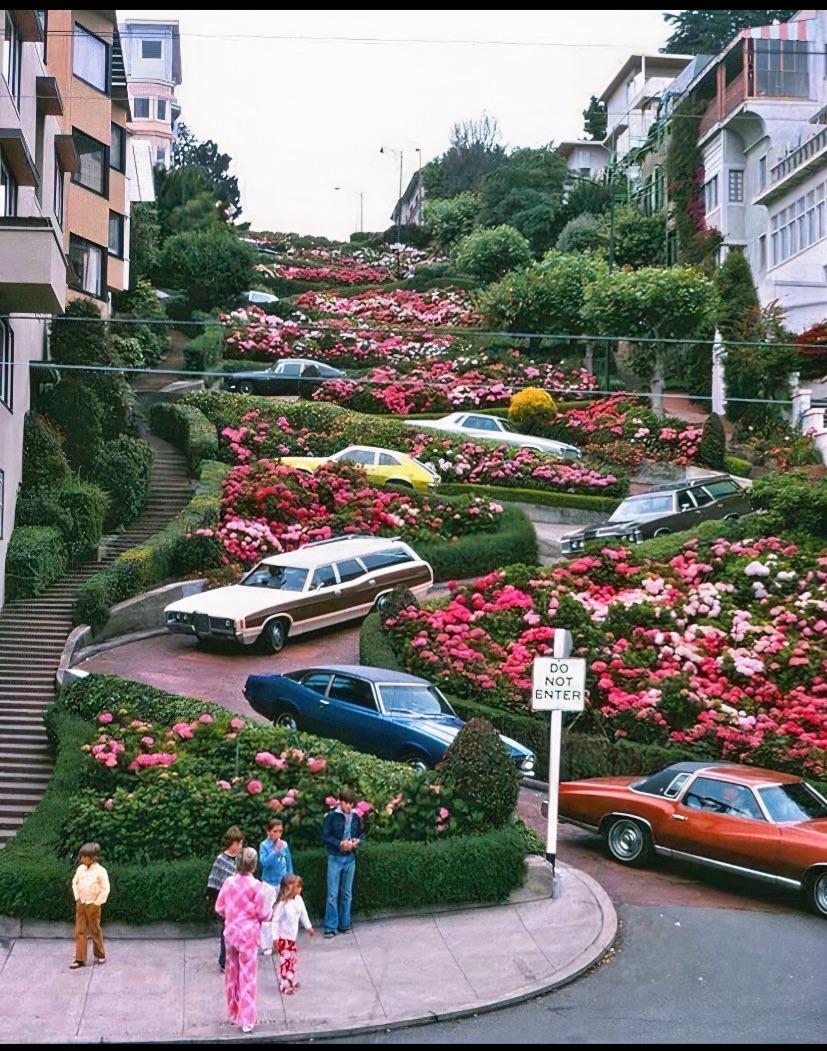
Lombard Street, San Francisco

We are delivered safely to the reception area, which turns out to just be a place to transfer to a golf cart that takes us the rest of the way to the actual reception on a path that equals the driveway in challenge but is slightly better paved and relatively wide considering we are now in a 4′ wide golf cart. The hotel is built on a cliff above a private beach, and the golfcart pathway that connects all the buildings and rooms looks like the famous Lombard Street in San Francisco. Wendy and I like to hike, but prefer not to have to repel back to our room.

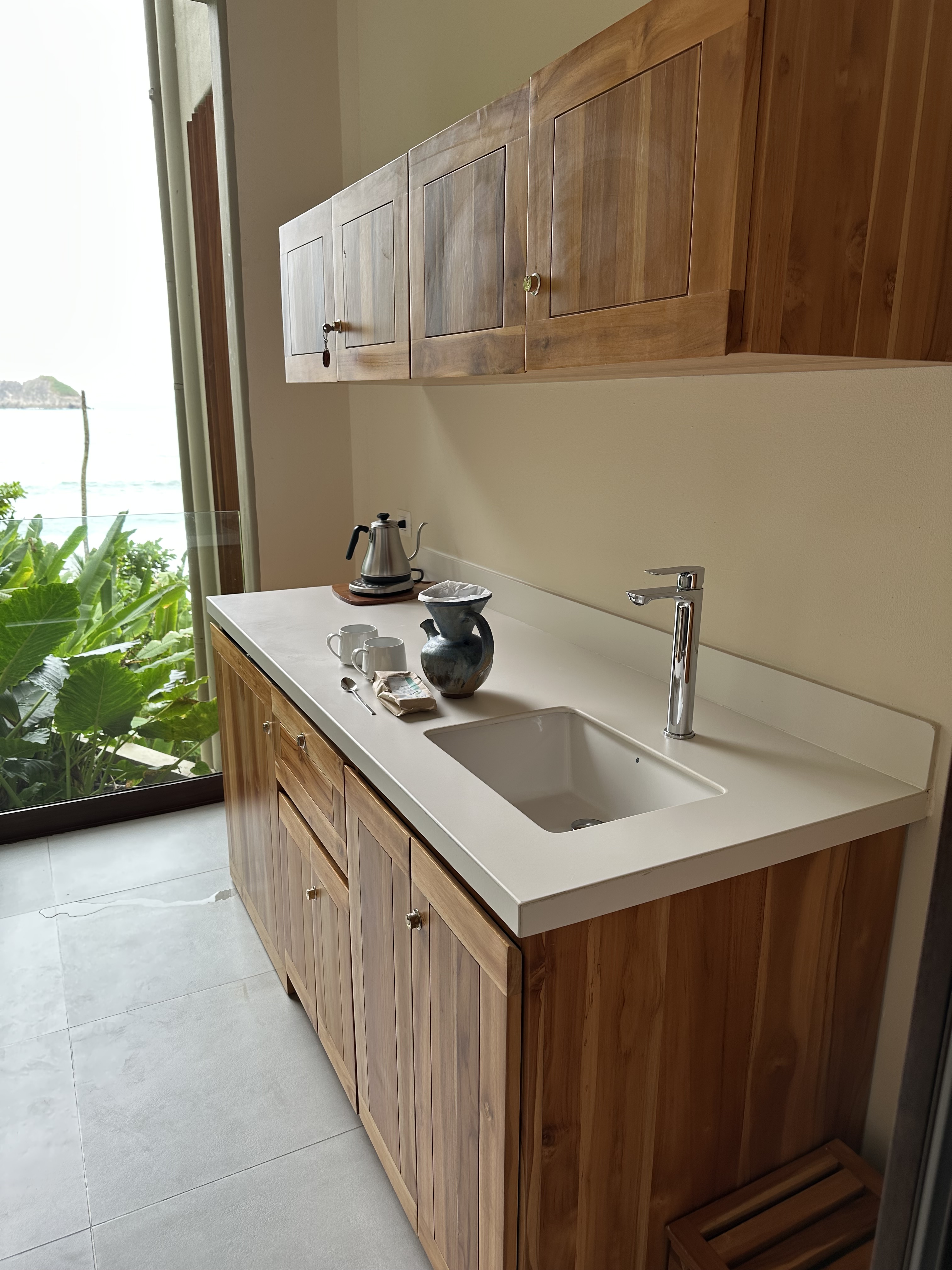
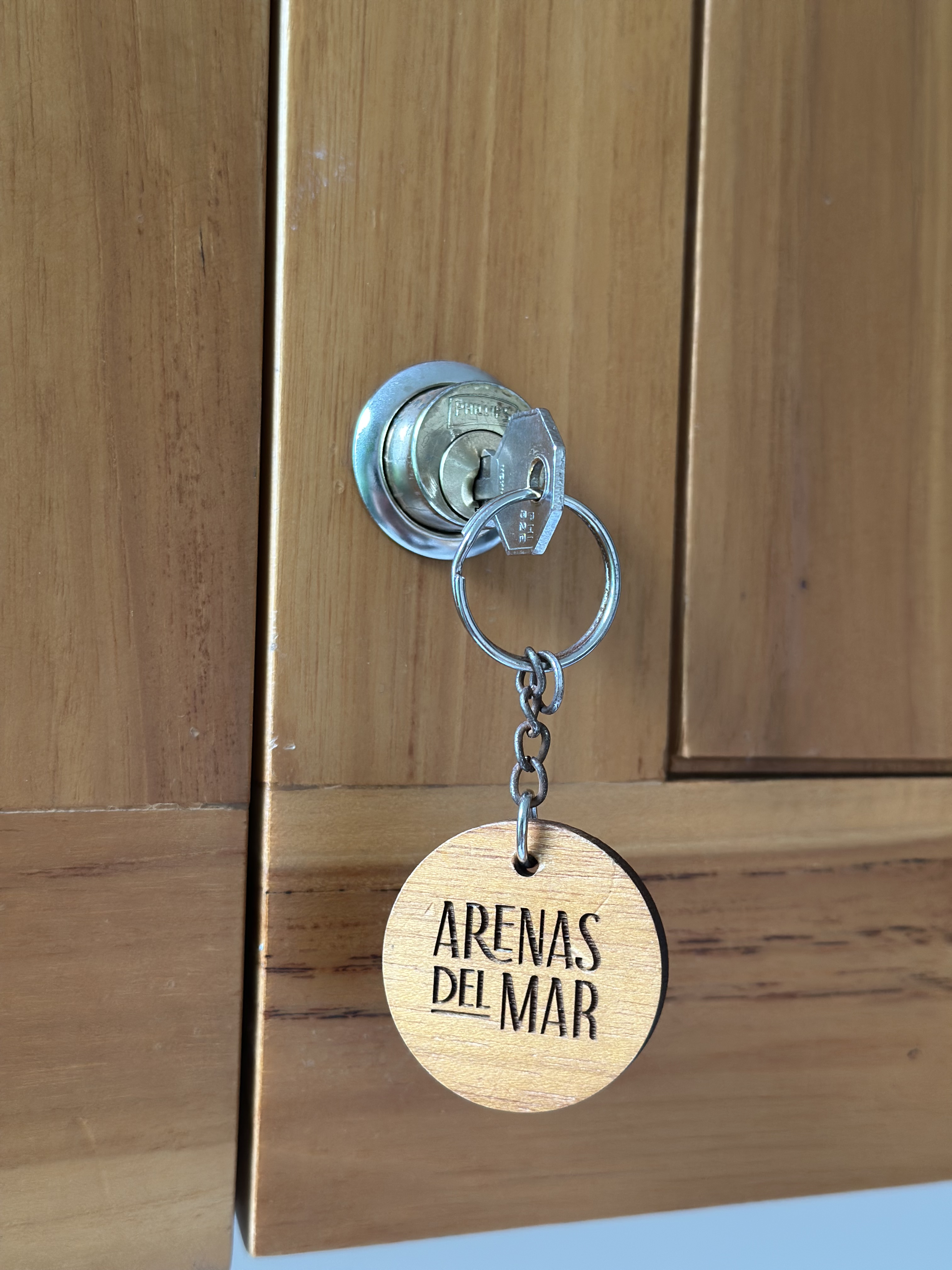
The room is beautiful, as are all the rooms here. There are 7 buildings, each with 6 rooms, half of which are family (suite) units and the other half are singles. Ours is a superior single and has a wonderful view of the Pacific Ocean and an outside porch/lanai with a beverage service counter (all complimentary). All of the cabinets in the service counter have locks, including the drawers, and we are advised to keep them locked when not in the room (and to even remove the key) so that the monkeys don’t rummage through the fridge and drawers looking for treats or things to steal. Some monkeys have learned they can turn the key to open a locked door, we’re told. If you don’t lock your sliding door to the patio, they will get into your room, and you can only imagine how that would turn out.

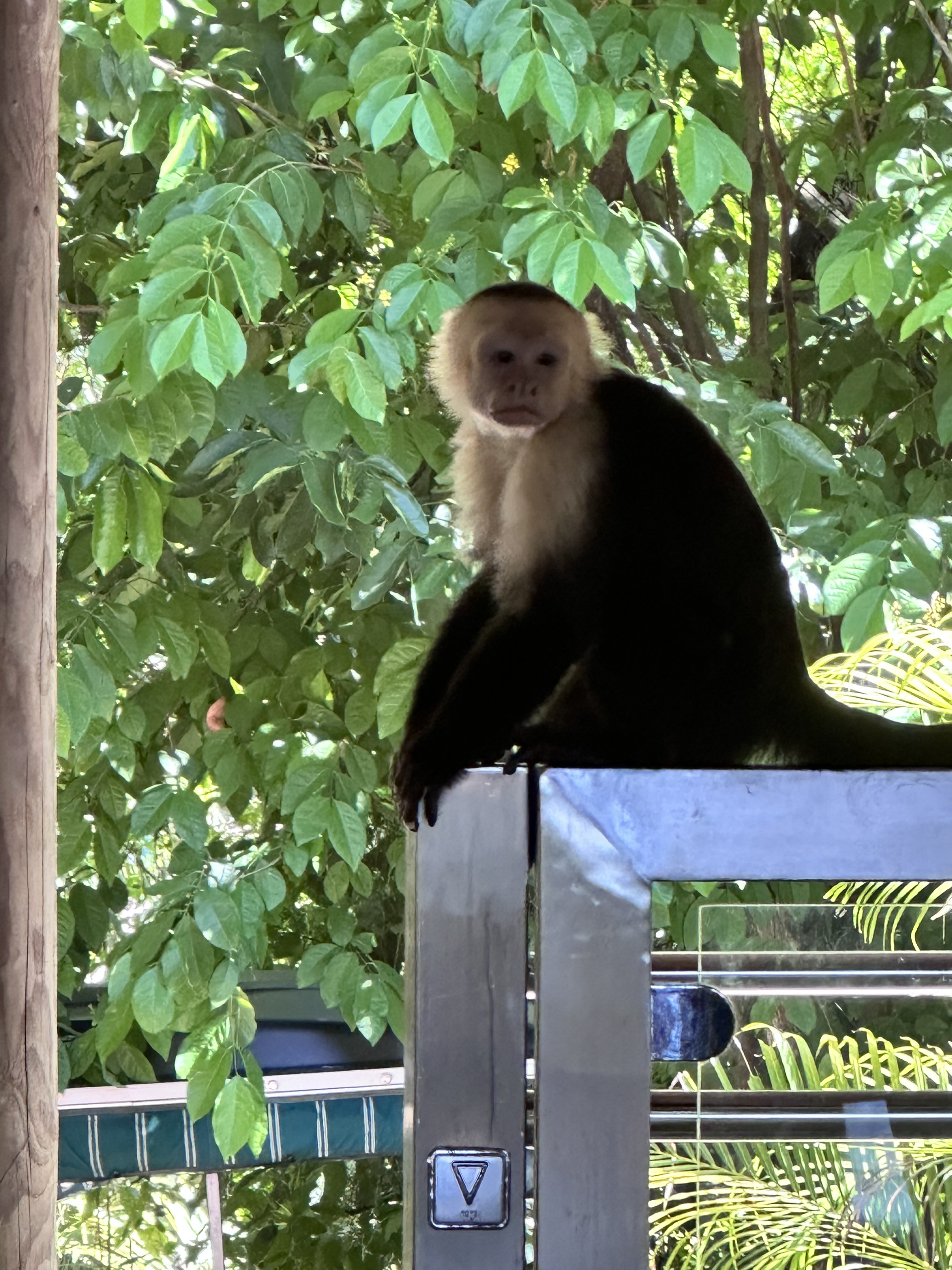
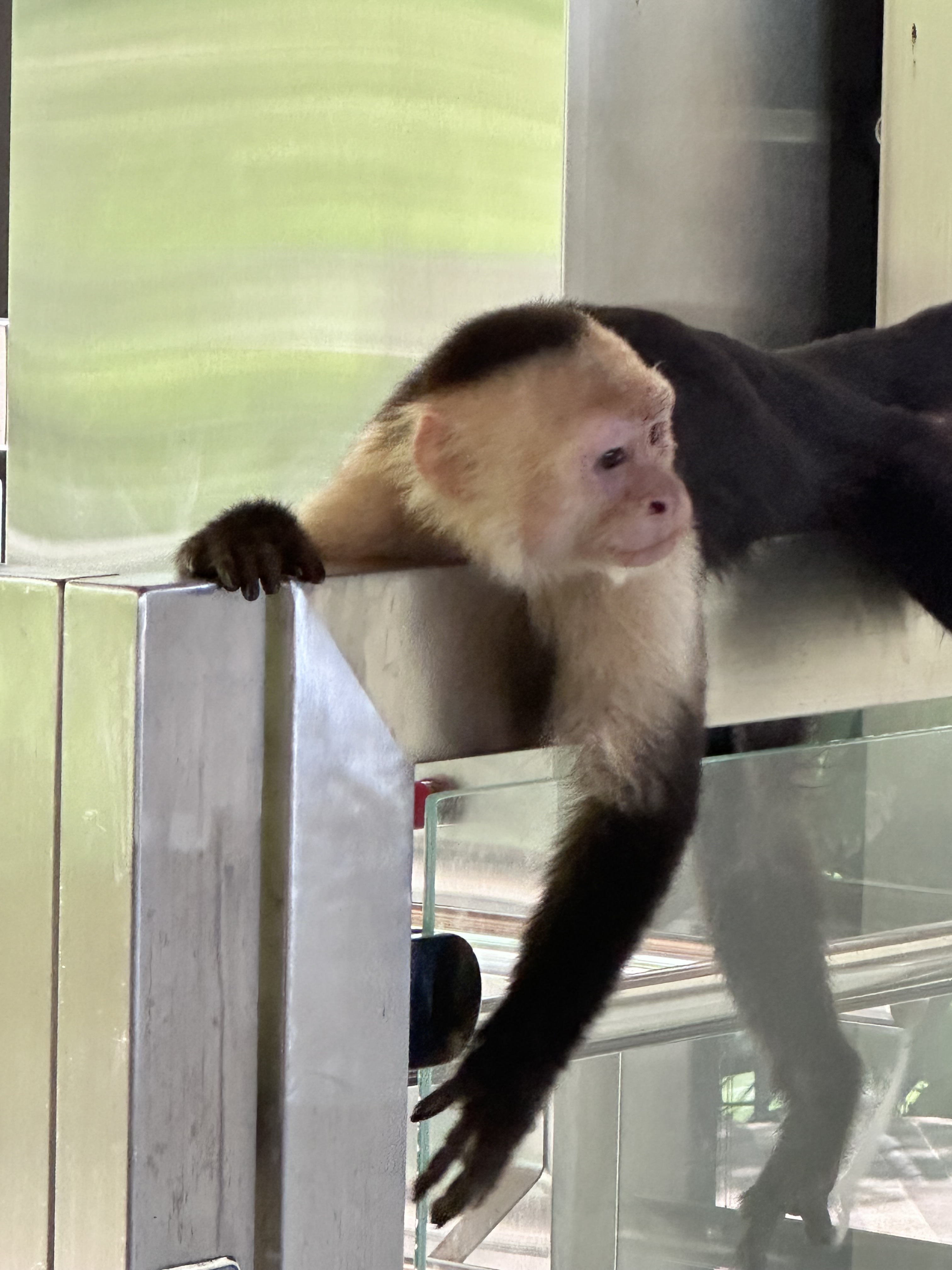
These White Face monkeys are nicknamed Mafia Monkeys. They will look supremely cute and allow you to get very close to take a picture, then quickly reach out and steal your phone. They hold the phone behind their back and extend the empty hand, waiting for a treat to barter your phone back. They don’t give a hoot about cash; they want food or candy. I gave up carrying a banana in my pocket years ago. They are fond of purses too. We haven’t yet had the pleasure. One monkey in the lobby snuck over to the unattended lobby bar and jumped onto the booze bar. He was quickly and loudly chased away by the desk agent. I thought I recognized him from the Cool Pool Bar at Arenal Springs….

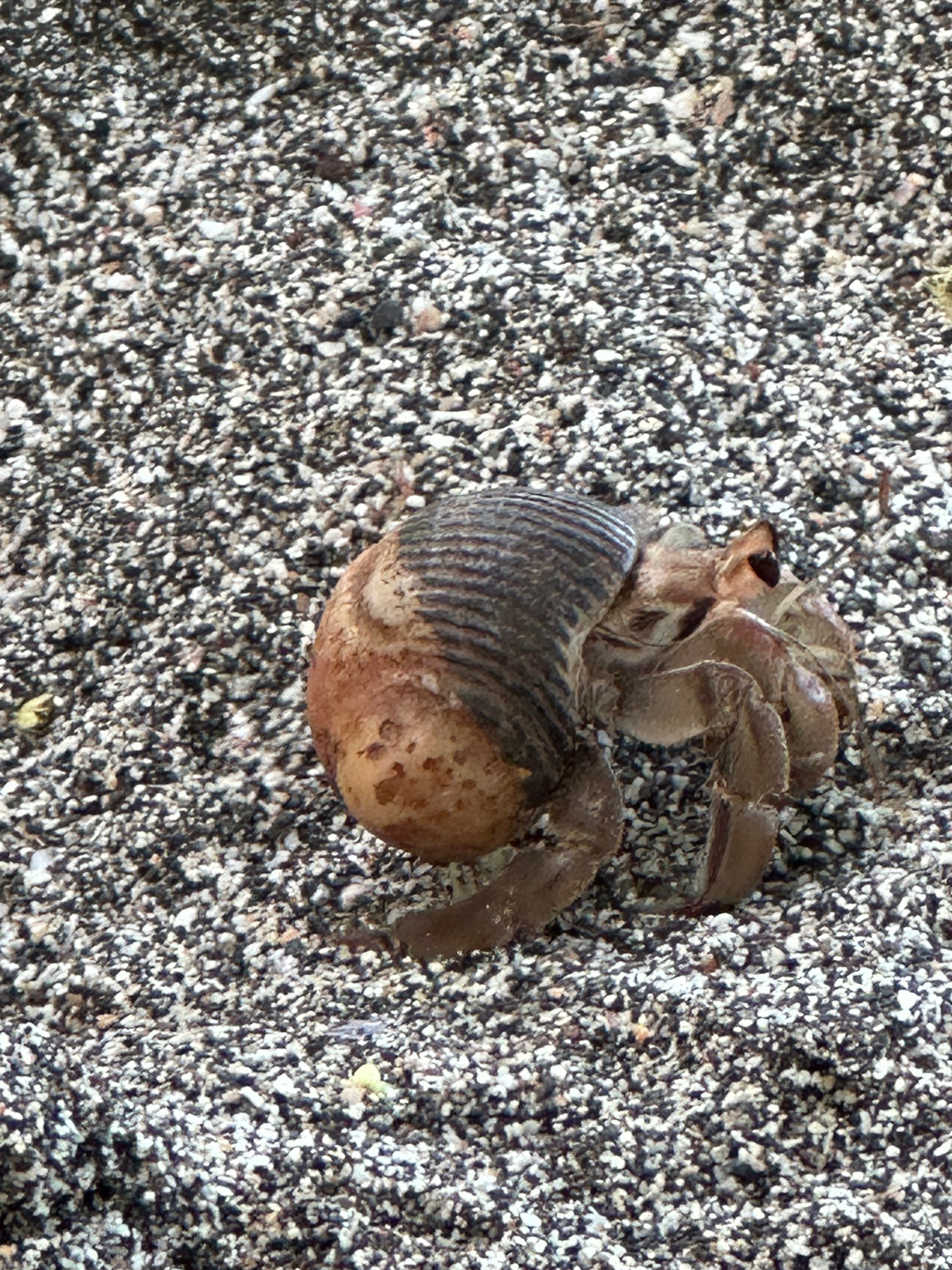
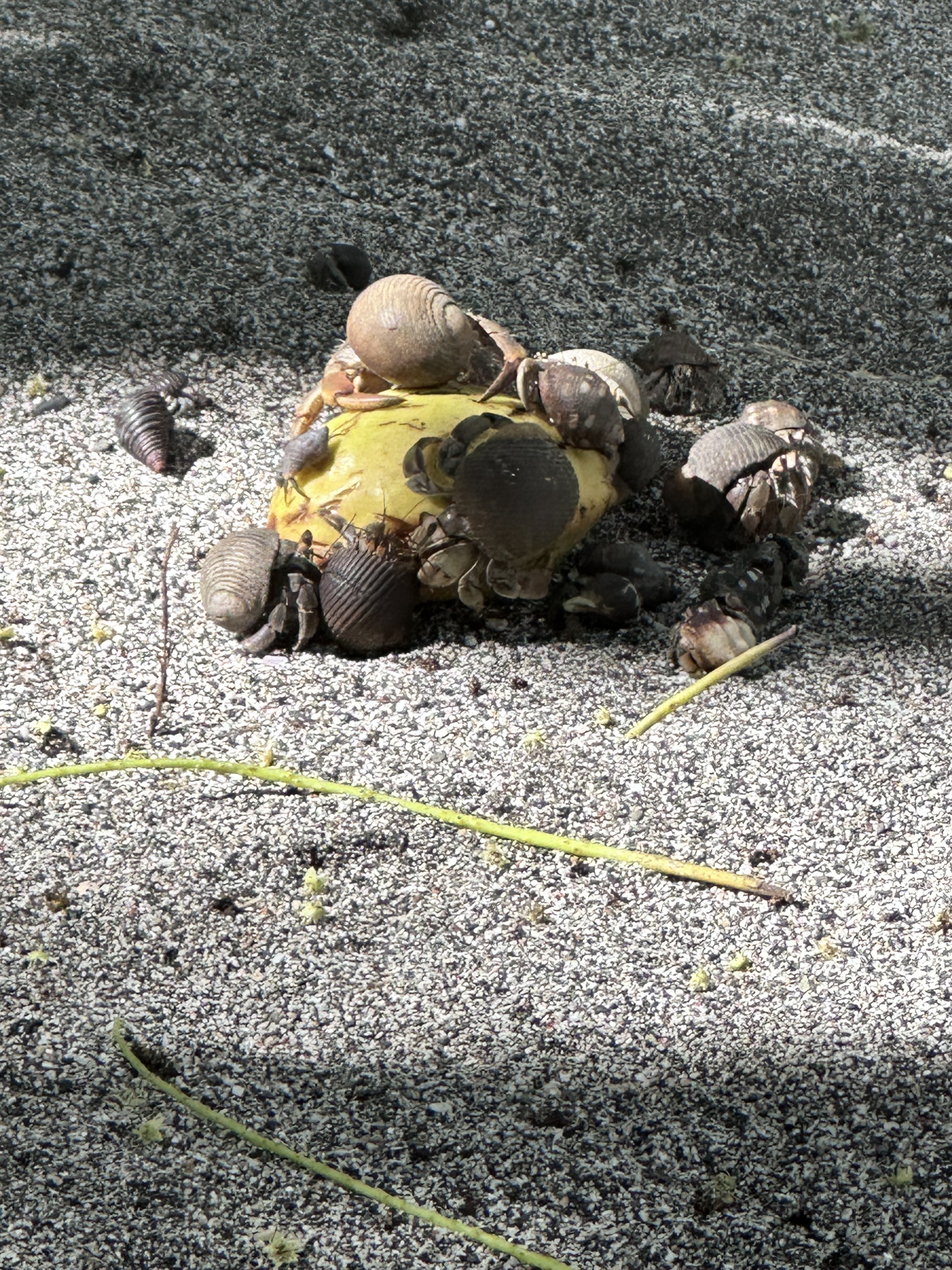
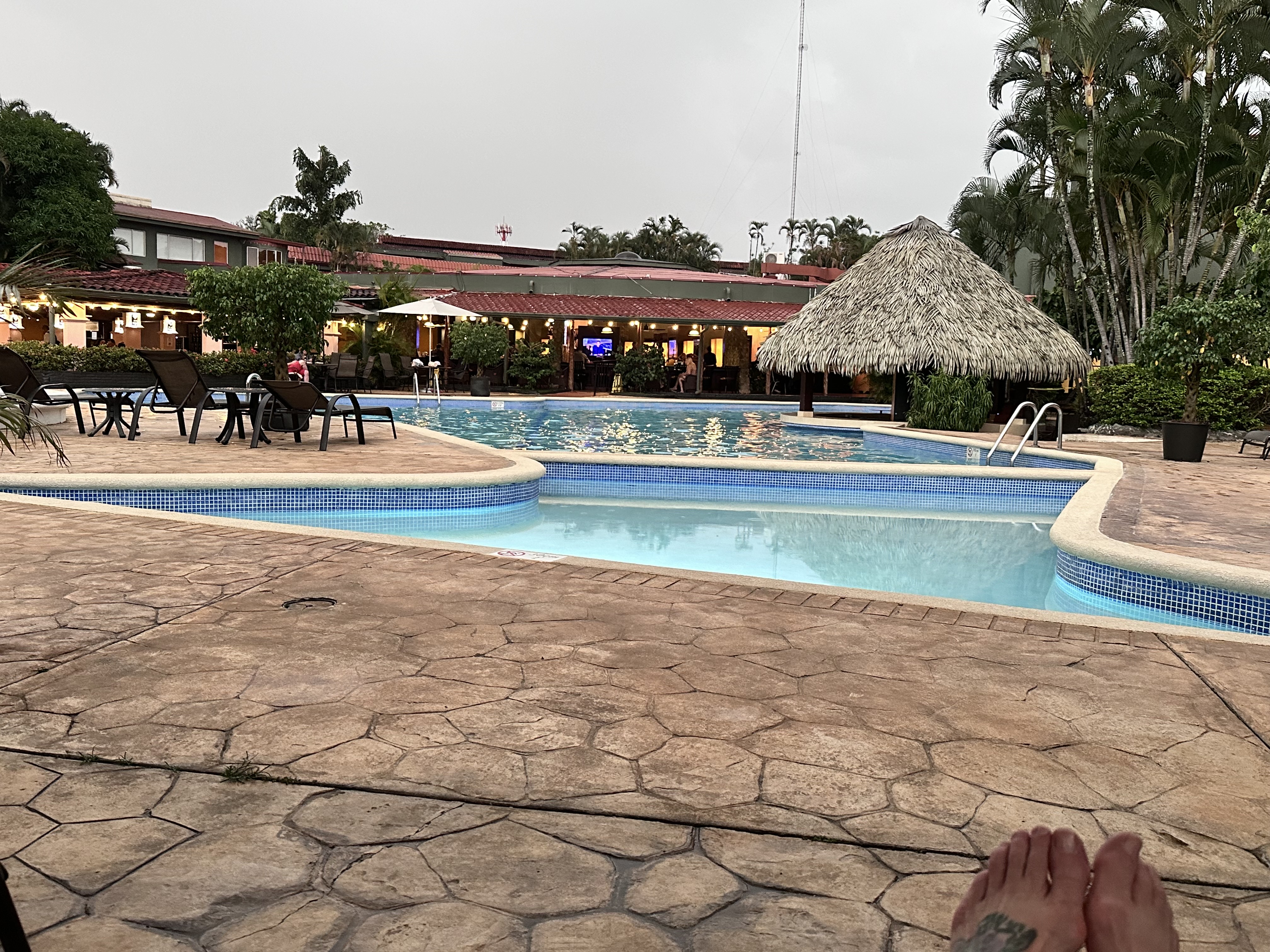
Luckily, the pool and the beach are just steps away from our room (true for rooms in buildings 1, 2 and 3), and we immediately indulge in a cooling plunge and a walk on the beach. The beach sand moves constantly, and it doesn’t take long to see that thousands of hermit crabs are scouring the beach looking for food. It’s no problem, they sense us coming and “hide” by pulling quickly into their borrowed shells. We realize there are no, none, nada shells on the beach, and this is why. The damn hermit crabs have taken them all, leaving only rocks.

We recline for a bit, make a reservation for dinner at the poolside restaurant, joke with the waiter about the stupid weather forecast, which was for torrential rain and thunderstorms, and head back the 100 or so meters to our room. We hit our front door about 5 seconds before a few drops fall, lighting flashes, thunder crashes and the sky opens up. The lighting, thunder and pouring rain continue on for an hour or so until just about 5 minutes before our dinner reservation, and suddenly stop. This particular day we are living charmed lives, and here we are without a lottery ticket…..

Wednesday May 7: We go in-shore fishing today, and we are up at the literal crack of dawn. Breakfast is included with our room (as it has been at all of our hotels), but doesn’t start until 7AM, and our pickup for the fishing boat is at 6:45. The chefs here are extremely accommodating, however, and we were able to put in an advance order to have a custom cooked meal to sit down early and eat in the “big restaurant” (there are two). We set our dine time at 6AM, Wendy ordered yoghurt and granola with a plate of fruit and I custom ordered a ham, egg and cheese breakfast sandwich. They had never heard of such a thing, but we described it, they nodded “si, si”, and the next morning delivered a magnificent breakfast sandwich on Texas toast, with 2 fried eggs! My stomach loves this place.

Our driver, Ronald (“just like President Reagan!”), masterfully maneuvered our transit van through the skinny and very rustic (translation: rough) streets of Manuél Antoñio and Quepos and delivered us safely on time to Quepos Pez Vela Marina. He handed us off to our Captain, Oscar, whose English is sketchy but adequate, and his cheerful demeanor matches his young (and very handsome) cousin Steve, our deckhand, whose much more imprecise English pegged him as likely one of the guys in English class that preferred to flirt with las señoritas rather than listen to lessons. How he passed his fluency test is a mystery. Maybe he spent his senior year in a labor camp. We don’t judge, and we didn’t ask.

Captain Oscar at the wheel as we head out to fish for bait

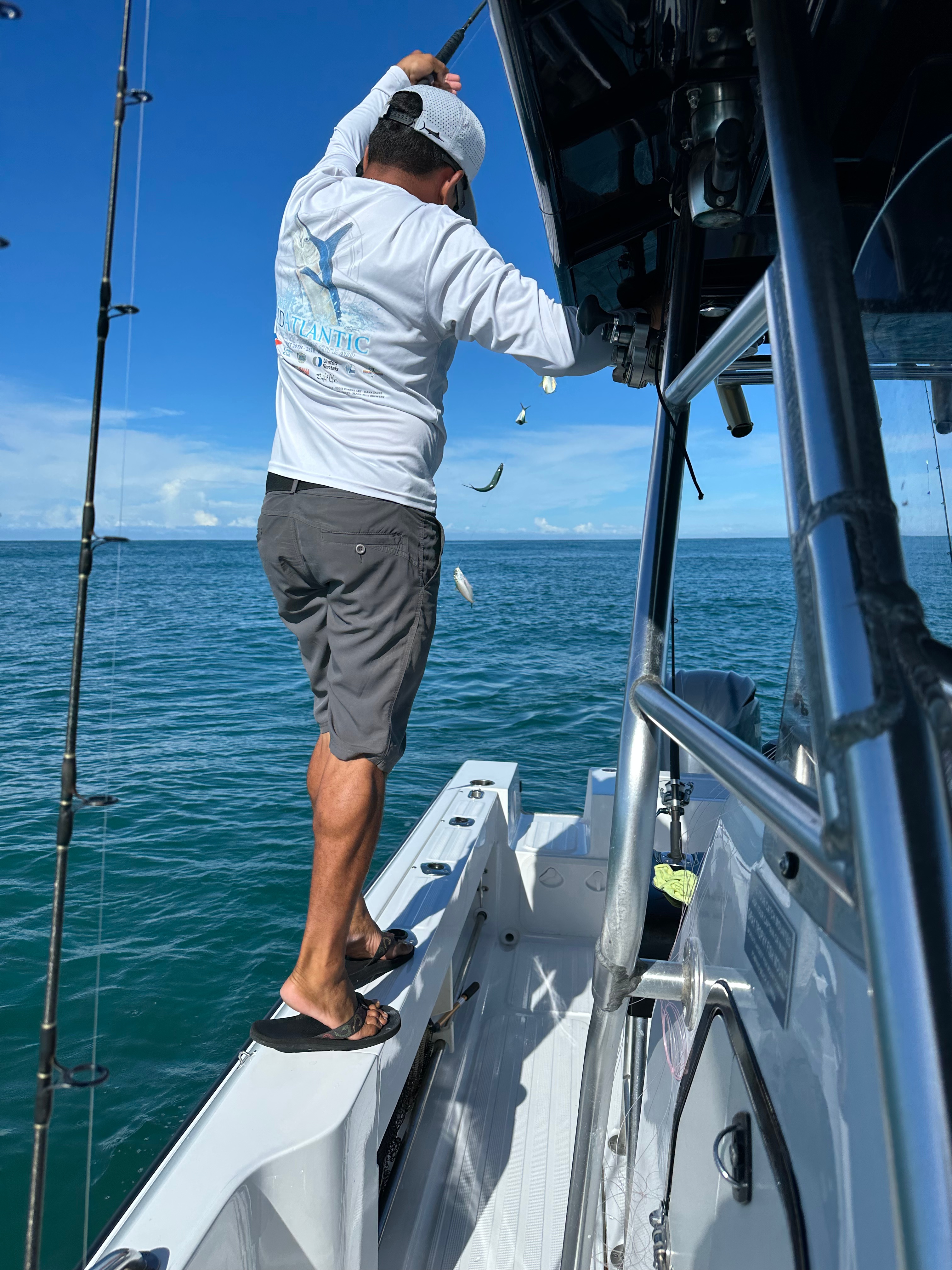
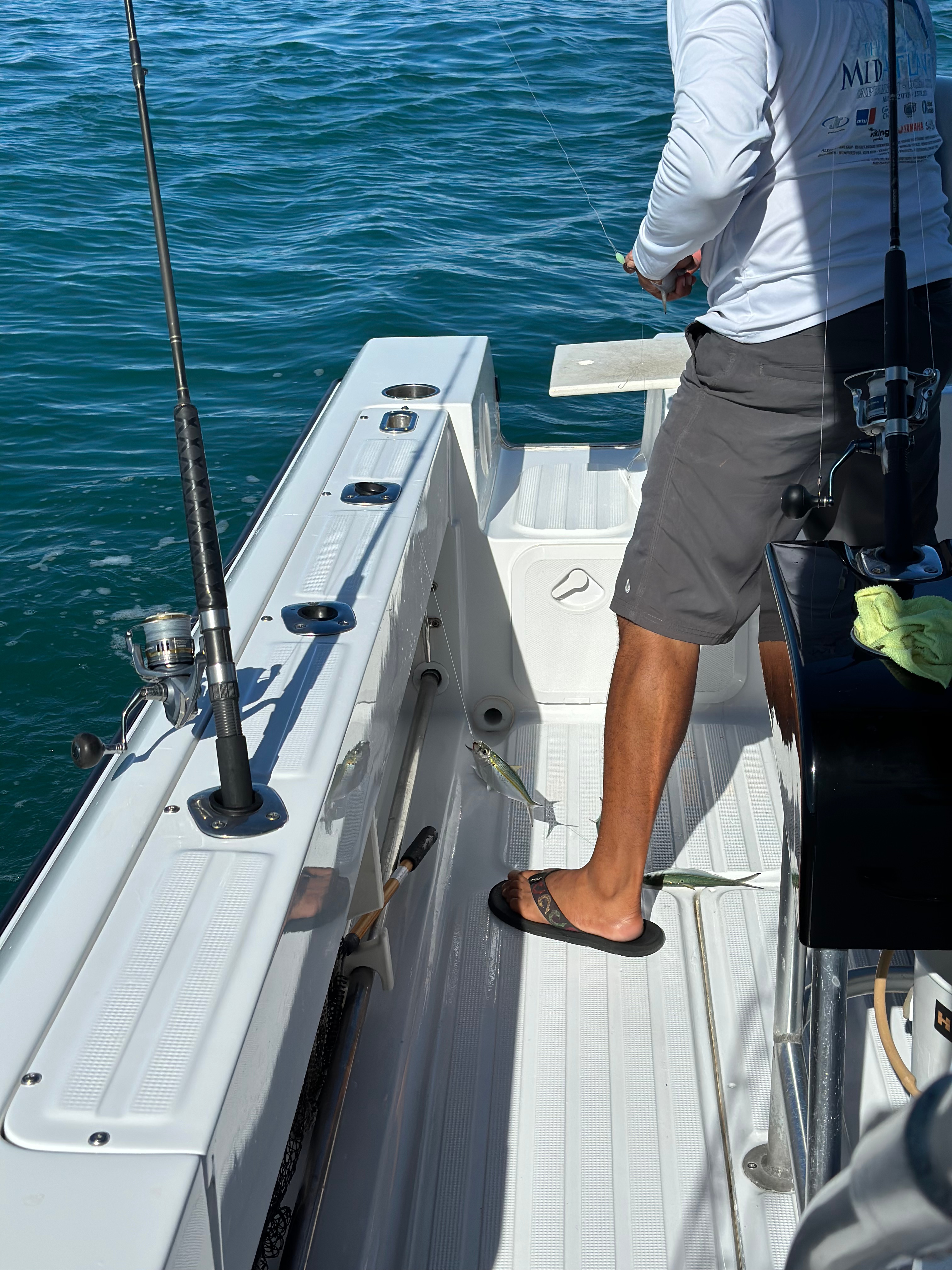
Before you can fish you need bait, so that’s the first stop. No, not at the bait shop, there isn’t one. We cruise out of the marina on the 28’ center-console boat and throttle up to cruising speed for about 20 minutes, following some directions being given to Captain Oscar over his cell phone, until we meet a small knot of other boats. Everyone has a small fishing pole with leaders that have about 20 small hooks spaced 6” apart. They are fishing for sardines to use as bait.

The art is to locate a school of sardines (called a “bait ball”) desperately crowding together to avoid the larger predator fish that are trying to eat them, then drop this many-hooked rig down into the center and pull it out. As if by magic, 7-10 silver sardines have bitten the shiny bare hooks and get pulled up and tossed into the live well where they will swim in circles until it’s their turn to be breakfast for a sport fish. We repeated this several times and charged up the bait tank with about 3 dozen baitfish, and we were off to fishing.

Pro Tip: dress lightly, it’s warm out there. Sunglasses, sunglasses, sunglasses. Sunscreen too. Flip flops are best; you are going to get wet. A dri-fit shirt is perfect, long sleeve if you hate the sun. Hat, hat, hat! Don’t wear any clothing you might want to wear to a high dollar gala later on, you’re gonna get wet. An if you’re lucky, you will also get scaly and bloody.

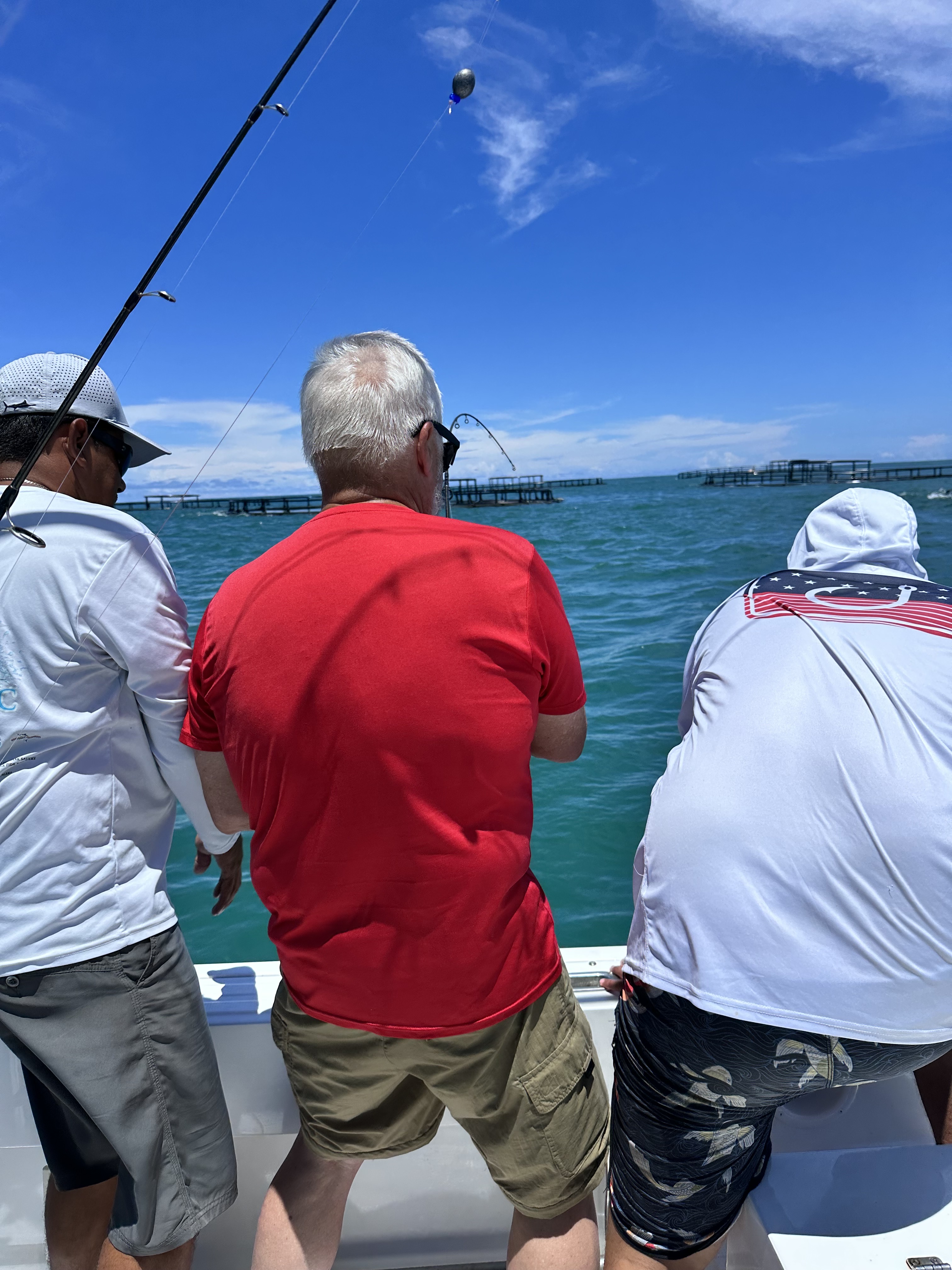
We trolled outside the beach surf line for Roosterfish for about an hour without any luck. It was cool, though, because there was a heavy swell running and we were very close to the backside of the breaking swells, which threw up tremendous spray and mist. We moved after that to Oscar’s favorite fishing hole, an abandoned floating fish farm that provides some underwater structure that attracts smaller fish, and therefore the predators that we were after.

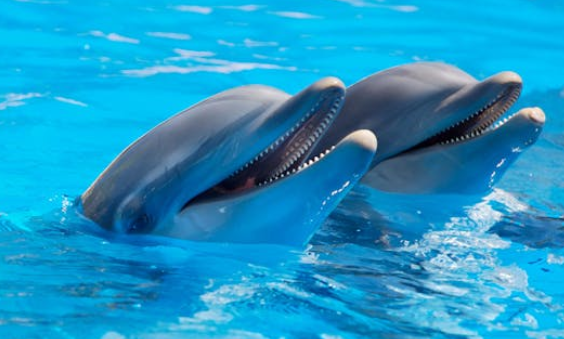
On our way there we were shadowed by a school of 10 small dolphins that were also fishing and probably doing better than us at the moment. I got the sense they were mocking us with their energetic dives and jumps and those smug smirks on their faces. Maybe I’m being too harsh, maybe that’s just how dolphins look.

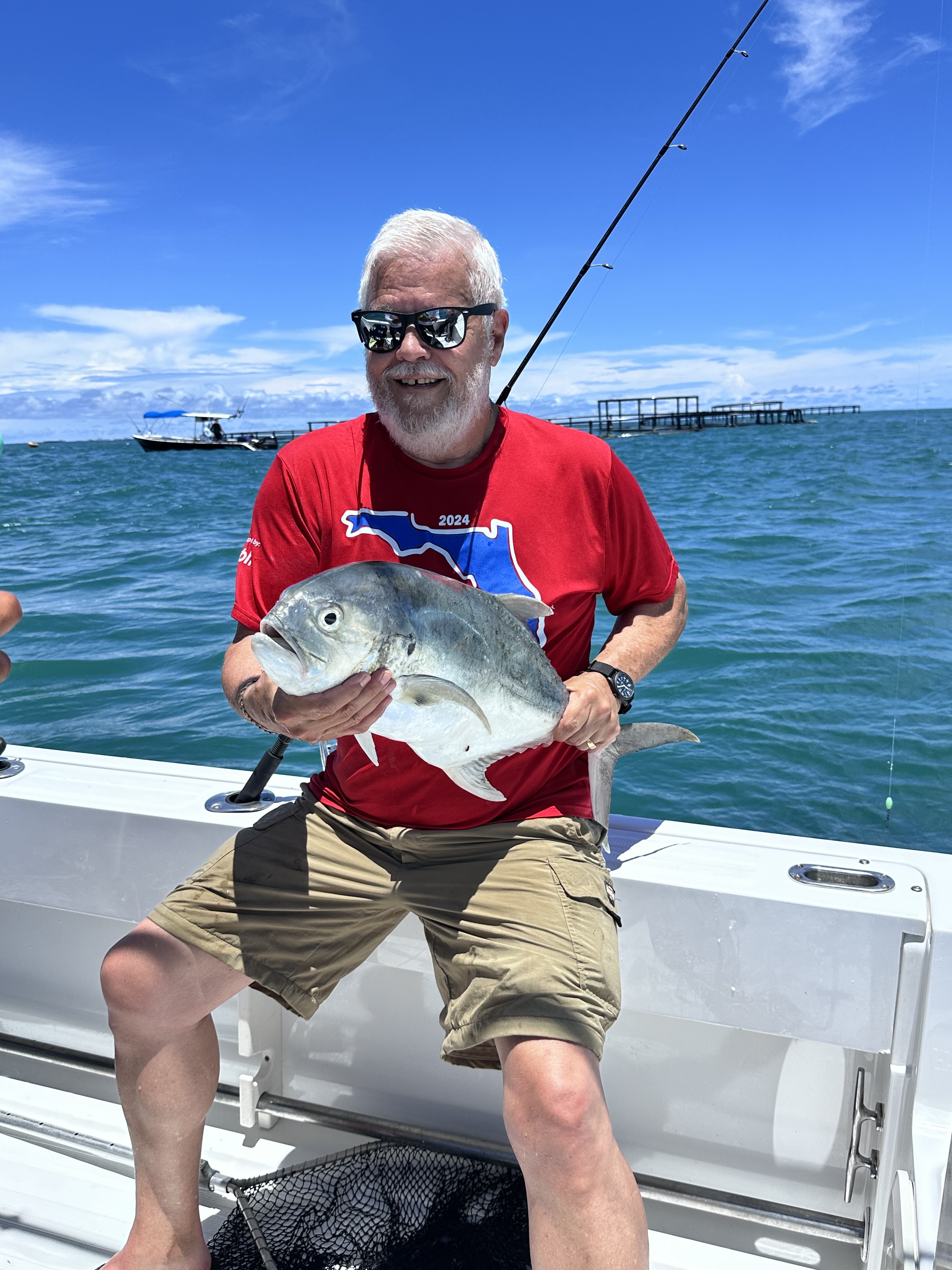
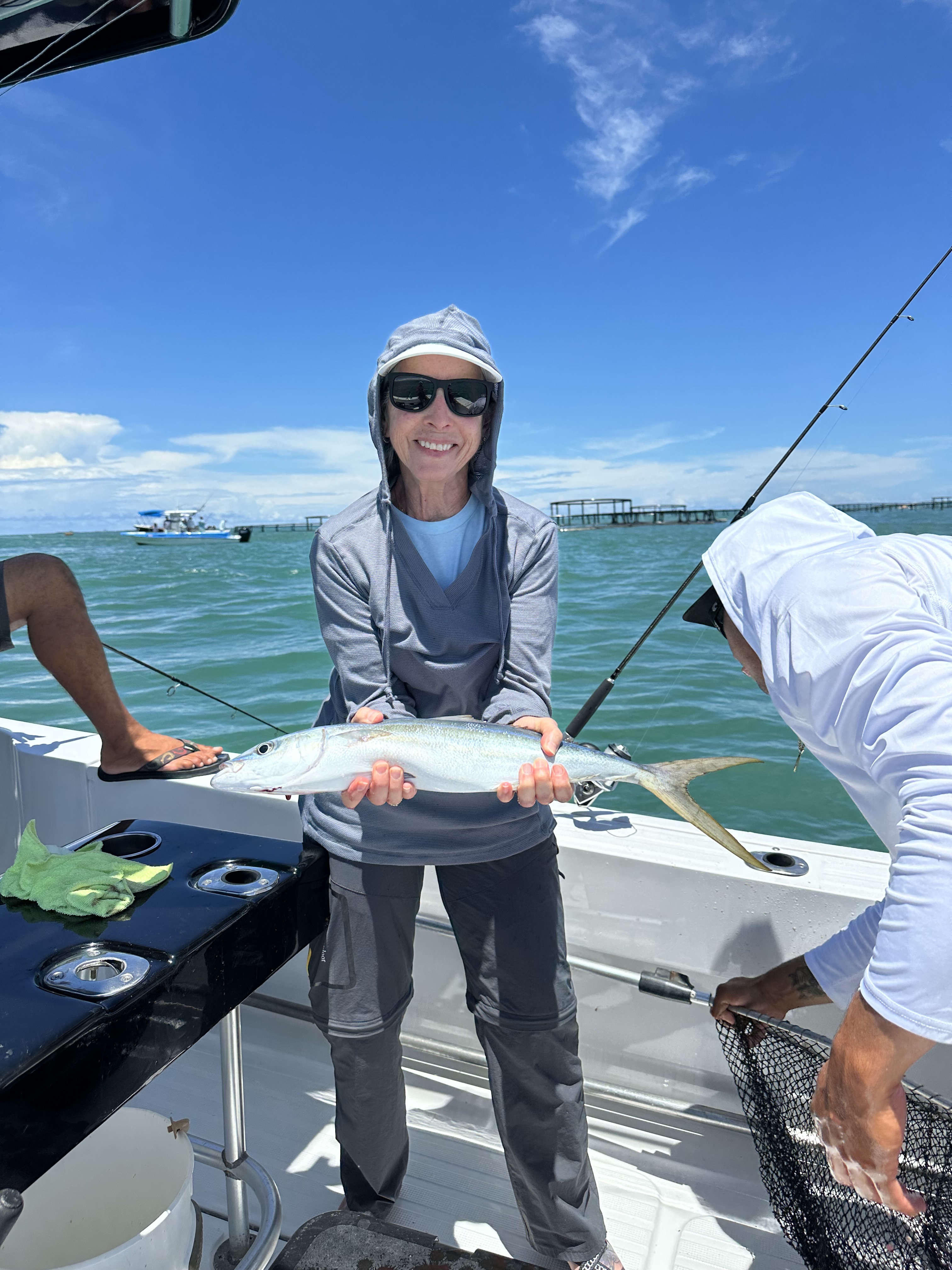
And we found our prey, in spades. In a span of 30 minutes Wendy hooked and landed a beautiful good-sized Rainbow fish, kind of like a mackerel but with light flaky meat and really good for eating, so we kept it. The captain hooked a nice fish and handed the rod to me. The fish fought like teenager would if you tried to take their cell phone, then broke the line. It wasn’t long before my line hit, and I battled for about 15 minutes to land a trophy-sized Red Snapper (we also kept “Mr. Chubby” for dinner). I remarked to Oscar that “maybe we should just catch one of everything” and while we were chuckling about that his rod lit up and he handed it to me. Again, a big but short battle and the line was bit through right near where the hook used to be. It could have been a small shark, but we didn’t have time to speculate because my rod jumped and this time, I took it easy, played it smart, and landed a nice, average-size Amberjack, which we released since our dinner plate was already overflowing. It was time to head back, and after Oscar cleaned and fileted our catch, we took it back to the hotel via the same GTA level 9 game that delivered us in the morning.

The chef at the “small restaurant” had advised us that it’s called “fishing” and not “catching fish” for a reason, but that if we were to bring back something, he would cook it. We’re not sure he was expecting 10 kilos (about 22 lbs) of fish, but he took it and suggested perhaps the Rainbow could become ceviché and the Snapper could become a special surprise served with veggies and rice. I’m pretty sure the fish of the day will be snapper in the restaurant tonight. Wendy was inspired to a haiku:

Trophy fish displayed as art
Upon a platter
To our delight, so delish

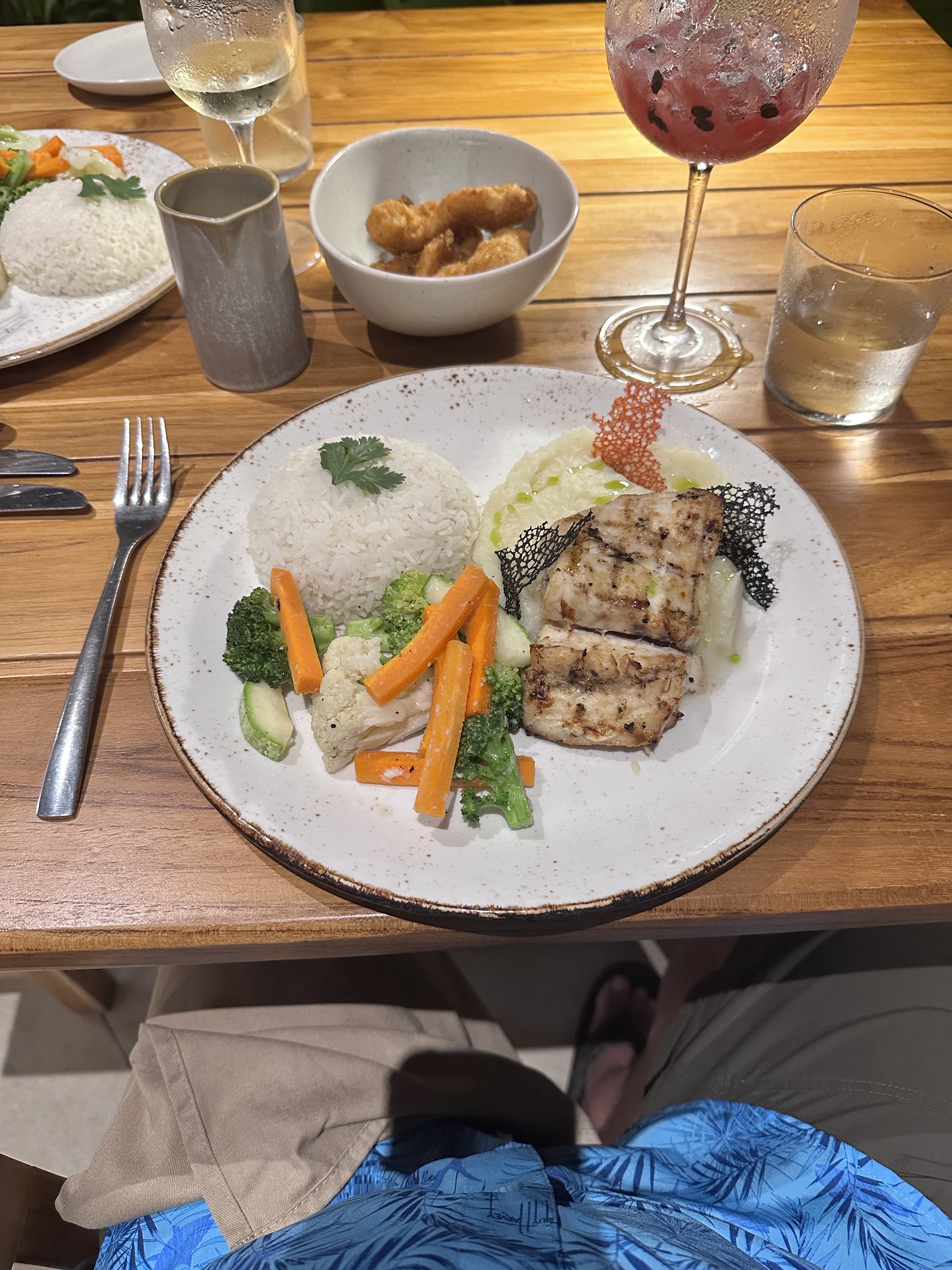
We returned to the restaurant at 7PM, making our way there through a massive downpour that drenched us despite the short distance of 100 meters and the use of 2 golf umbrellas. We were in good spirits however and were handed a towel to dry off. The ceviche was spectacular and the broiled snapper on mashed potatoes with a mango/plantain/squash puree was Michelin 3 Star quality when a drizzle of melted garlic butter was added. There were even breaded “fish fingers” for us to take for a snack the next day. The breading was incredible, like twice breaded to deliver a delicate crust that completely encased the fish. Crispy with a tender center, ten times better than any fish sticks we ate as kids!

Thursday May 9: Today we tour Manuél Antoñio National Park. Our guide, Andy, provided by Iguana Tours, picks us up at the hotel promptly at 8AM and in 15 minutes we’re at the entrance gate. I highly recommend 2 things, if you can afford it: 1) get a guide (in advance, not at the entrance gate), don’t try this yourself or you’ll miss most of what you came to see; 2) arrange a private tour, just the two of you, so you can zip from beast sighting to beast sighting without having to listen to the guide (in variable quality English) explain to the New Jersey grandma everything at least twice.

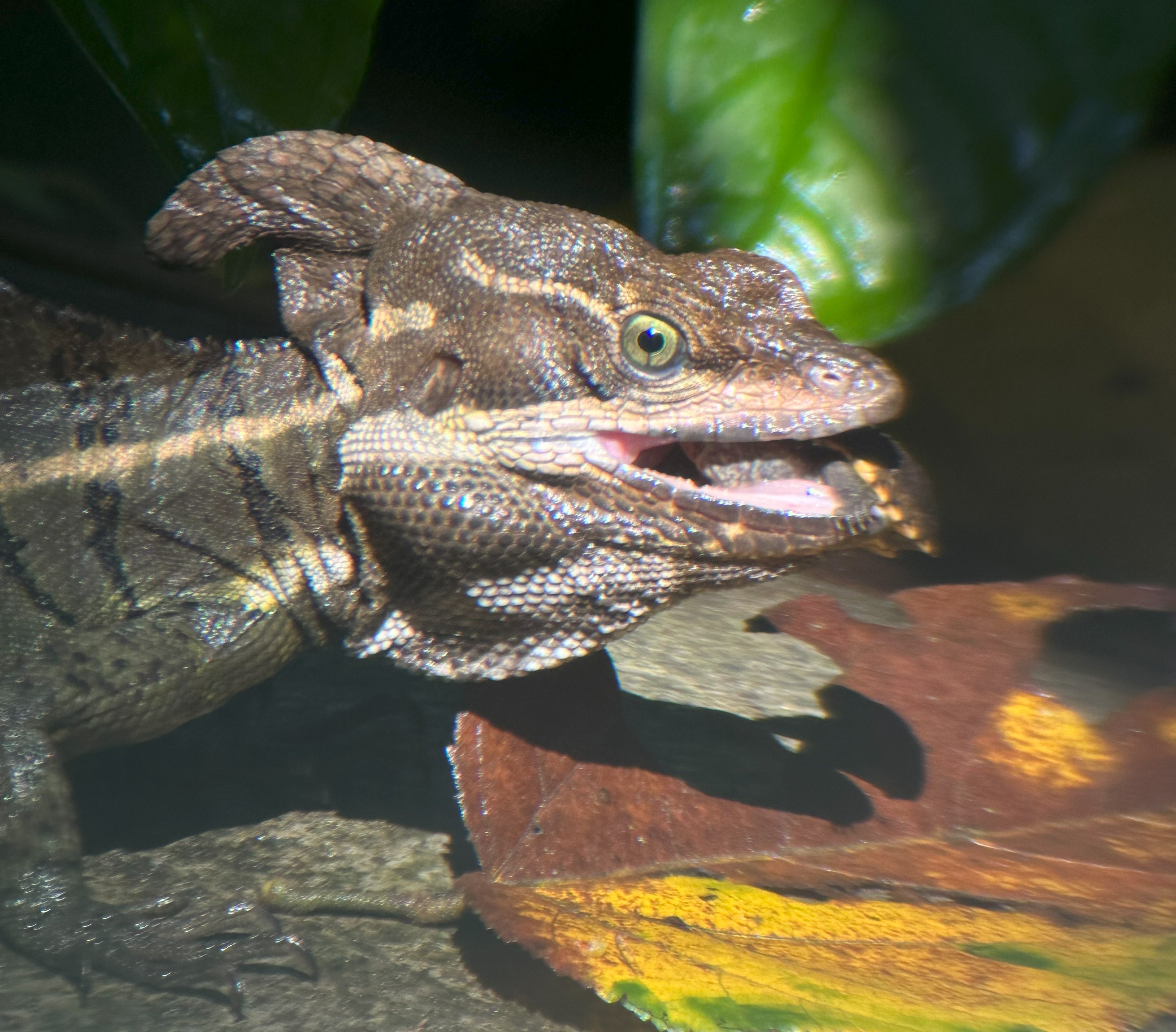
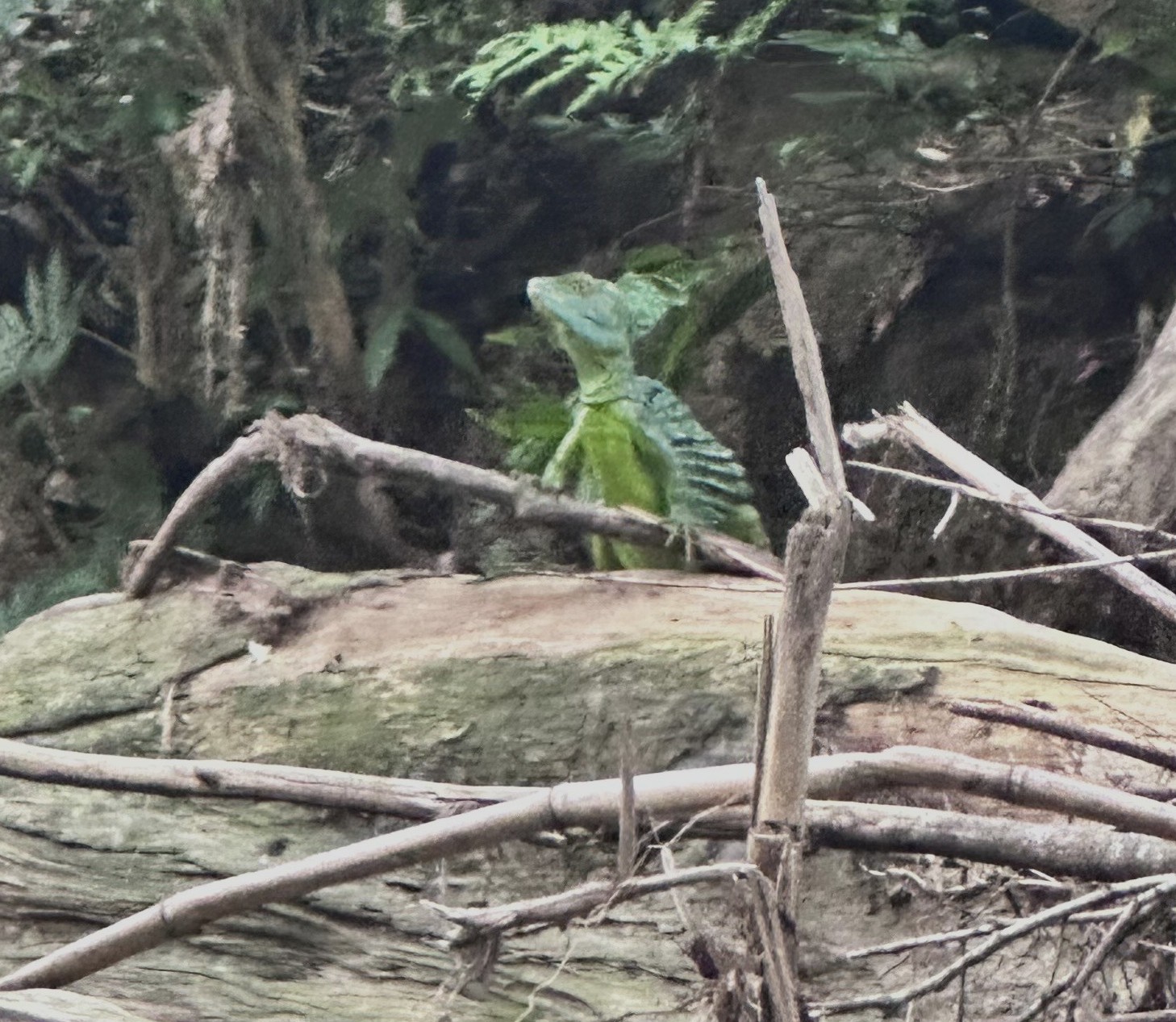
Andy (remember him from the Pura Vida Uno installment with the Civil War / No Army story?), spoke amazing English. He’s been a guide for 17 years, 12 of them at MANP. Not only does he have extremely well-trained eyes, but he also has extraordinary hearing. The other guides (with larger groups) were following us to stop where we just were, and Andy assisted them with hints about what we saw. He frequently takes my phone to snap photos through his high-powered spotting scope with great dexterity. He even shoots a few narrated videos, so we won’t forget what we saw. My favorite is of the Basilisk lizard eating the small turtle that he spotted literally just inside the entrance gate. In the picture you can see the little turtle’s foot and tail hanging out of his mouth. Andy ends each narration “and don’t forget to find much more on my Instagram channel @AndyTheSpecialist”. Smart move, but it’s cutting into his tip if our blog needs to hype his business (just kidding, Andy)!

This basilisk lizard is chowing down on a small turtle. The leg and tail hang out of his mouth. Nature is brutal.

Our tour, about 2km and 1½ hours long ends at Manuél Antoñio Beach, where we are given the option of staying for up to 1½ hours or returning with him to the entrance. We brought our bathing suits and sandals and a towel, so we wave ¡adiós! to Andy, take advantage of the nearby changing rooms and pick a spot on the beach. The water is calm, the sand is soft and white, and the water is very pleasant, around 85F. We enjoy the beach for an hour, change back to our hiking gear, and head back to the entrance a little early. Early enough to hit a restaurant outside the entrance for some ice cream, desperately needed in the hot humid weather.

Pro Tip: bring a suit, towel, refillable water bottle and sandals to enjoy the beach at the end of your hike; the changing rooms are nice, the beach has lots of shady spots, and there is a small cafeteria nearby to get a snack and cold drink to make your beach stop even nicer. Pro Tip #2: don’t forget the Gelateria!

Our ride back to the hotel is just as exciting as all the others, but I have to admit that I’m getting used to it. I lived (and drove) for a few years in Boston and this seems very familiar. To this day Wendy still giggles when we’re driving somewhere and I mutter “Boston Mode ON” just before I make that slightly-less-than-legal left turn. You have to have lived and driven in Beantown to understand.

Friday May 9: Our last 2 days here are “free days” with no planned activities. Today we decide to sleep in a bit, have a nice relaxing breakfast in the treetop restaurant, and arrange some transportation into the town of Quepos to walk around and do a little shopping and sightseeing.

Our quiet breakfast is interrupted by the waiters quickly closing all the panoramic sliding glass windows.

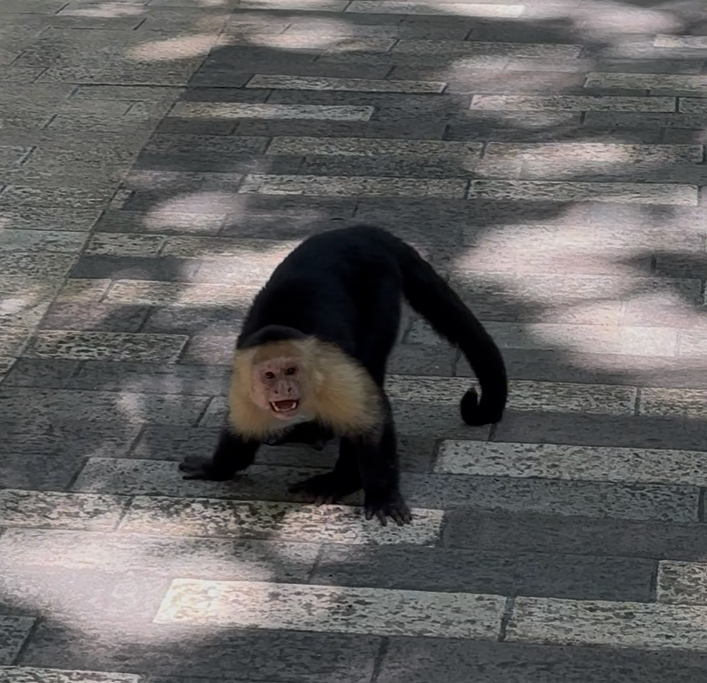
The White Face Mafia Monkeys have descended on the restaurant. Once they figure out there won’t be any easy pickin’s from the breakfast guests, they move on to the open-air lobby, where they become a Photo Booth. Really cute, but remember not to get too close when snapping a picture! We walk back to the room (all downhill) and a couple of them stroll along with us. Their gang leader (I have named him Harold for no special reason) decides to test his theory about who the Alpha Primate is in this scene and turns on us to bare his teeth and hiss. I outweigh him by about 100X, and we laugh and keep on walking, and he instantly quits his show of force and saunters off with barely a shred of his pride left.

We’re not impressed Harold. In your face!

More like a Mafia Chicken. In your face Harold!

The hotel provides a private van to deliver and pick us up for $15, billed to the room. We highly recommend this as there is a pretty active transportation underground comprised of all sorts of “entrepreneurs” of dubious reputation. It’s also way better than Uber (which is unregulated in Costa Rica and can be unreliable, or worse subject to police checks since it’s technically illegal) or a cab (which can take a very long time to get all the way out to the hotel to pick you up). Our total trip was 4 hours, too much time since we greatly overestimated how much time it would take to walk all of downtown Quepos. But we killed time at the marina in the Runaway Grill snacking on ceviché and chips & salsa and loving the breeze blowing in from the ocean.

Saturday May 10: This is our last full day and is also a free day. Today we will explore the other beach, Playa Espadrilla, just a short walk from the hotel and separated from the private beach by a couple of rock outcroppings. This beach stretches 2 km all the way to MANP. It’s low tide in the morning and we are able to scoot around the rocks.

It’s also the first morning that it has rained. Every day up until now has been a beautiful clear morning, followed by an afternoon rain or thundershower. The rainy season is coming!

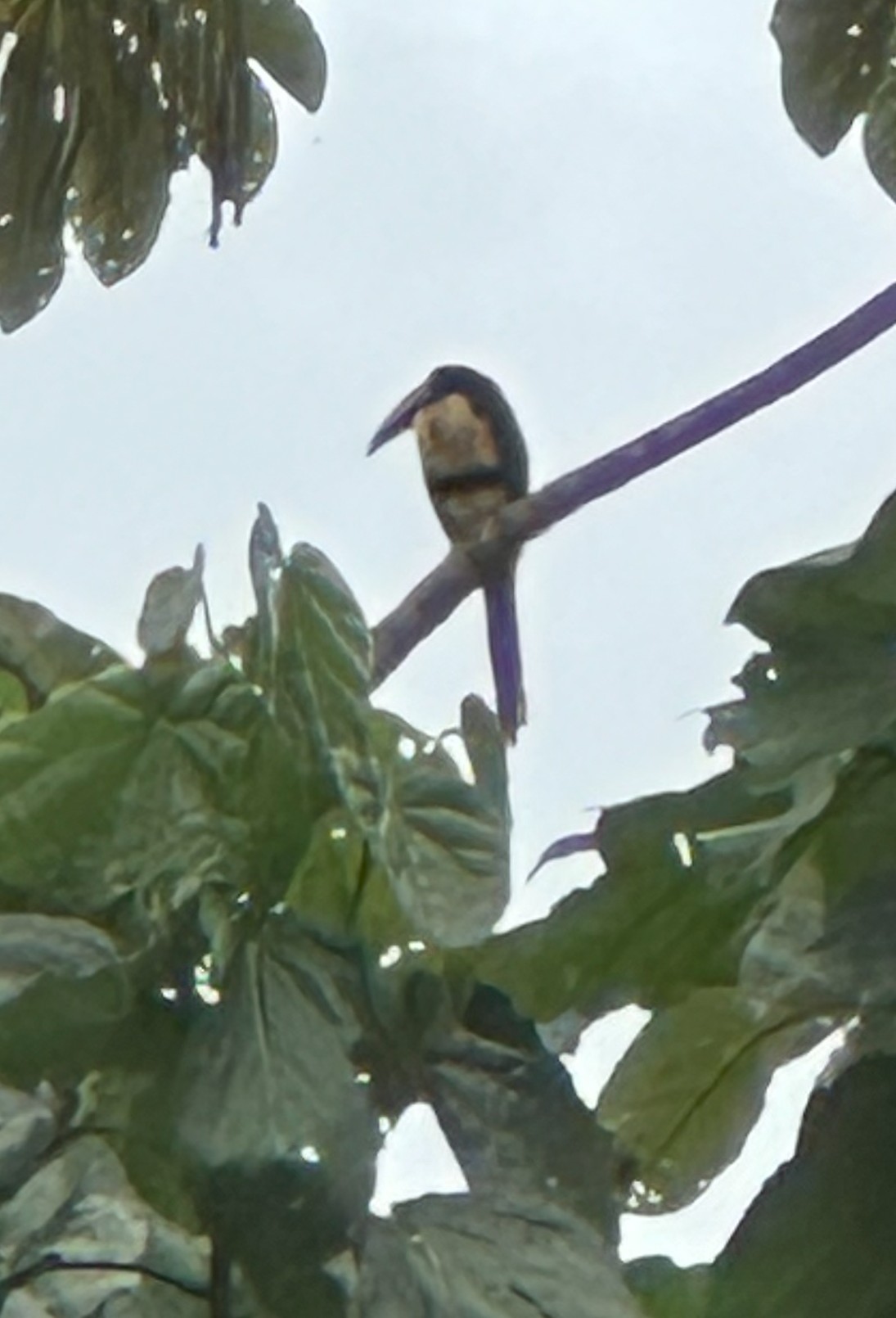
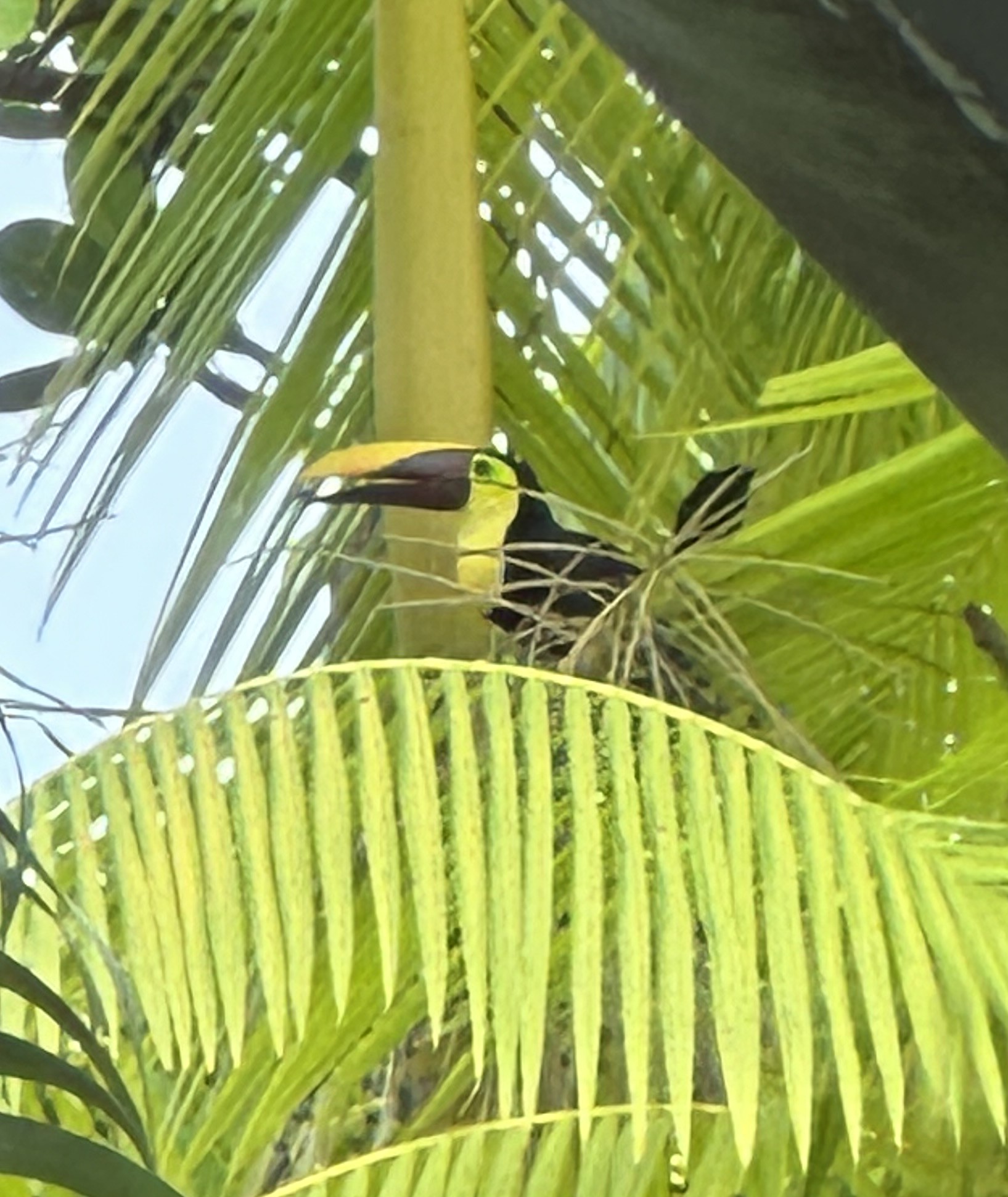
Finally! A toucan.

We breakfasted at leisure in the treetops Mirador restaurant. We are chatting with the couple from New Zealand eating breakfast next to us when the husband spots something in a tree outside. Finally, our toucan! This is the last checkbox on our Beastie List, and we’re delighted!

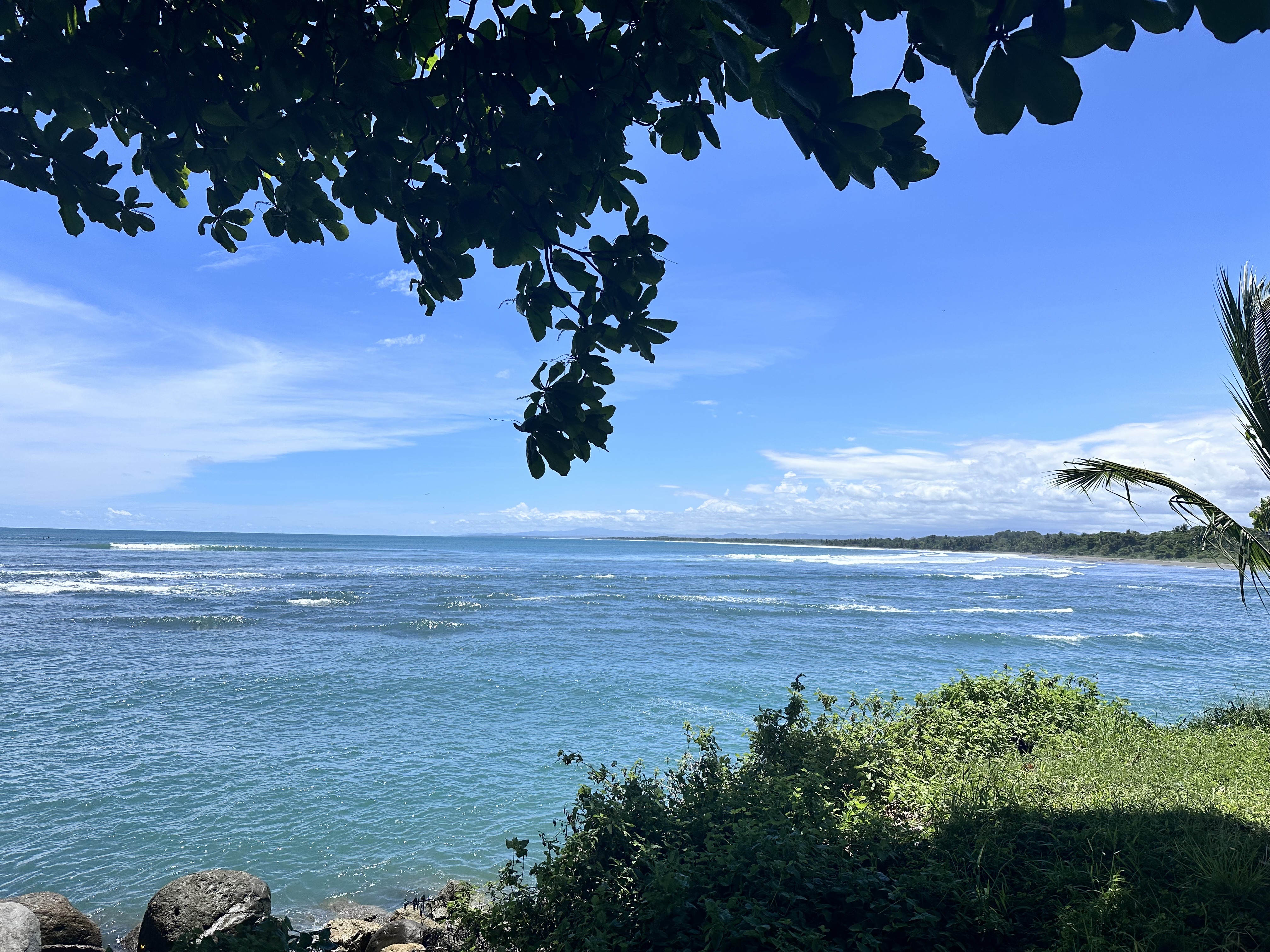
We enjoyed a 2 mile (both ways) walk along the water, crossing over several small creeks that had cool water running down from the mountains. There were no hermit crabs to be found, and we figured the reason was that there were very few guava trees to drop fruit to feed them. Playa Playitas, the private beach, is loaded with guava trees that provide nice shade but also lots of fruit.

The hotel has a separate overland path to this beach. Where it ends there are bathrooms, a shower to rinse off, and lots of toys for guests like boogie and surfboards. There are a few guests taking advantage and it looks like a bunch of locals also shredding the decent-sized waves. Since the tide is rising, and the rock outcroppings are now surrounded by breaking waves, we choose this path to return to the hotel. The path terminates at the golf cart road, and soon a cart comes by to take us the rest of the way.

The afternoon is spent by the pool and packing for the trip home.

Our room came with a complimentary laundry service, which we took advantage of, and although we packed in 2 small roller bags and 2 backpack under-seat bags for the 11 days, much of our clothing is clean! Except the bathing suits, which were worn about 75% of the time.

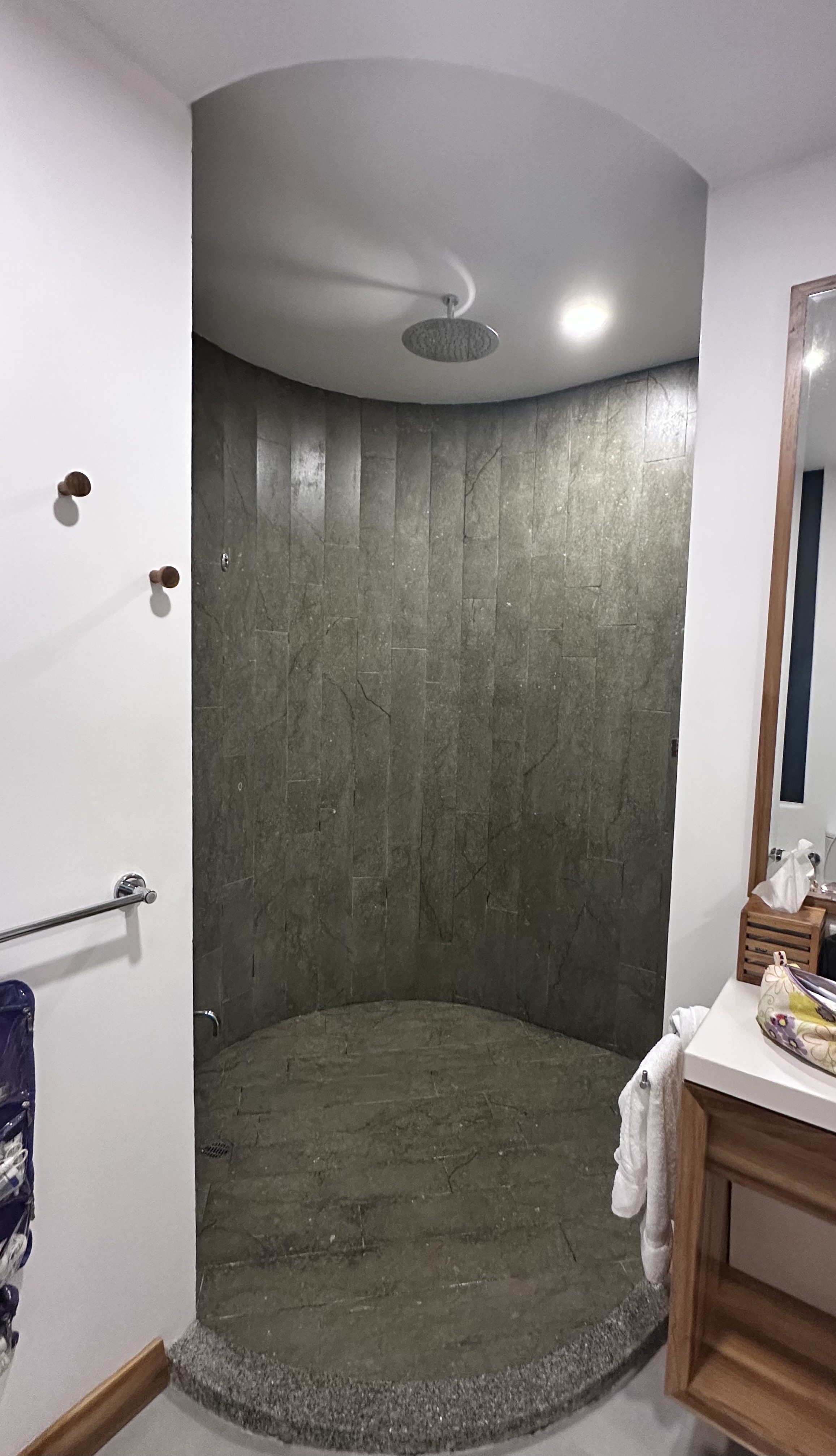
Our bathroom has a large circular shower with walls and floor done in quarried tile meant to evoke the feeling of showering in a waterfall in the rainforest. Our only complaint: it takes forever to get the hot water flowing. I get used to showering in the cool flow from the directly above large shower head, and it does, indeed, feel like a waterfall. There is, smartly, an extendable line to hang clothing on to dry.

Sunday May 11: Our trip home begins before the sun is up. The thoughtful chefs have again prepared some food for us to take on the road and it is waiting for us at the reception desk. There are no Mafia Monkeys to entertain us, likely because I have given them exactly zero treats during our stay. Feed a Mafia Monkey, you have a friend for life. Their Don, Harold, didn’t leave a very favorable impression on us.

Google says the ride to Juan Santamaria International Airport in San Jose will take 3 hours. Our driver, who is waiting for us on schedule at 6AM, obviously plays a lot of Grand Theft Auto, and makes it in a little over 2. Granted, it’s Sunday morning and the traffic is light, but that boy can drive! He passed everything on the road except the one stop we made for el baño.

Our flight on jetBlue is on time, and we bid ¡adios! to Costa Rica. Next trip here, we’re doing the east coast!
Posted in Costa Rica | Tagged , , , , , , , , , | 3 Comments

Pura Vida Dos: Volcan Arenal

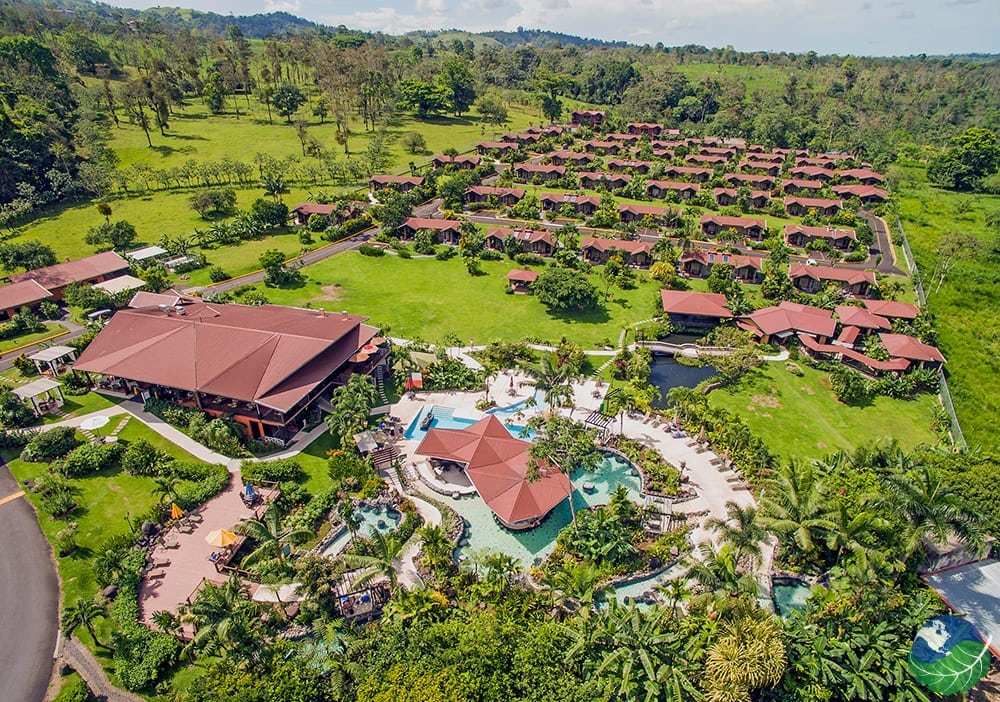
Arenal Springs Resort & Spa is a fortress. As Costa Rica, so far, seems to be a very peaceful and low-crime country, especially in the tourist areas, it feels like it is intended not so much to keep bad guys out as it is to reinforce a feeling of security for the guests to relax.

The bungalows are all duplexes with a view of the volcano

The guest rooms are arranged throughout the property in small buildings on streets that look very much like a small housing development. Our room is a duplex superior bungalow with one glass wall side that faces Volcán Arenal. The volcano is also the source of the superheated aquifer that feeds the mineral springs on the property. The spring runs at a constant 104F 24 hours a day, and the flow cascades from the “hot pool” at the top of the terrace through 2 more pools (one for adults, one for kids, @101F) and then into a large “cool pool” (97F) at the bottom that is adjacent to a much cooler freshwater pool.

This is the view from our doorstep

The “cool pool” has a large swim-up eating and drinking bar. Being the start of the low season, none of the pools were ever crowded, but the swim up bar was packed all the time. On closer examination, it was the same crowd of partiers the whole four days we were here. I think I might start a rehab clinic next door.

Sunday May 4: May the Fourth be with you! We saw exactly no Star Wars themed characters or fans on this day, except maybe some of the characters from the intergalactic bar scenes at that swim-up bar. Do these people ever sleep?

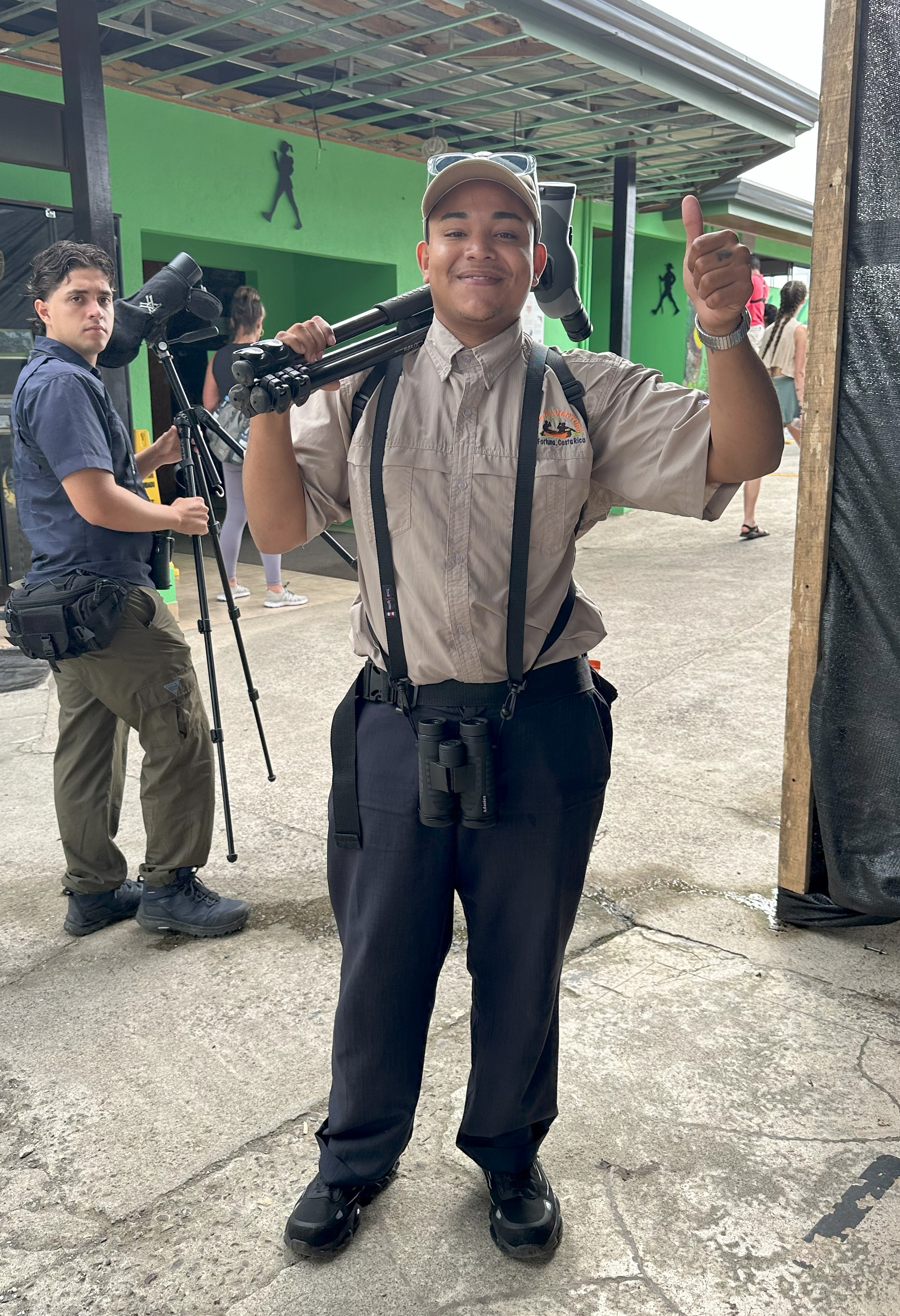
This day we paddle our way to bliss with the Safari River Float on the Rio Peñas Blancas. This tour, and tomorrow’s Hanging Bridges tour, were arranged through Canoa Aventura. They are impeccably precise on their pickup schedule, which we greatly appreciated.

Samuel! Canoa Aventura was excellent

Our guide today is Samuel, a smiling and funny young man recently graduated from a specialty college where he majored in Eco Biology. He was offered an internship with Canoa that turned into a full-time job, and they are lucky to have him. His bubbly enthusiasm made the tour so fun that we requested him for our tour the next day at Hanging Bridges.

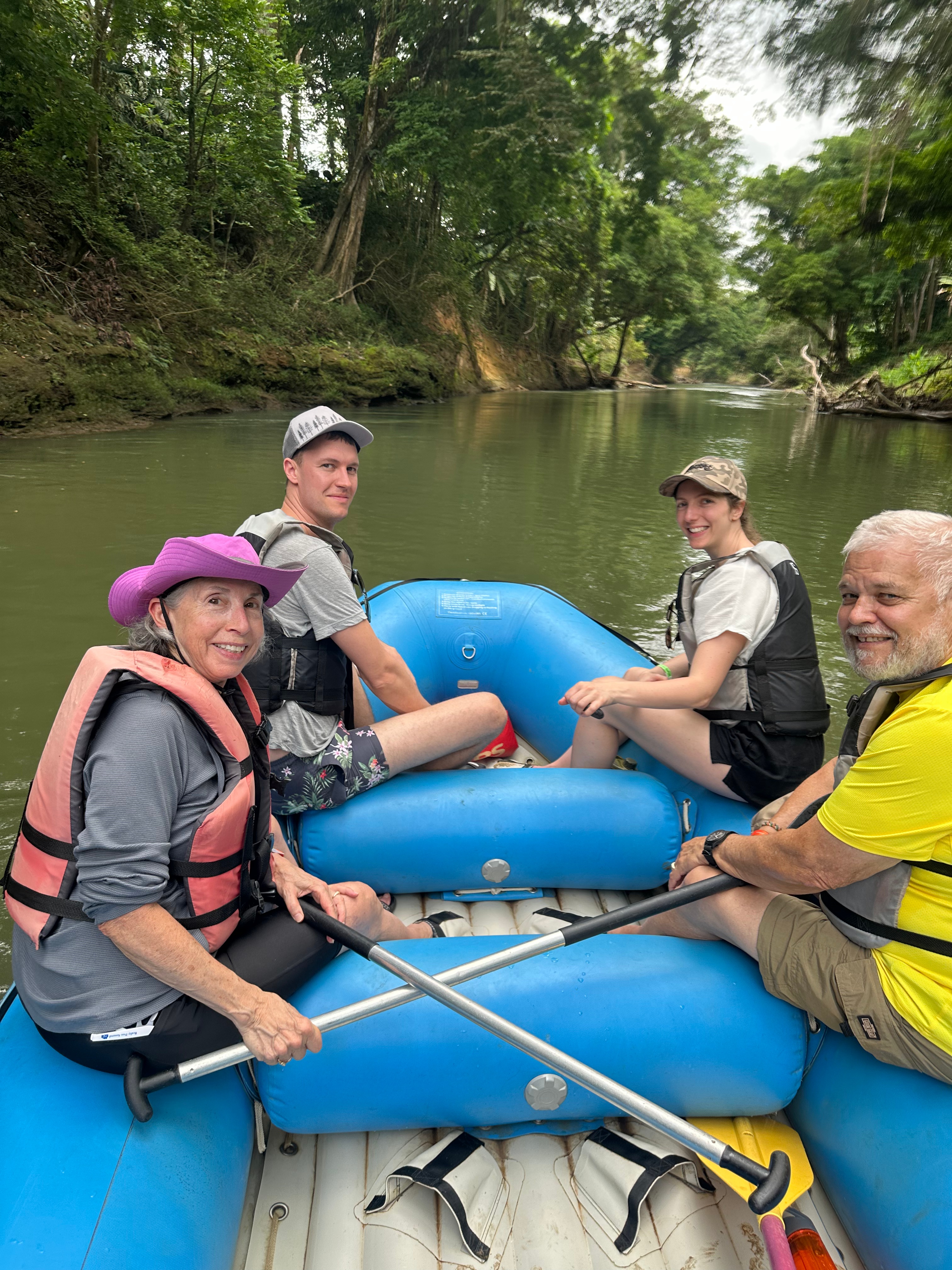
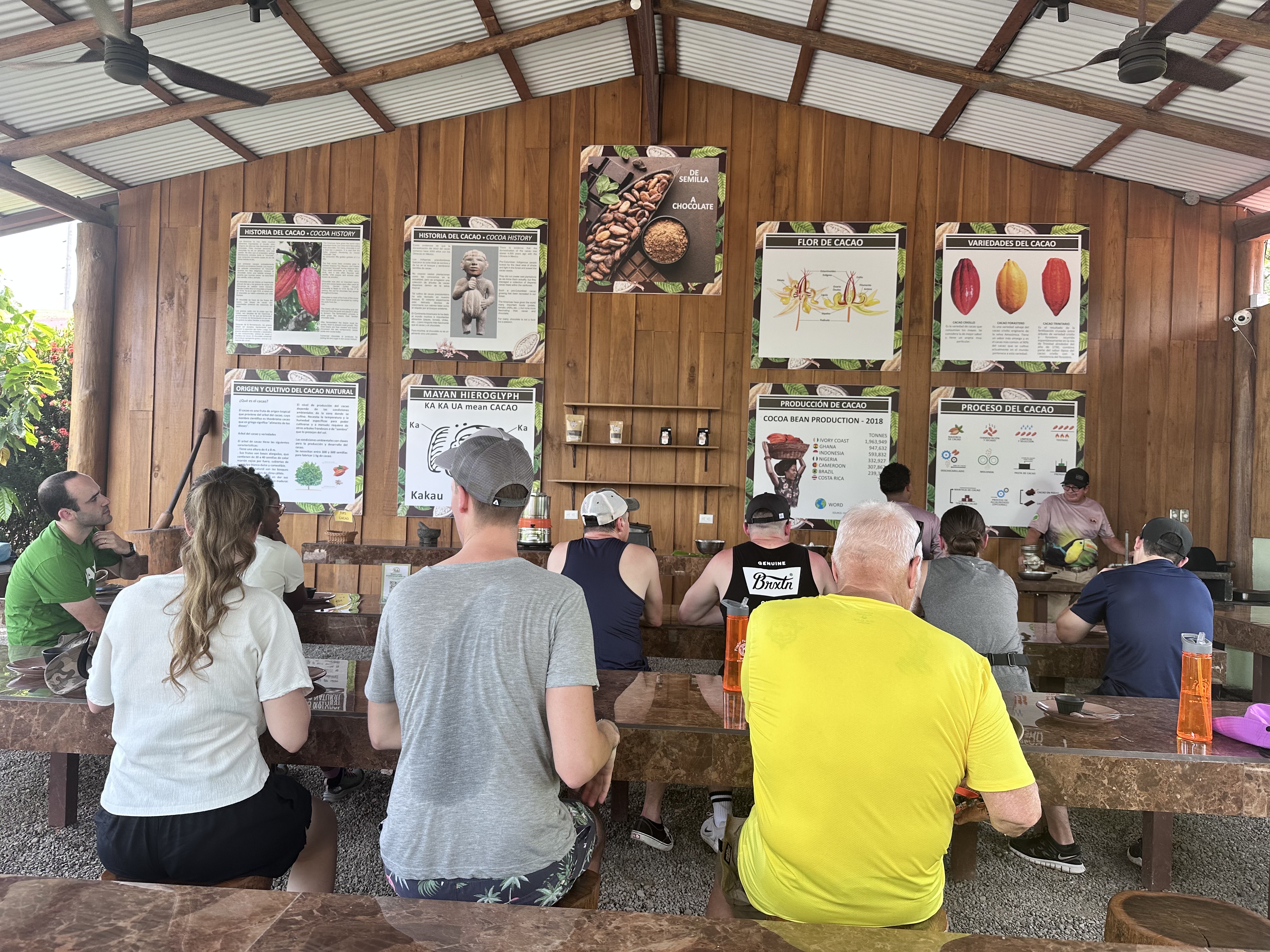
This float is about 2 hours and covers 10km, about 6 miles. The Peñas Blancas flows to the confluence with Rio San Carlos and the tour ends at a Canoa property that houses their float terminus, a chocolate factory (we all got to see how it’s made and eat some!) and a moonshine still for making hooch out of the surrounding sugar cane. We were treated to a local snack dish of warmed tortillas with cheese and fried plantain, accompanied by a choice of water, coffee or sugarcane tea (hot or cold). If you have a sweet tooth like me, the sugarcane tea is amazing, and the simple snack was surprisingly filling and deliciosó. Everyone was offered a shot of moonshine but we passed as non-drinkers. At 130 proof Samuel says it can make the “moon shine” in a thunderstorm. One shot sends you to heaven, the second shot sends you to the trunk of the transit van for the trip back to your hotel.

Samuel’s happy crew of back paddlers. A normal load is 6, but it’s officially the Off Season

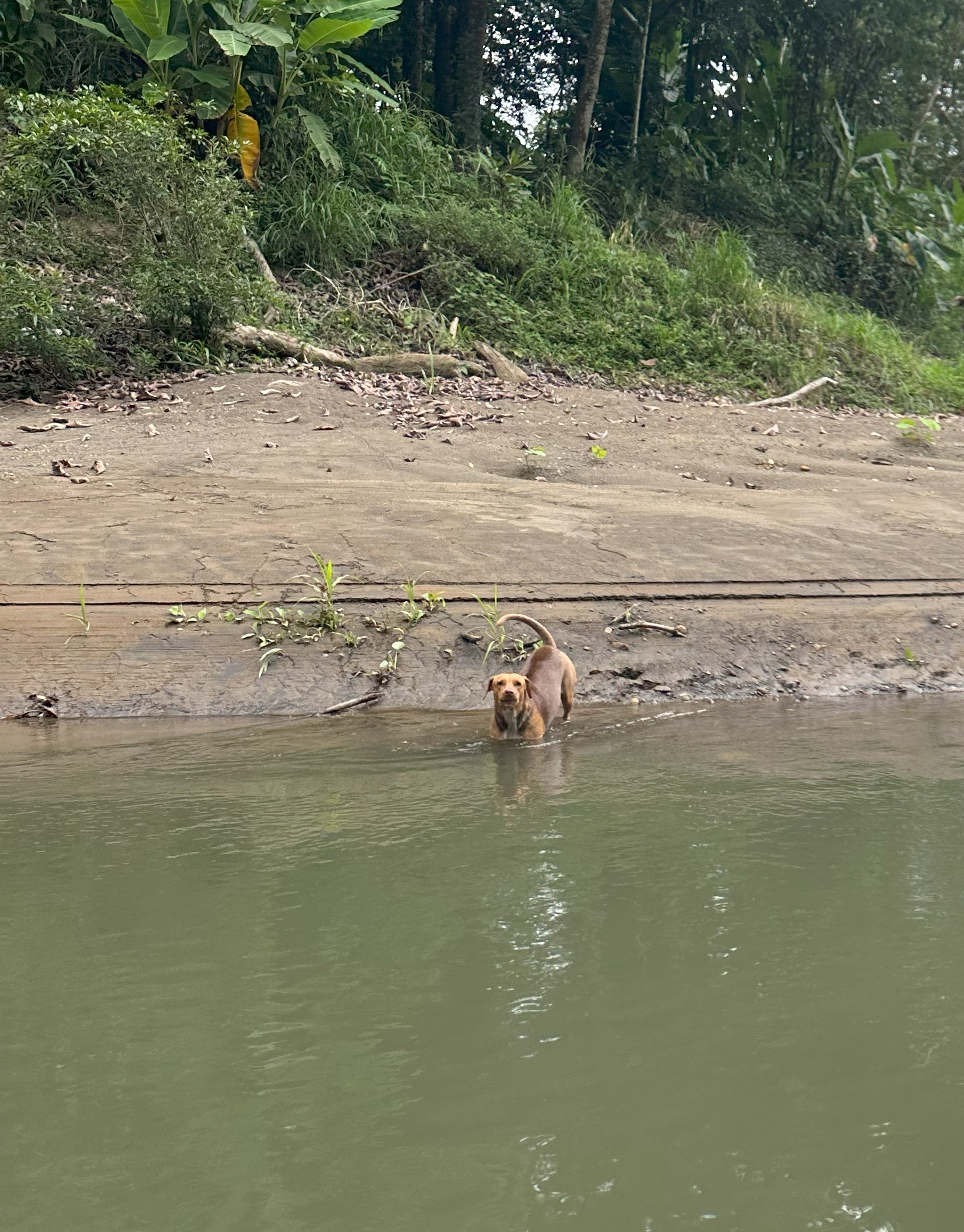
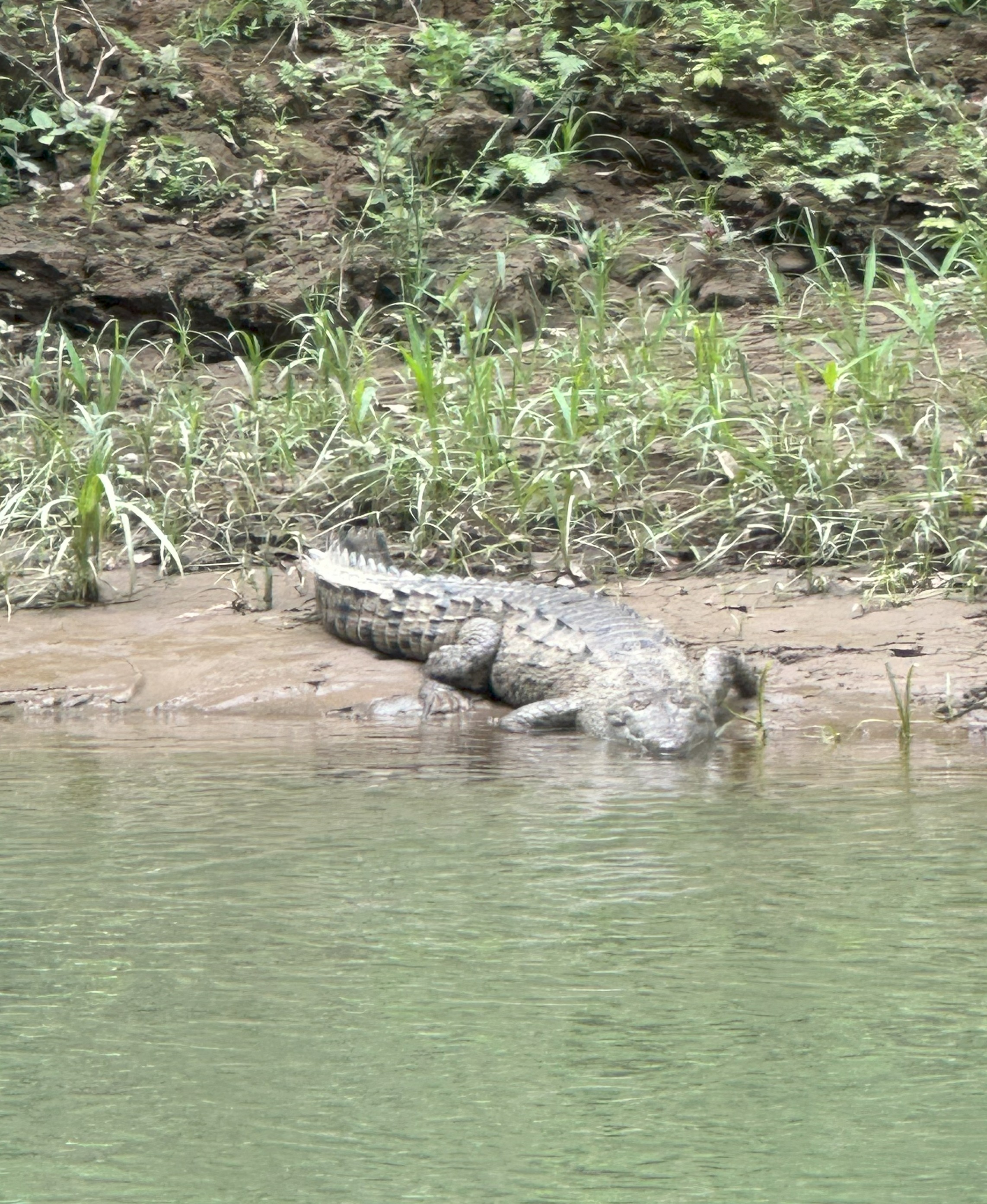
On the float you have a chance to see dozens of species. We saw American crocodiles (several), a river otter, a Jesus Lizard (a basilisk that can run on water, although it didn’t), two species of monkeys, owls, bats, turtles, and Crazy Luna, the raft-hating farmer’s dog (the river bisects a large farm).

Luna was delightfully persistent, absolutely sure she was scaring the bejezus out of us and forcing the raft to flee downstream. The more warmly we called to her the more furious she got.

We saw so many other beasties, it’s hard to keep count. And you don’t just sit there and stare, you get to help navigate the raft through some very mild fast water, frequently to Samuel’s urgent command to “backpaddle, backpaddle!” to move the raft to the bank so we can closely examine things like owls and bats and Jesus Lizards.

Learning about, and eating, chocolate. Mr. Wonka (in the hat at the front, far right) is the chocolatier and hooch brewer

Of course, we’re at a resort & spa, so we spent the afternoon soaking our backpaddling muscles in the hot springs, cooling off in the freshwater pool and sipping a couple of tonic and cranberries.

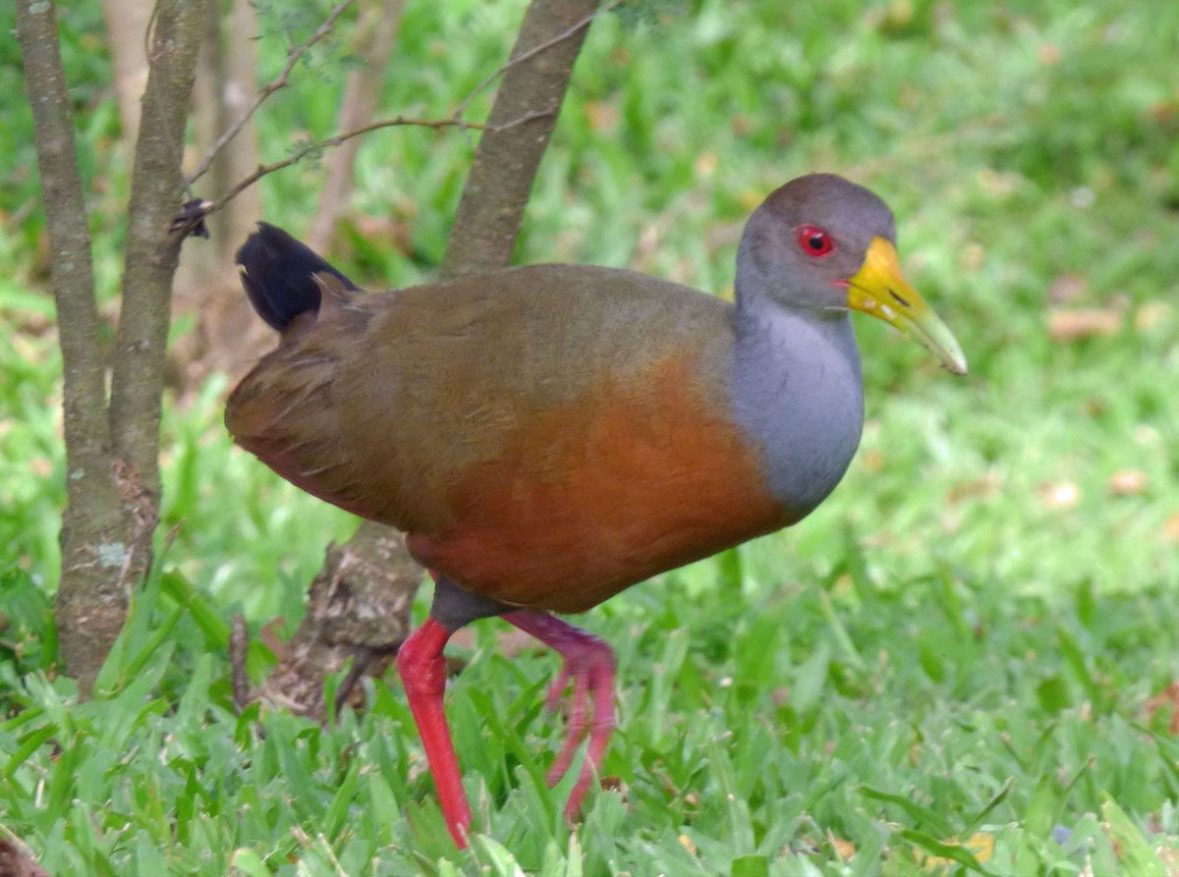
At the pool we were visited by a local, who was quite persistent in watching us. Maybe we were on his turf? Our family bird expert, Glenn, tells us this is a Gray-cowled Wood Rail. His name is Crazy Charlie. He didn’t have much to say.

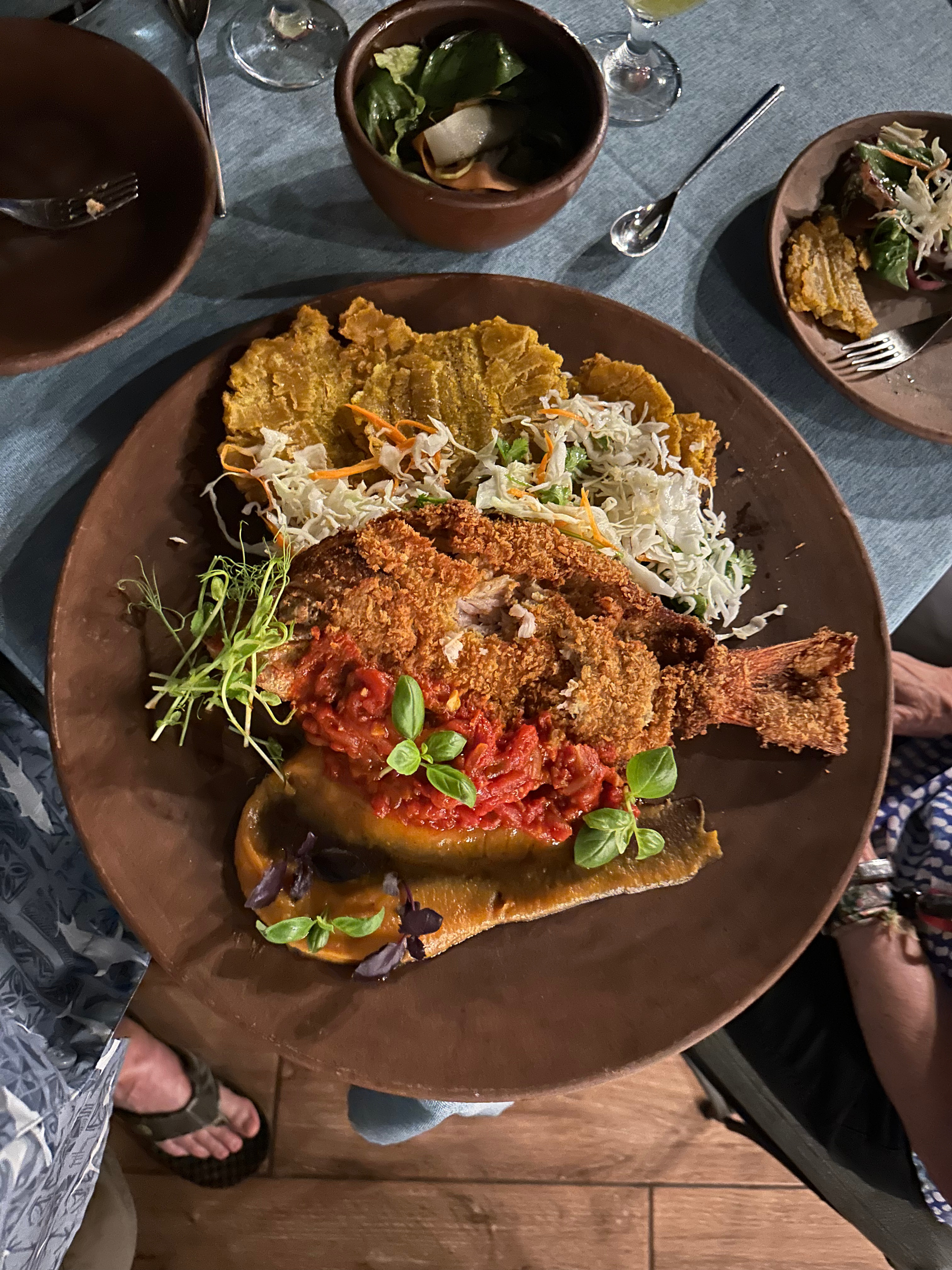
We dined casually in one of the hotel restaurants and chose a whole fried snapper and a couple of salads. We have done the fried whole fish thing before, but this chef had cleverly removed the main part of the skeleton, so the entire center section was crispy skin and meat. It was accompanied by fried plantain chips and a sauce made from pureed squash and just a hint of spiciness and herbs and some fresh tomato salsa. Michelin star deliciosó!

Fried whole snapper, that has been deboned, with fried plantain chips and a squash puree sauce and salsa

Monday May 5:

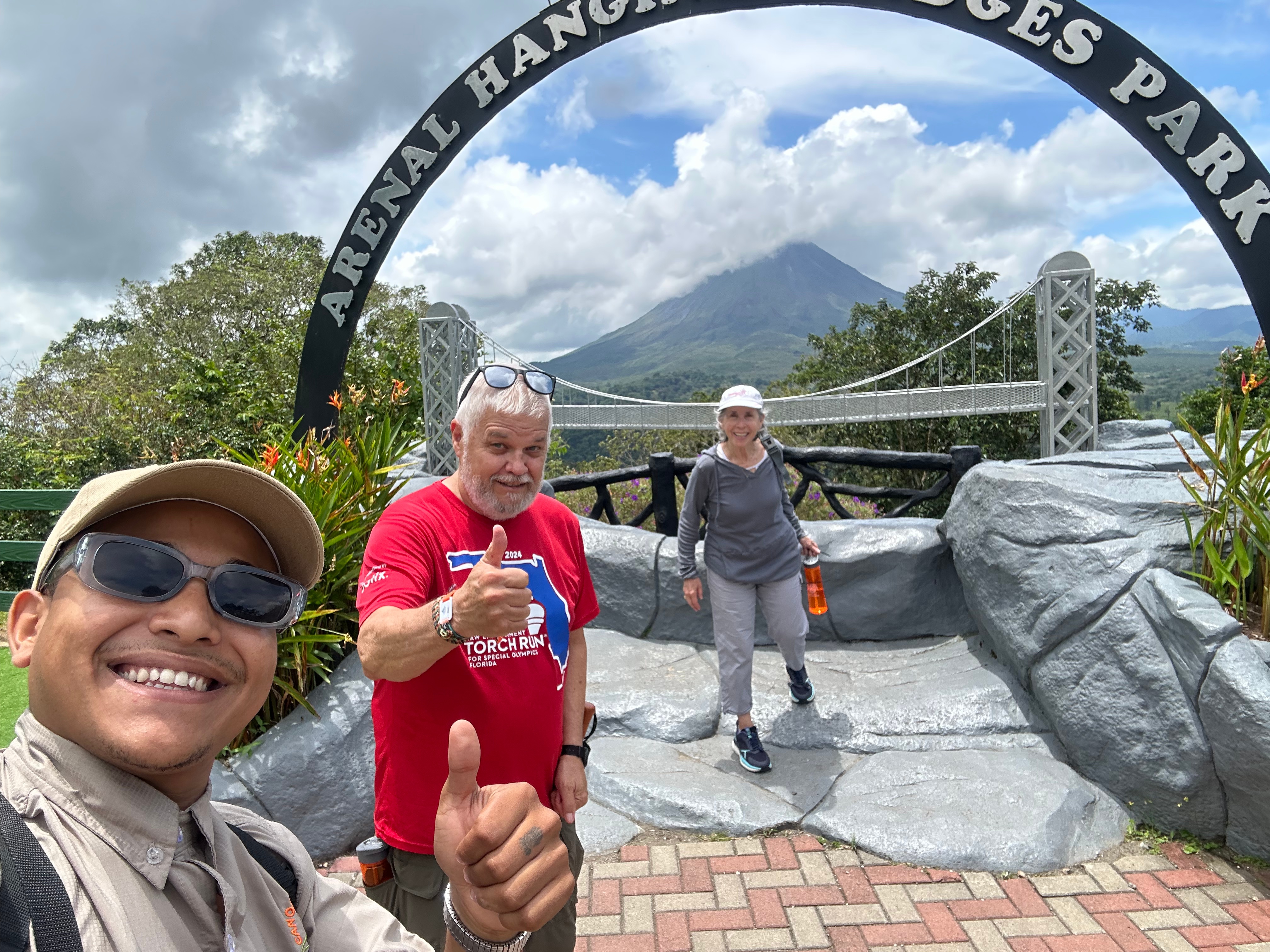
This morning, we are pleasantly surprised by Samuel coming to pick us up at the hotel for our Hanging Bridges Tour!

He did this tour for a different group yesterday afternoon after our Safari Float, and he tells us he knows where “everybody” (the wildlife at Hanging Bridges) is today.

Many of the species on the tour apparently are territorial and migrate around the park on a Pura Vida schedule. Our mood is bright for the short drive, and we are even more excited to find out that the park isn’t crowded. This first week of May is turning out to have pleasant, dry weather and no crowds. We uselessly carried our umbrella everywhere. We would come back at this time in the future for lower prices and fewer people for sure! Especially when we find out that March and April are the hottest months.

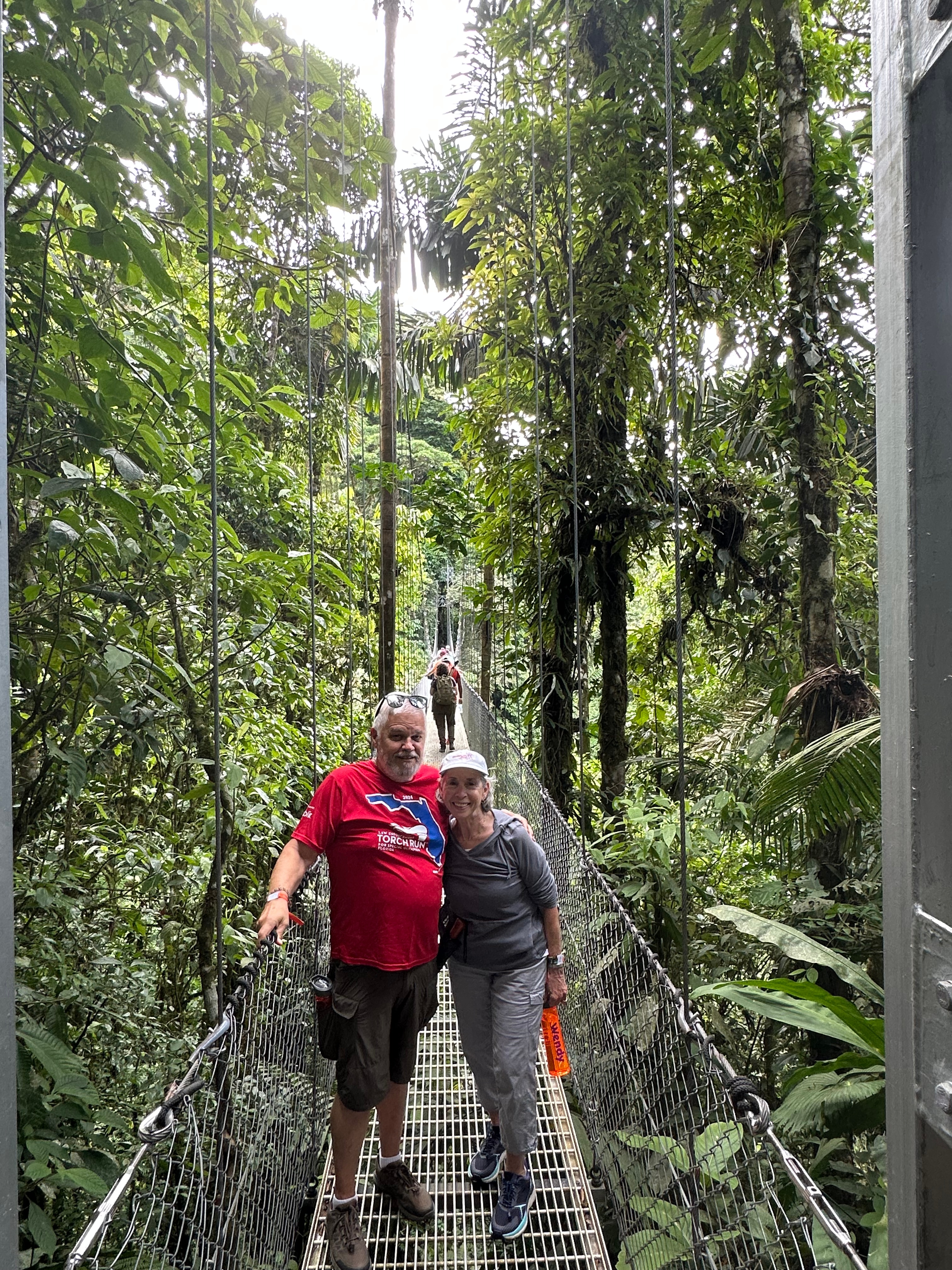
The tour is a 2 hour walk along 2 miles of trail that crosses 16 bridges, 6 of them cable-suspension bridges and the other 10 are fixed, although today the last suspension bridge is under refurbishment, so we won’t cross that one. If you are afraid of heights, don’t take this tour. The suspension bridges are totally safe, but the height (up to 400+ feet) and length (up to 92 meters, about a football field) combined with the “bounciness” and the sway from side to side can be unnerving.

92 meters long, 400 ft up. Pura Vida!

The views are over-the-top spectacular, and it’s really cool to see the same trees from the top that you just saw from the bottom. The hike is up and down the sides of a canyon, and although the path is very well developed and maintained, the inclines can be steep. Wear your best walking shoes or hiking boots! And you get a chance to see quite an array of wildlife.

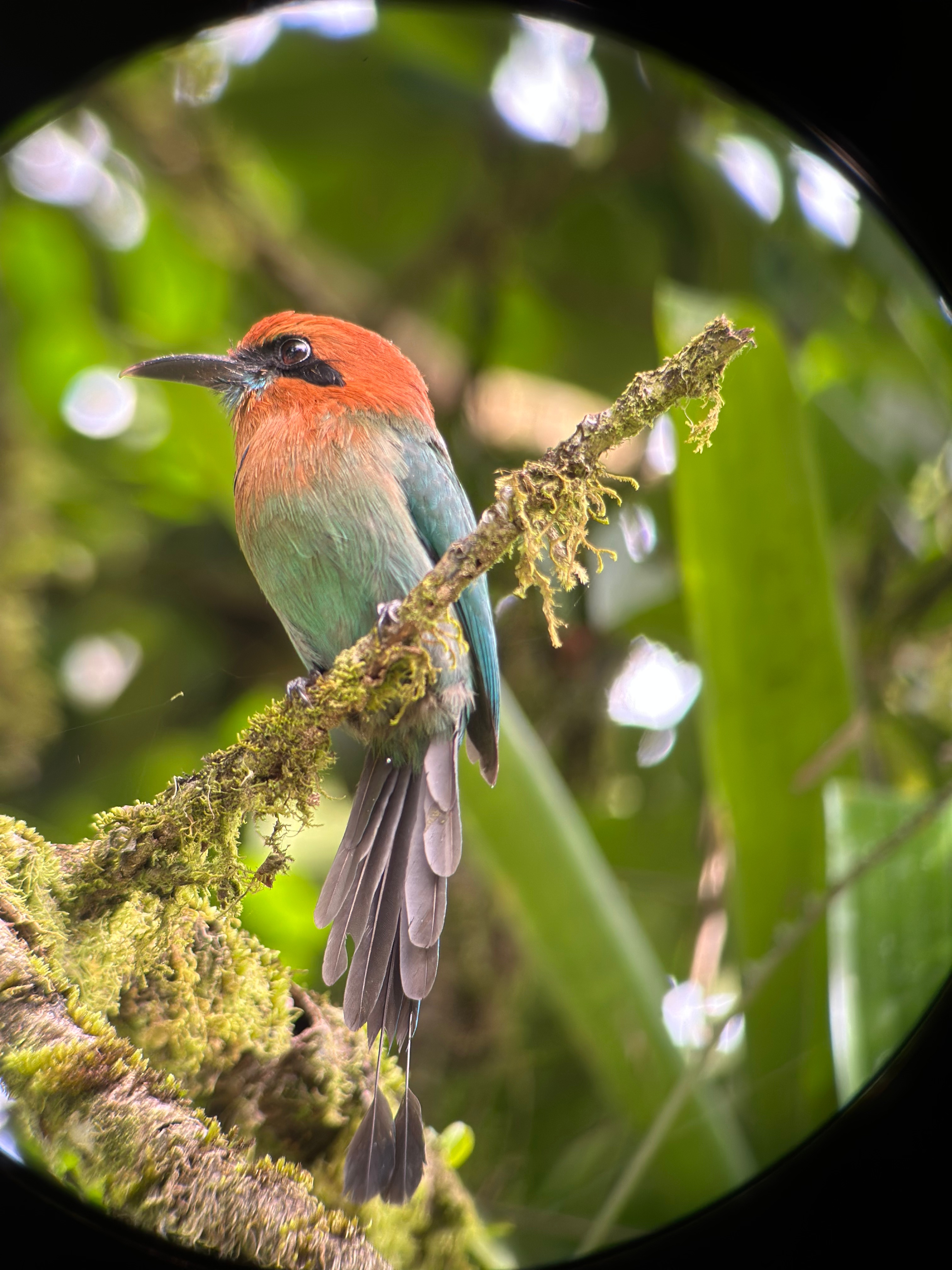
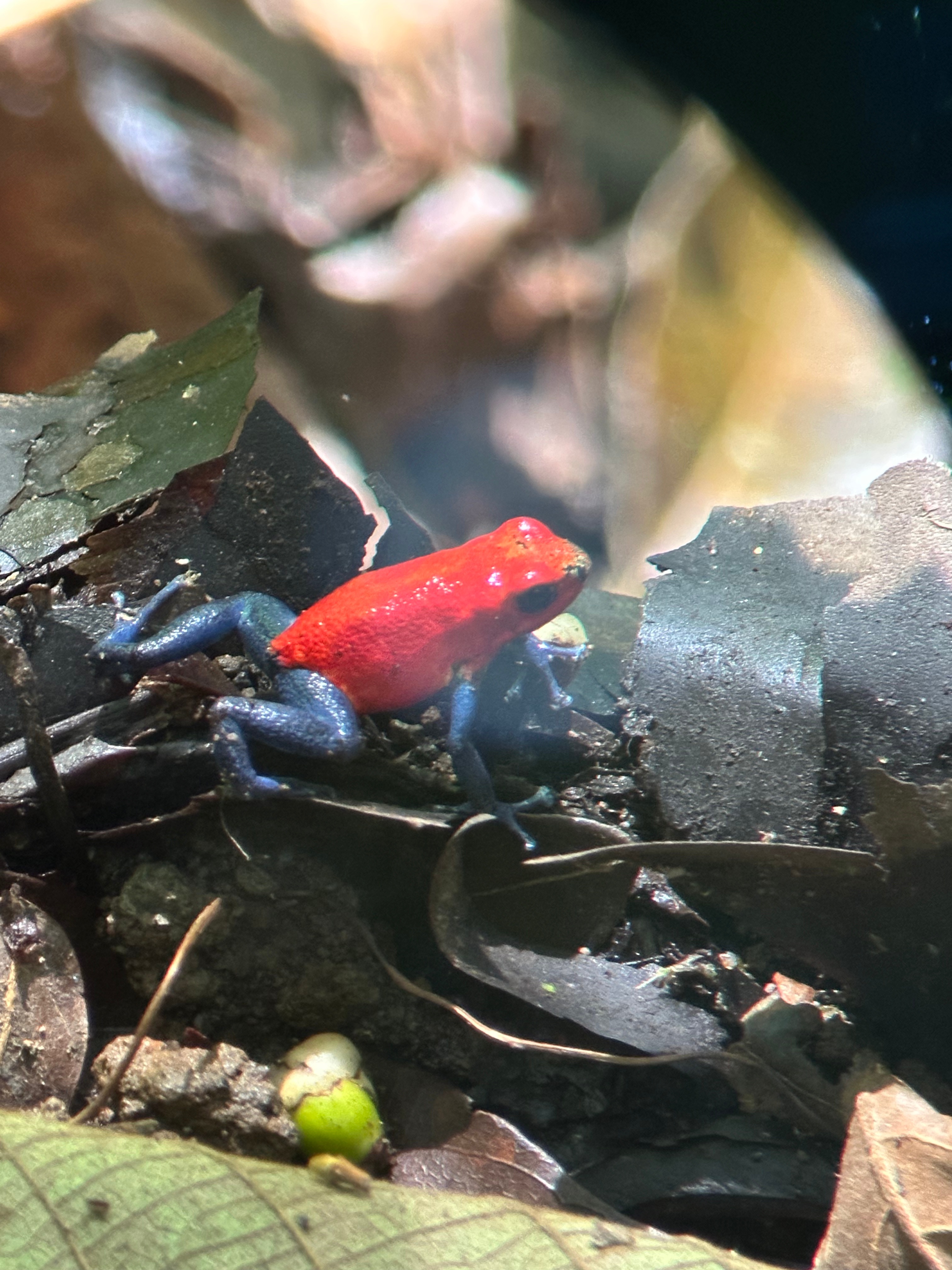
We saw lots of birds, strange worms and caterpillars, spider monkeys, iguanas (several types), a massive march of leaf cutter ants (cut leaves included), spiders, a Soil Crab (very rare in the north of Costa Rica), a tarantula (in his hidey hole), bunches of birds of all types and colors, and tiny Blue Jeans frogs. These bad boys, bright red tops and denim blue bottoms and legs are so poisonous that one frog can kill 6 humans. Their skin slime is collected by pushing them through a funnel made from a plant leaf, and a Spike Palm spine is dipped in it, which is then blown out of a tube made from a banana leaf to take down an enemy. The poison is a hemotoxin, so death is long and tortuous, inevitably resulting in massive organ failure. Too toxic to hunt for food, these darts are only for self-defense. Other vegan toxins treat arrows for hunting food without killing the human consumer. We heard more than one version of the poison dart story, but I picked this one because it has cooler content. The other version had only arrows, no darts, and no enemies in it. What’s the fun in that?

The leaf cutter ants are very industrious. They cut only a certain kind of leaf with a high acid content. They take the cut leaves back to the nest and compact them all together into a mass, which then ferments from the heat and moisture. At some point mushrooms sprout from the fermented blob, and that’s what the ants eat.

Based on the description that Samuel gives of the crowds on this tour during the high season (as recently as last week), I can only envision Disneyland during spring break without any express lines. I’m glad we came later because we never had to wait for anything except a minute or two for the first hanging bridge (capacity is strictly controlled on all the hanging bridges).

After our long soak in the magical mineral springs, we decide that a scouting trip to the town of La Fortuna is in order, about 4 miles away. I have no trouble finding several Ubers within a few minutes of the hotel. We summon one and head out. About 2 miles into the trip our driver suddenly turns into the driveway of a large private estate and pulls up to the security gate and then just sits.

He is chattering away at a mile a minute with a buddy on his phone, and then uses his translation app to inform us that the police have set up a roadblock about .1 miles down the road into town (we can see them easily). Then he explains that “Uber isn’t regulated in Costa Rica”, meaning it’s illegal, and he can’t risk getting pulled into the stop with passengers in the car. So, he calls us a “red cab”. Red is the color of official taxis, and it’s probably pressure from the cab dispatcher on the local mayor that brings out the roadblocks. After all, cab fare into town was about $8 while the Uber was only $5. The cab eventually comes and we escape jail (maybe a little stretch here) by paying the full freight of $8 for ½ the ride into town. I still tipped the Uber driver for what looked and felt like saving us from either a “no bueno” situation or a long walk. And that’s the story we’re sticking with.

La Fortuna is an interesting town that looks like it was purpose-built for tourism. It’s unlike all the small towns we drove through on our way up from San Jose in that every other establishment is either a souvenir shop or a restaurant. Our cab driver recommended La Fortunendo, which has the look and feel of a sit-down fast food place, but the menu and food of a full-on restaurant. We’re not terribly hungry so we settle on some ceviche and a coffee-crusted beef entrecote to share. The portions are large, the beef looks like a sliced London broil. It’s all delicioso, and we woof it down.

So hot it has to be an effective anti-viral

The ride back is, you guessed it, via Uber. I appreciate a good underground economy as much as the next Americano. No roadblocks this time, the fare is still $5, and out of gratitude for a quick and easy return I tip the driver another 5er.

Tuesday May 6: Today is our transit day to Arenas Del Mar Beachfront Resort & Rainforest adjacent to Manuél Antonio National Park. This is the only hotel with direct access to 2 beaches (Playa Espadrilla, the public one, and Playa Playitas, the private one) and MANP. It’s a 5-hour road trip, so we elected to hire a private driver so we could soak up the local scenery.

Before we set off, we remarked to our driver how exciting it was to see so much wildlife, but that we had not yet seen a toucan. We drove down the driveway about 100 meters and he stopped and just like that pointed out a small one high in a tree.

A “mini” toucan, high up in a tree

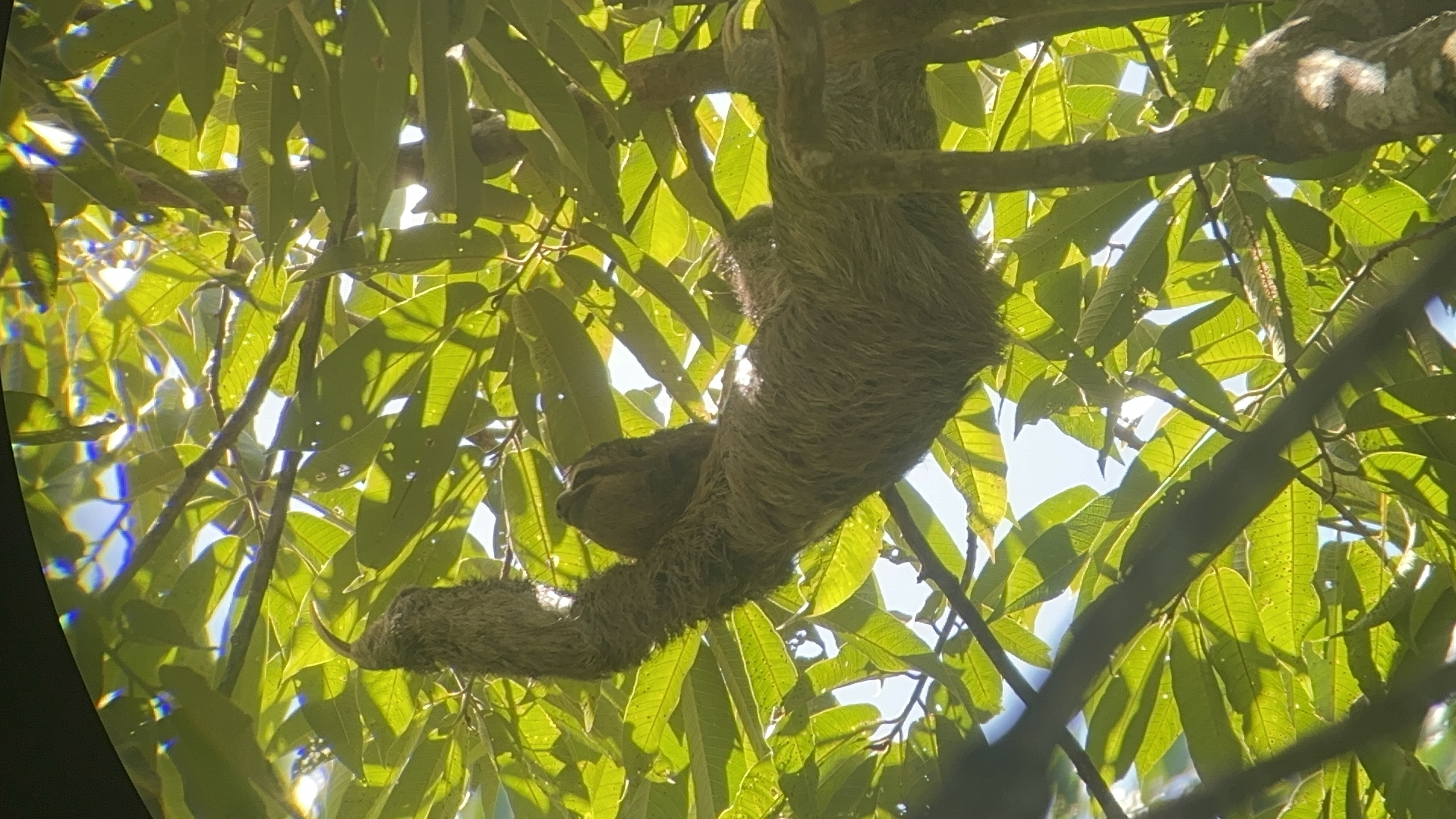
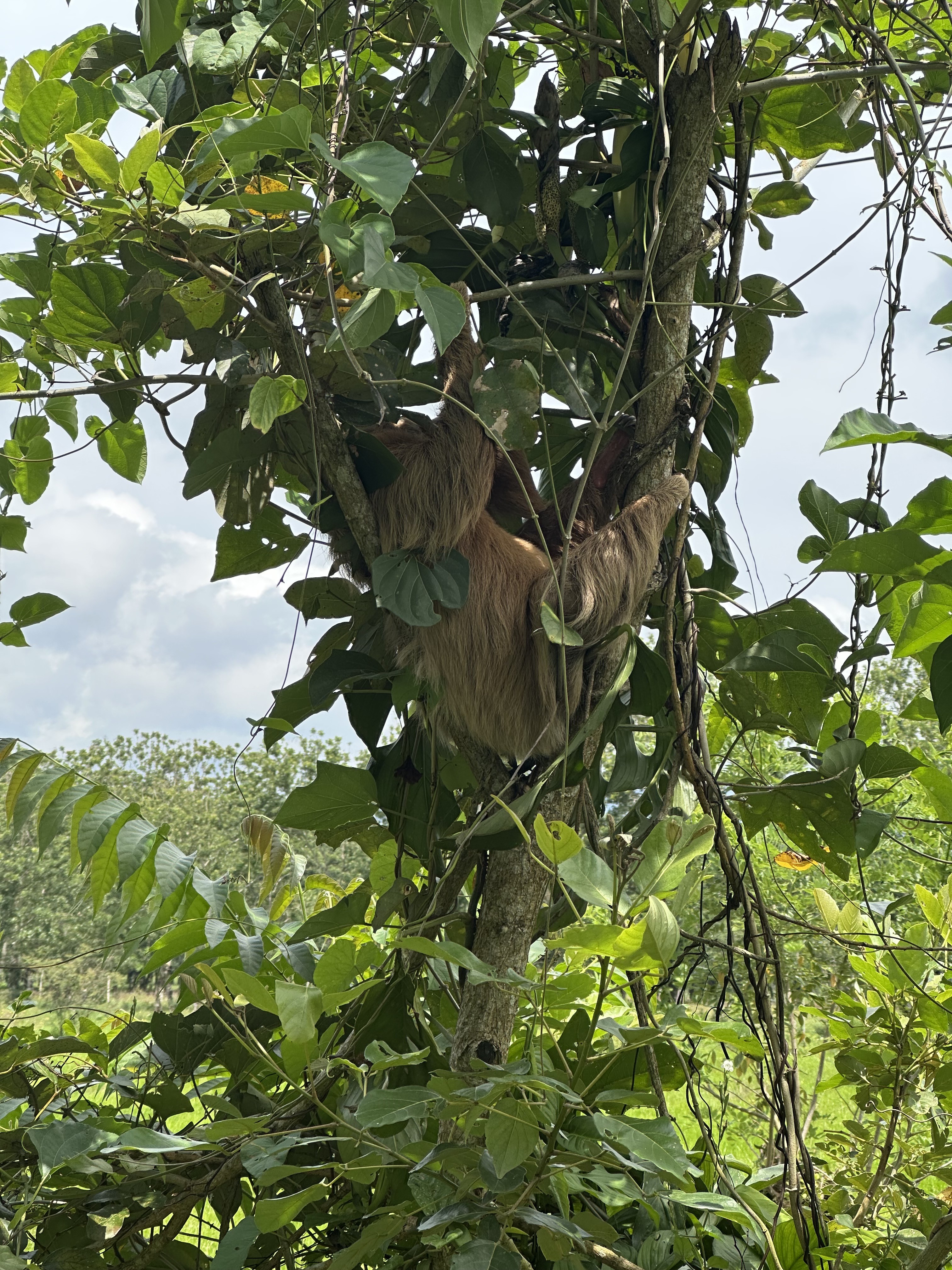
Who knew that spotting wildlife was a Costa Rican superpower. Not much farther, on the main road south, he pulled up to a quick stop, slammed it into reverse (all the cars behind us calmly swerved around us like this is a totally normal thing) and stopped adjacent to a small tree not much taller than the van at the edge of the road. In the base of the branches napped another sloth! Right in front of us this time. So far, all our sloth sightings have been drive-bys, and we are told later that this is because the roads all skirt the perimeters of the forests, and the sloths don’t inhabit the forest interiors, they travel around the edges. In fact, they use overhead wires to transit from one side of the road to the other.

Fast asleep, this guy on the side of the road is about the size of a 4 year old kid

The powerline infrastructure has widely spaced wires to accommodate this wildlife “highway” so that fully cooked animals don’t routinely drop in the road, freshly electrocuted.

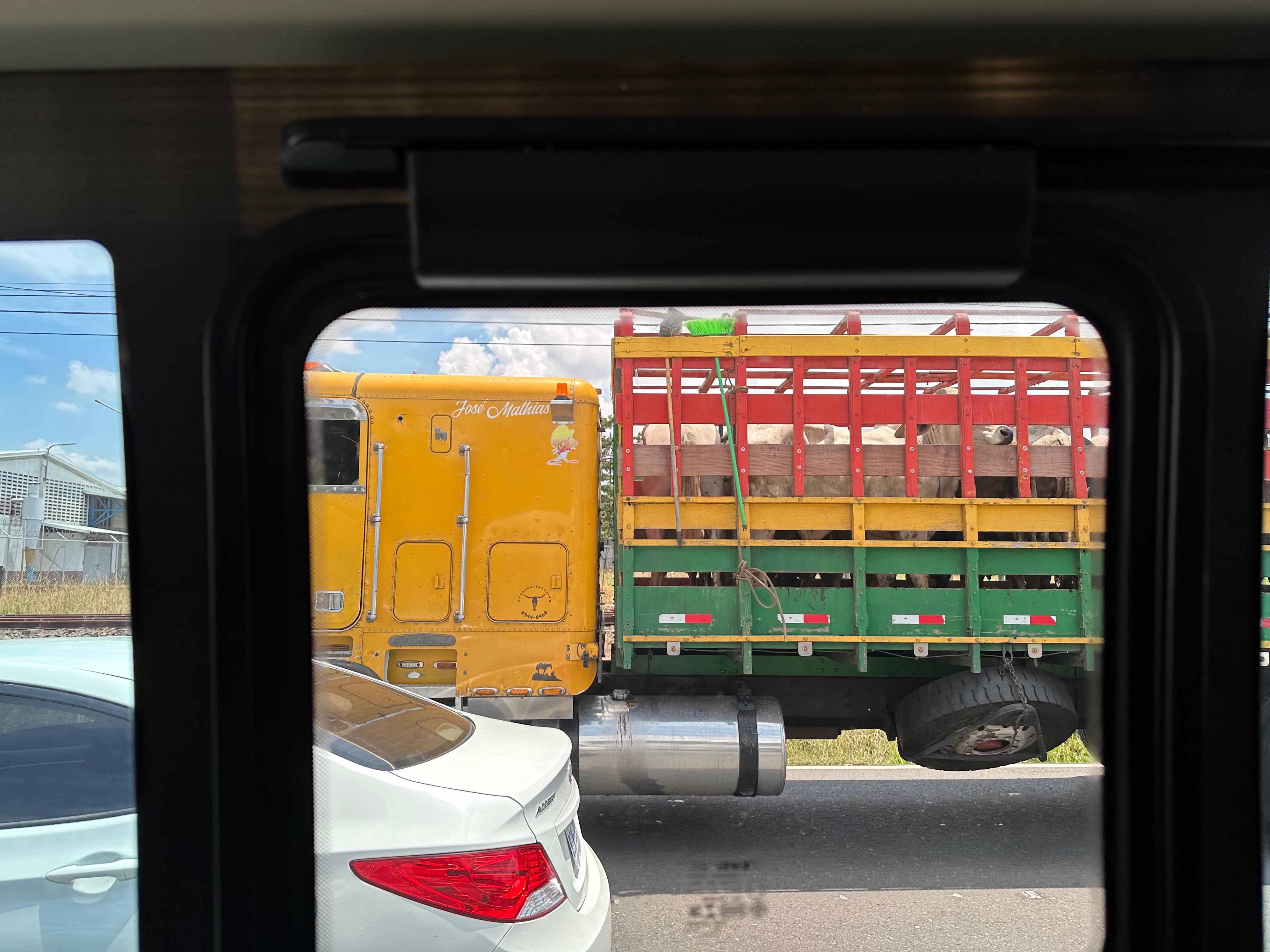
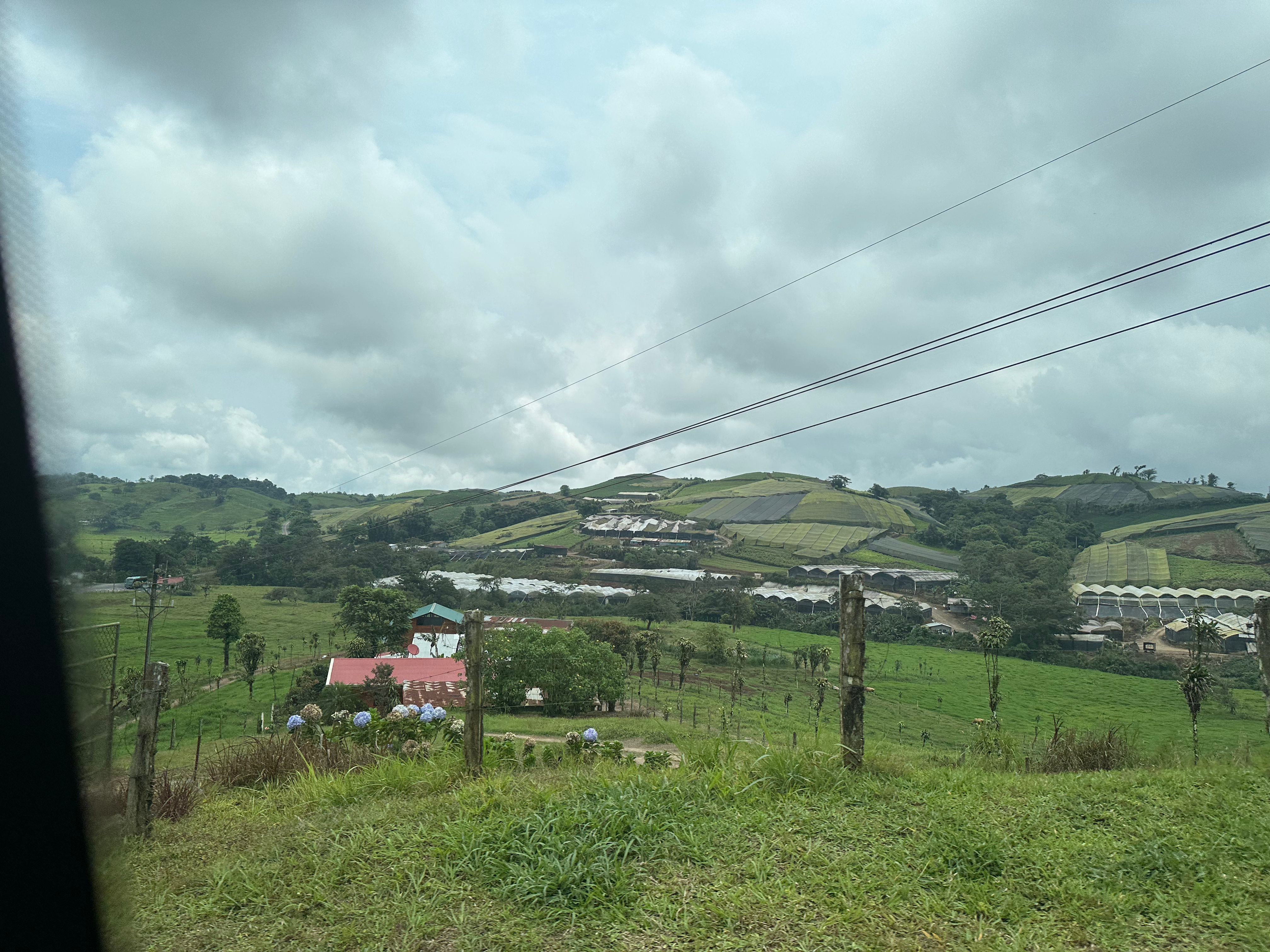
We drove south on small roads through the central valley and then into the coastal highlands, where the roads don’t get much wider in spite of the huge increase in truck traffic. The two main mountain ranges in Costa Rica are very different. The mountains on the west are all volcanic, and the soil that developed there has a clay-like texture that is extremely rich in nutrients and minerals. That’s where most of the agriculture takes place. The eastern range formed by tectonic plate upheaval, and is rockier and sandier, with soil less suited to agriculture. Lucky for us, agriculture requires better roads, and our route takes advantage of that. I can only imagine what the roads in the east look like in comparison. It takes us 5 hours to transit about 170 miles.

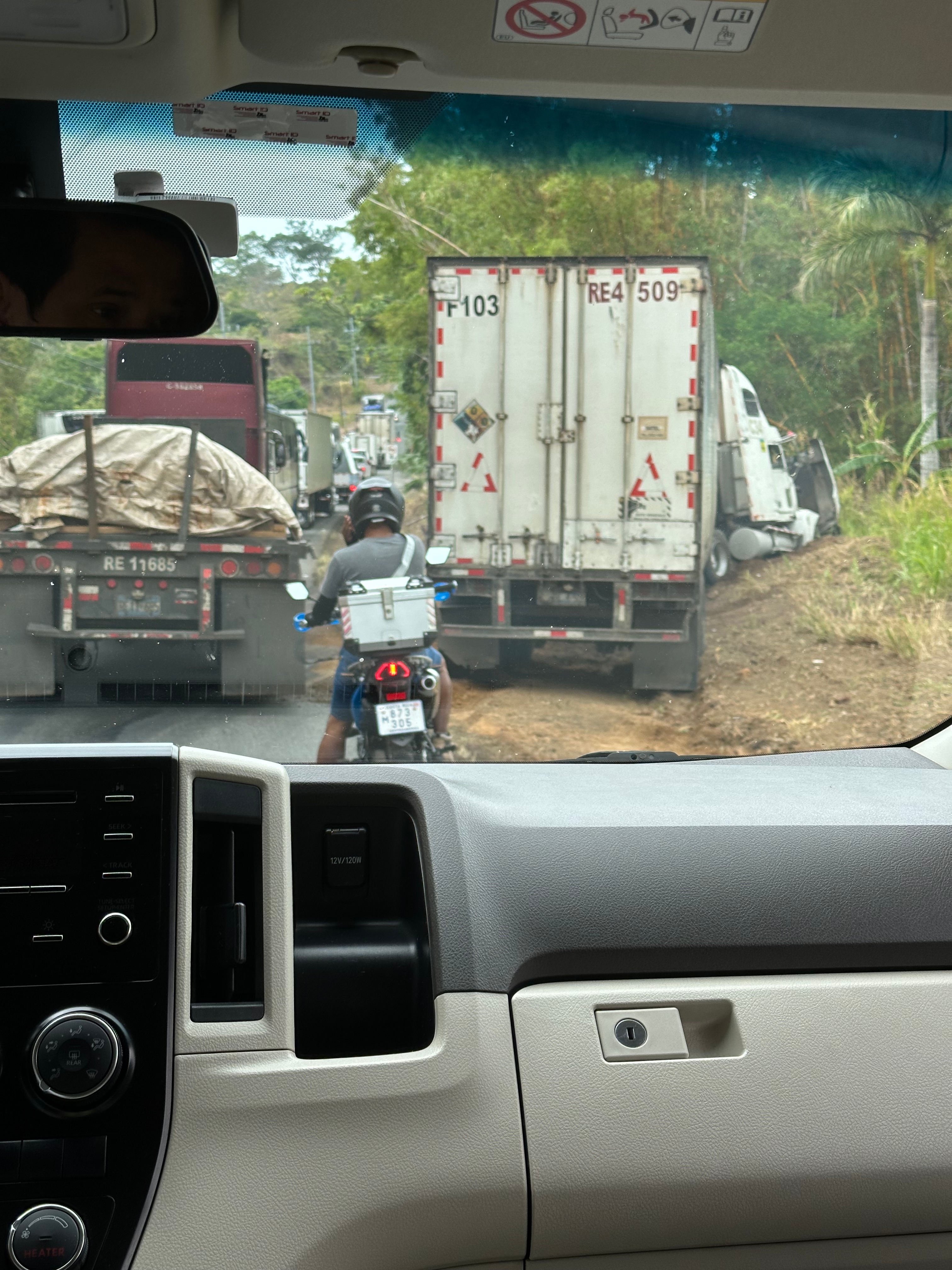
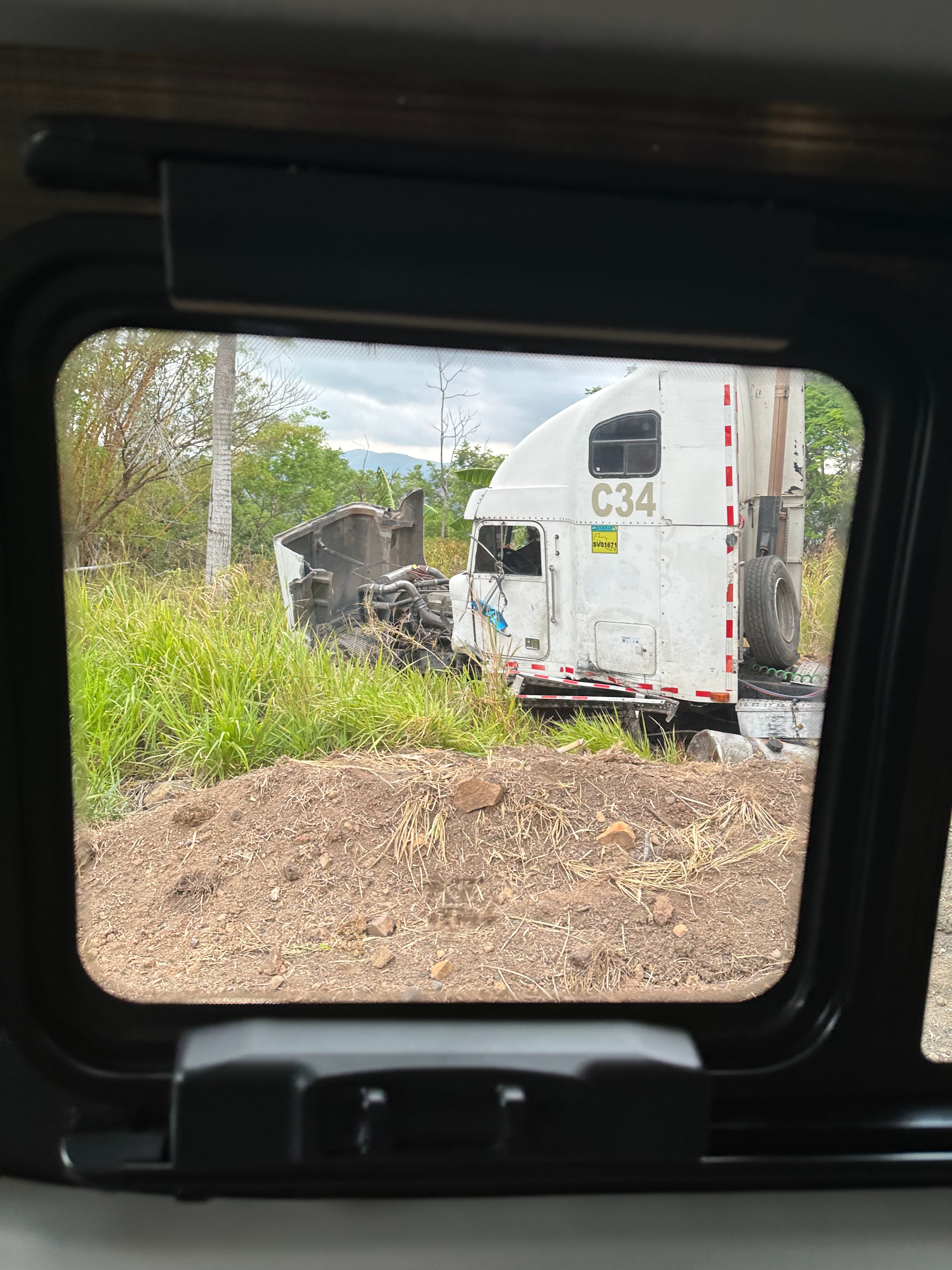
A little over midway, traffic suddenly comes to a stop as we pass a semi-truck on the oncoming side that has just been sideswiped by another semi-truck traveling in our direction about 4 vehicles ahead of us. The sideswiping truck has swerved all over the road and ended up off the right side in a big ditch. Debris and smoke are everywhere, and traffic in both directions grinds to a halt. One driver has suffered a small cut (our driver provides a band aid), but otherwise everyone is alright, and soon a few men sort out a passageway through the wreckage and we’re lucky to be one of the first to get free and continue our journey. Nobody seems particularly alarmed by all of this, so I can only guess it isn’t that unusual. Thank God we happened to be at a wide spot in the road!

We make sure our seat belts are snug. Our short delay has eaten up the extra time we had by getting a 15 minute earlier start, but we decide to still stop for lunch and a bathroom break at about the 3 ½ hour mark. The driver pulls over at a truck stop close to a bridge, which is awesome because we get a 3 way stop: bathroom (great relief, and clean!), lunch is a large plate of extremely traditional country fare of local veggies and meats with fresh fruit juice ($8, we shared it), and the bridge crosses a wide river full of crocodiles. It was curious that this river also bordered some cattle grazing, and the clash of the cattle drinking from the river that was seemingly teeming with crocodiles looked a little surreal. I’ve seen African documentaries, and this scene looked exactly like the one that has crocs snacking on Wildebeests. A cow looks much like a Wildebeest to me, so I can’t guess what’s keeping all those predators from dining on them.

Next up, our extended stay at Manuel Antonio! Pura Vida Tres!

Posted in Costa Rica | Tagged , , , , , , , | 1 Comment

Pura Vida Uno! Costa Rica in 3 Parts: San Jose

Everywhere you go in Costa Rica you are acknowledged with the expression “Pura Vida!” A concierge helps you with your luggage and you offer “Thank You” (or perhaps “gracias”). “Pura vida” is as often the response as “de nada” (you’re welcome) or “con gusto” (with pleasure). But pura vida doesn’t mean either of these things, even though it is interchangeable with both. The literal translation is “pure life”, but just rolling it off your tongue imbues a richness to it that hints at the hidden meaning. I consider it more of a colloquial blessing or a Costa Rican verbal high-five. It’s also great for the practicing of rolling your “r’s” to sound more like a native. It’s not unlike using “Aloha” when coming and going in Hawaii to telegraph friendliness. We hear it constantly from the moment we first contact our tour agent, Pacific Tradewinds, to the last moment when the airplane door closes in San Jose on our return flight. It may have become a part of my lexicon….

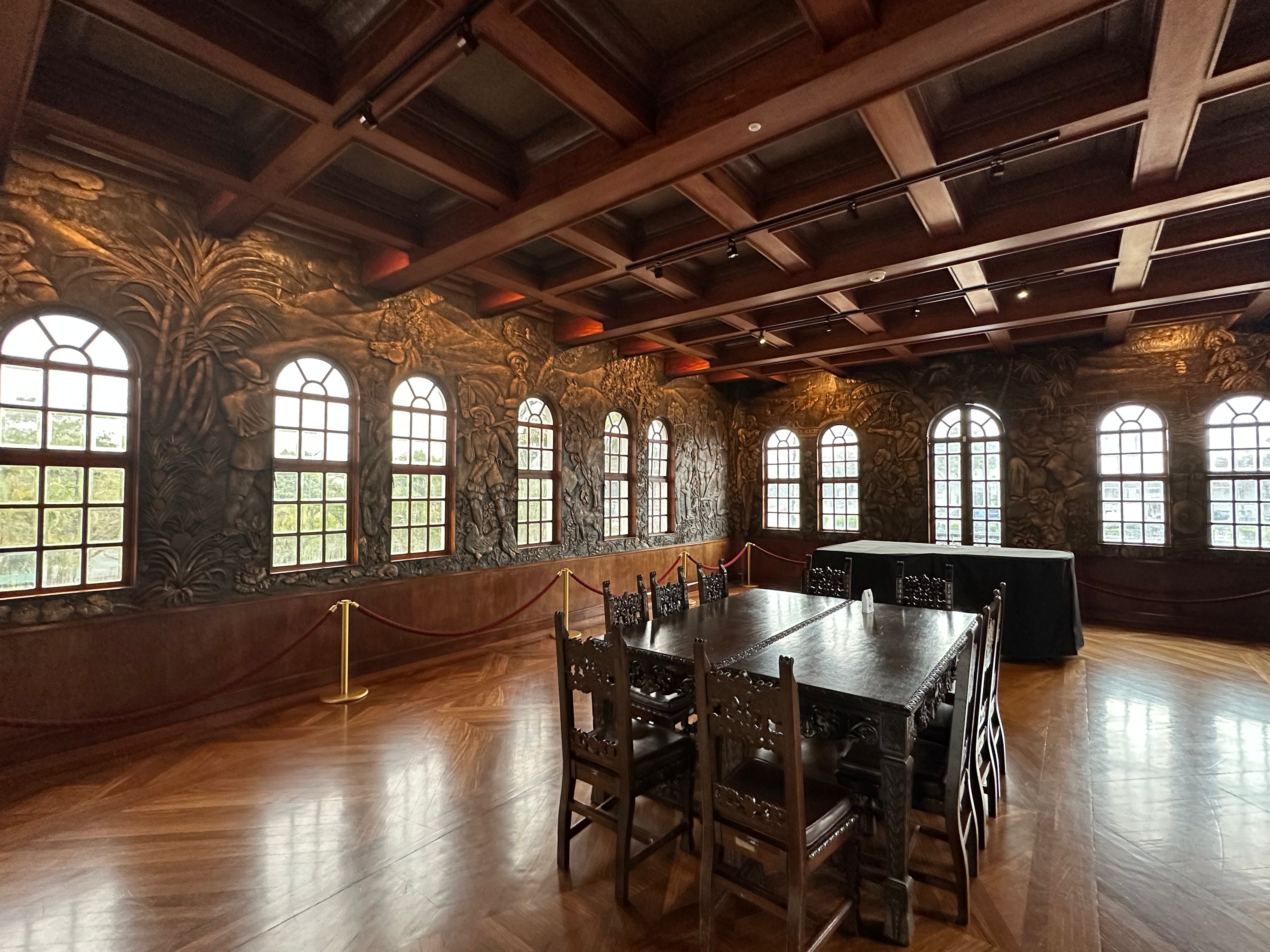
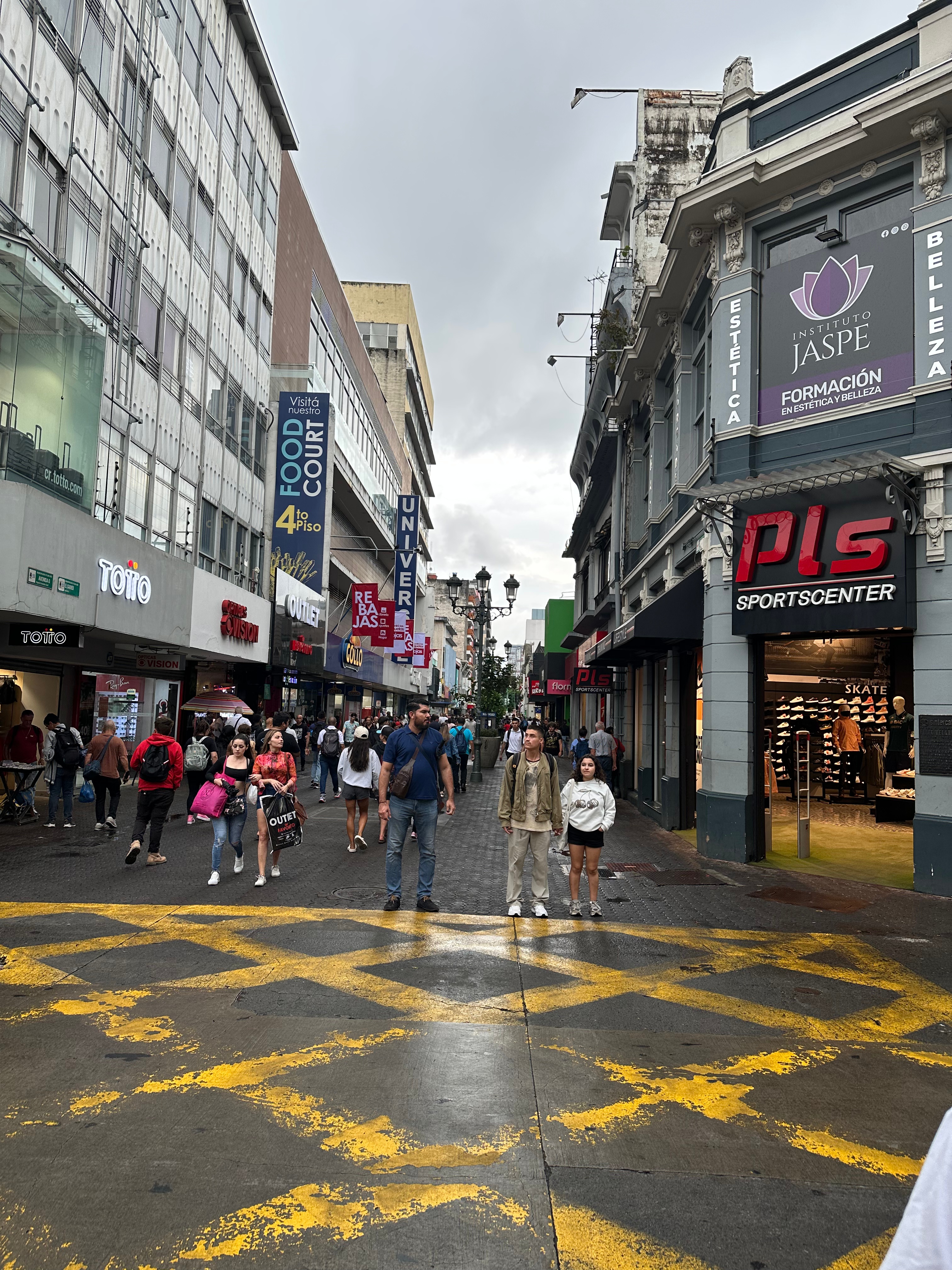
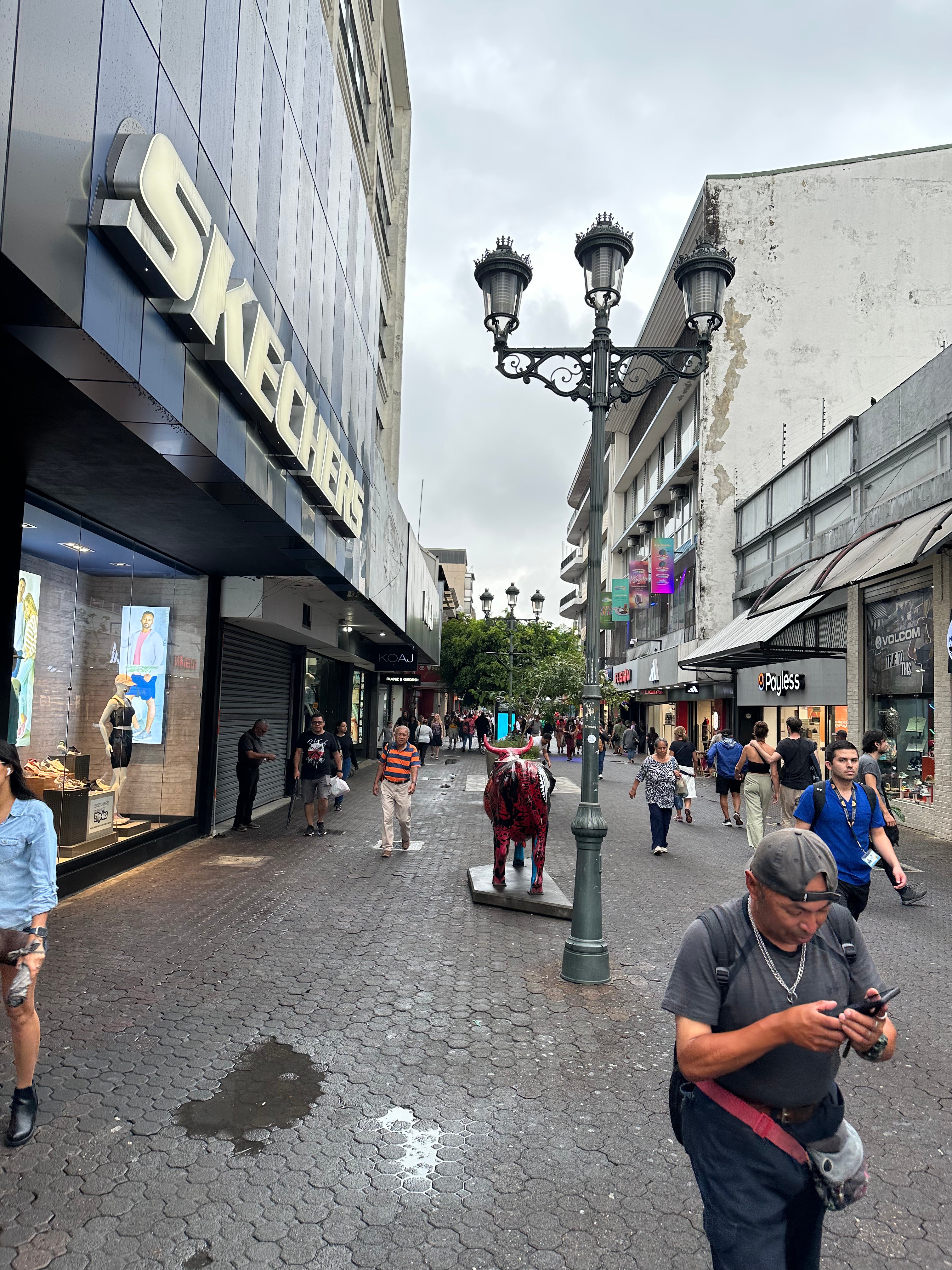
San Jose Downtown (east of Juan Santamaria Int’l Airport)

This trip to Costa Rica is 20 years in the making. The planning started on our honeymoon in 2005. Then the grandkids started coming. And then we retired into an RV and headed out to see the world (the whole “front end” of this blog chronicles much of that). The world got suddenly very small when one son got married and derailed our just-started “round the country” trip. Then we un-retired and moved a few more times. Many more trips around the sun later we finally re-retired and moved to Florida and bought and renovated one house and built another. So here we are, 20 years older and on our third trip alone (there was an unplanned long weekend in Savannah GA in the interim). All of the other intervening trips were with friends and family. I guess we get a honeymoon every 20 years whether we need it or not. We have resolved as a result to not wait even a full year before the next one.

Some of you readers may be travelers or maybe inspired to come to Costa Rica as a result of this blog, so it seems fair to start with some basic acquired travel knowledge. Much of this was gleaned from our natural history museum tour, or via banter with our tour guides and drivers. I say banter because that’s my style. Wendy has a much more journalistic interrogative and tends to get more intimate details. Her exchanges (muy poquito español) with others (poquito inglés) can be entertaining, and I sometimes intervene (um poco mas español) to referee and get a plausible result. The questions are often mis-heard, and the resulting answers have nothing to do with the original query. But we eventually get where we need to be on the give and take, and these tips are the result.

Tip #1: Language. You don’t need any español at all to come to Costa Rica (but if you have um poco, fantastico!) Elementary through High School education is mandatory for all children here; if you refuse to go to school (or are expelled for less-than behavior) you literally go to a labor camp until the day you are 18 (and your parents are in b_i_i_g trouble!).

There is no military here, so as a kid your best shot is to go to school and do well, and the government is dead serious about it. In school, English language is mandatory, and you must pass basic fluency to graduate. There are always slacker students that pay more attention to girls than language of course, but most of the natives speak at least enough English to get you through a simple conversation. And hotels and restaurants are overwhelmingly staffed with English speakers. You can take these Spanish basics to start you out: “cerveza”, “tequila”, and “Donde está el baño?” These should be sufficient for your most critical needs. You can also use “la cuenta, por favor” to sound polite and erudite.

Tip #2: Weather. December through April is the dry season. You may be fairly confidant of outside activities not being interrupted by anything more than a light and brief rain. You can carry an umbrella, but it’s likely just going to be dead weight.

November and May are transition months where you can get some surprise thundershowers, which are brief but very intense (like taking a literal shower). Your umbrella (even a poncho) will be marginally effective; you should just resolve to get wet and dry off after, or duck inside and wait it out. The rainy season from June to October has semi-regularly occurring rainstorms that you might be able to plan around. Sometimes you can set your watch to them. We walked less than 100 meters to dinner one night in a thunderstorm with two golf umbrellas and arrived soaking wet. But since everyone in the restaurant was also soaking wet, it really didn’t matter. The waiter brought us a towel. It is always warm (75F to 95F) and always humid (99-100%), except maybe in the highlands where you are unlikely to travel because the roads are nothing more than semi-paved goat paths.

Tip #3: Clothing. We found that very light, wrinkle free shirts, like my Guy Harvey river shirts or my Dri-Fit polos, are perfect! You can get as wet or sweaty as you like and be dry 10 minutes after you hit an air-conditioned room. Shorts are definitely a solid yes, especially the lightweight easy-dry ones. If you don’t have supermodel legs, long but light pants. Sandals or flip flops are a big YES, but hiking shoes are a must for the treks (the lighter the better, with grippy soles). Water shoes for your aquatic activities, especially for river rafting where you need to stick your feet into a stirrup in the raft to keep from falling over the side. A collapsible umbrella, just in case (we never once opened ours up but came close a few times). A light windbreaker, waterproof is best, you won’t need it for the wind. Cotton tshirts and shorts/pants will stick to you like a wet towel, think Dri-Fit breathable polyester for your best comfort.

Tip #4: Money. The Costa Rican colón is the local currency. The exchange rate as of this writing is .002, meaning 5 colóns is equal to a penny. We met a street vendor who had a huge stack of 5ers and was selling them for US$3 each, making a tidy profit of 9,000% (yes, we bought one, they are beautiful).

You can literally use them for notepaper because notepaper is more expensive. But the US$ is also widely accepted as long as you can do the math: multiply the colón price X 2 and divide by 1000. A 5,000 colón meal is US$10. Easy! You will pass several money changers (tipo de cambio) in customs, but you don’t need to stop. If you do you will likely end up with a giant stack of bills about 100 times taller than the money you exchanged for them. And you can barter better with good old US cash.

Tip #5: Tipping. There are no simple answers here. I asked many sources and got no standard answer. It’s best to think of it as a function of your budget. My loose calculus is: $5 for a driver who helps with your luggage; $5-10 for the waitstaff that delivers your free breakfast at most hotels; $20 for a good tour guide (unless you are sharing him with 4 or more people, then $10); $5 for a cab or transit van driver (plus the fare of course); think about a bulk tip at checkout for the attendants that schlep you around in golf carts and the concierge ($100 for 5 days at our 5 star resort with at least 20 rides); and $5 per night for the maids that clean your room and turn it down at night. Bring a stack of $5, $10 and $20 bills in addition to your credit cards. Nobody takes Venmo that we found. Oh yeah, if you do REALLY good at fishing, $100 for the boat was my call (captain and deckhand).

Thursday, May 1: We launch today and fly from Florida to Costa Rica. This is our first time using the new terminal C at Orlando/MCO. It has a large digital aquarium in the center, displaying a video of manatees today. Meh. Only 2 families with small kids going in, it took up the whole center of the space. There’s has to be a better use of space than some high tech, already-needs-repair multi-screen home movie system.
Our 10AM flight was easy. I always upgrade our seats for the legroom and early boarding. This trip we were surrounded by a crowd of 40-somethings going together on vacation, and the free drinks part of the upgraded section got a good workout. The Goliath-sized guy across the aisle was nearly comatose after the 3-hour flight, but thankfully he was a happy drunk. We were heavily outnumbered, and their chatter indicated that they had an extensive warm up in the bar for breakfast. Pura Vida!

At arrival in San Jose, immigration was 15 lines wide, and about 10 people deep, and this was at the end of a Disney-style winding line. When you get to the front of the snake line, you get to choose your kiosk line, and you guessed it, the one we chose was the slowest. Even when we jumped left and right, we only fell more behind. But, hey, Pura Vida, right! We were on Costa Rica time (aka Mountain Daylight but has about a 20-minute plus or minus window for “on time”). And yes, they do ask where you are staying, and for how long, so be prepared. Many of those in front of us weren’t, with lots of digging through purses and even luggage for information.

We opted to stay at the Doubletree near the airport and had a private transfer arranged. We were cautioned to pre-arrange this transportation because there is a very large and boisterous transportation industry at work at the exit from customs, and much of it is “bootleg” or un-regulated. Cabs are available, but make sure you are in an actual cab stand with an official sign.

Our driver held a small whiteboard with our name on it, and in no time we were in his air-conditioned (thank you God!) van and off to the hotel.

We arrived early, about lunch time, but the hotel had been notified by Pacific Tradewinds and had our room ready. We didn’t upgrade this room since it would just be a convenient place to stay on arrival before we were whisked off into the country.

After check in we took what was supposed to be a short walk to a local market to acquire a few pieces of fruit (a morning wakeup necessity) and some toiletry items.

When you miss that small right turn and go left instead, it’s easy to walk an extra mile or so until you realize you literally “just missed” the market. In 90 degrees and 99% humidity this point is driven home quickly. We tripped across the market while navigating a short cut back to the hotel, got our items, and made a beeline for the pool to commiserate.

Friday May 2. Our original itinerary had us overnighting in San Jose near the airport, then taking a tour to a coffee plantation for breakfast and a park the next day. That tour had us in a car for 6 hours, and we blew it off to take a 5-hour walking tour of the old city of San Jose instead. The notes about the tour recommended “rain gear or an umbrella”. Umbrella is the clear winner here. While on our way to the tour start in the small transit bus (included in the price of the tour, a good Pro Tip), the skies opened up. It must have rained 2 or 3 inches in about 30 minutes. Several streets were flooded with 6-10 inches of water. We had a party of 5 and our tour guide modified our schedule to put us on inside venues for the first 2 hours and that strategy paid off handsomely. The rain quit, and we got a nice long walk through the center of the city, mostly in the Central Market area.
Pedro, our guide, was quite a character. He gave us the historical, the hysterical, the cultural, and the reality-check views of San Jose and Costa Rica in general. Population? Officially 5 million, ½ of them in San Jose. But there are also 2 million more illegals, who are either fleeing south from Nicaraguan poverty and oppression or transiting north from Panama toward the southern US border. But the US border has slammed shut, and many of the northern-bound transients have just been frozen in place. 2 million more mouths to feed and house is a lot for a population of 5 million. Luckily, about 20% of the official 5 million are expats from the US, Germany, Spain and France, and they, along with tourism, bring a lot of cash into the economy. So, somehow, it works. It certainly hasn’t spoiled the natural beauty of this place, or the overwhelming friendliness of the people. Pedro pointed out some street beggars and a few small homeless encampments, and while we aren’t used to this in Florida, Los Angeles and Seattle have Costa Rica beat hands down on blue tarps and tents. It isn’t even close. I think even Denver wins this one.
And who knew that Costa Rica went to war with America in 1856? Well, not officially. In the nineteenth century, Costa Rica didn’t have much of an army. (Even today, they don’t have an army at all, although they have a Policiá Nacional charged with keeping order.) That may have encouraged the thinking of William Walker, an American filibuster who sought to use his own army to establish slave states in Costa Rica and Nicaragua to take advantage of the lucrative coffee plantations and marketplace. Walker’s forces, though made up of Americans, acted independently and were not an official U.S. military force. This conflict is known as the Filibuster War (1855–1857). The natives of both Costa Rica and Nicaragua rallied and Willy lost, of course, as did slavery in the Americas. And something else we never knew, the original plan for the central American canal between the Caribbean and Pacific coasts was along the river that separates Costa Rica and Nicaragua, 100’s of miles north of the final location in Panama. If you study a map, like I did, you might scratch your head and wonder why that location wasn’t better. It would have required way less canal building. There must have been some other geopolitical persuasion, like a plethora of armed civilians left over from the Filibuster War.
How about that bit about not having an army? Costa Rica’s last civil war featured their small army siding with the government and ½ of the population against the other ½. So, when that ended in 1948, the victorious National Liberation Army, under José Figueres Ferrer, formed a new government much like the US model: three branches, an executive with an elected President; an elected legislative; and a judicial (elected and appointed). There are 3 political factions in Costa Rica (like many Central and South American countries), the communists, the socialists, and the capitalists. A compromise between them was reached on the new government’s charter, taking a little from the commies (social security), some from the socialists (land preservation and public ownership, education and sustainability), and the rest from the capitalists (free markets, easy taxation, small government, and a stable currency). But nobody wanted to have an army anymore because of the bad taste the last one had left them. So far, so good, but time has a way of testing these choices very thoroughly. By the way, this last tidbit of history lesson was compliments of Adrès Morera (Andy), our tour guide at the National Park. More on him later.

When we travel we typically eat our way through a country as the true test of its cultural richness. We ate at the Doubletree the first night, sharing 3 small-plate traditional meals: Costa Rican tacos (similar to taquitos but with highly flavored beef filling), a beans, rice and salad plate with mayo and ketchup dressing (the local equivalent of thousand island), and shredded chicken empanadas (which were excellenté!) The second night we went to a Mexican place and tried the locals take on traditional Mexican tacos, and they were really good. So far, the food scores a 10.

Saturday May 3. Today we go by private car to our next destination, Arenal Springs Resort & Spa, just 4 miles directly north of Volcán Arenal, the most active and prominent volcano in Costa Rica (there are 7 active ones and about 200 dormant ones). Our hotel is built around a natural volcanic hot spring, with four pools of different temperatures from 97F to 104F. The mineral content of the water is said to have powers of rejuvenation; we are determined to give them a serious test.

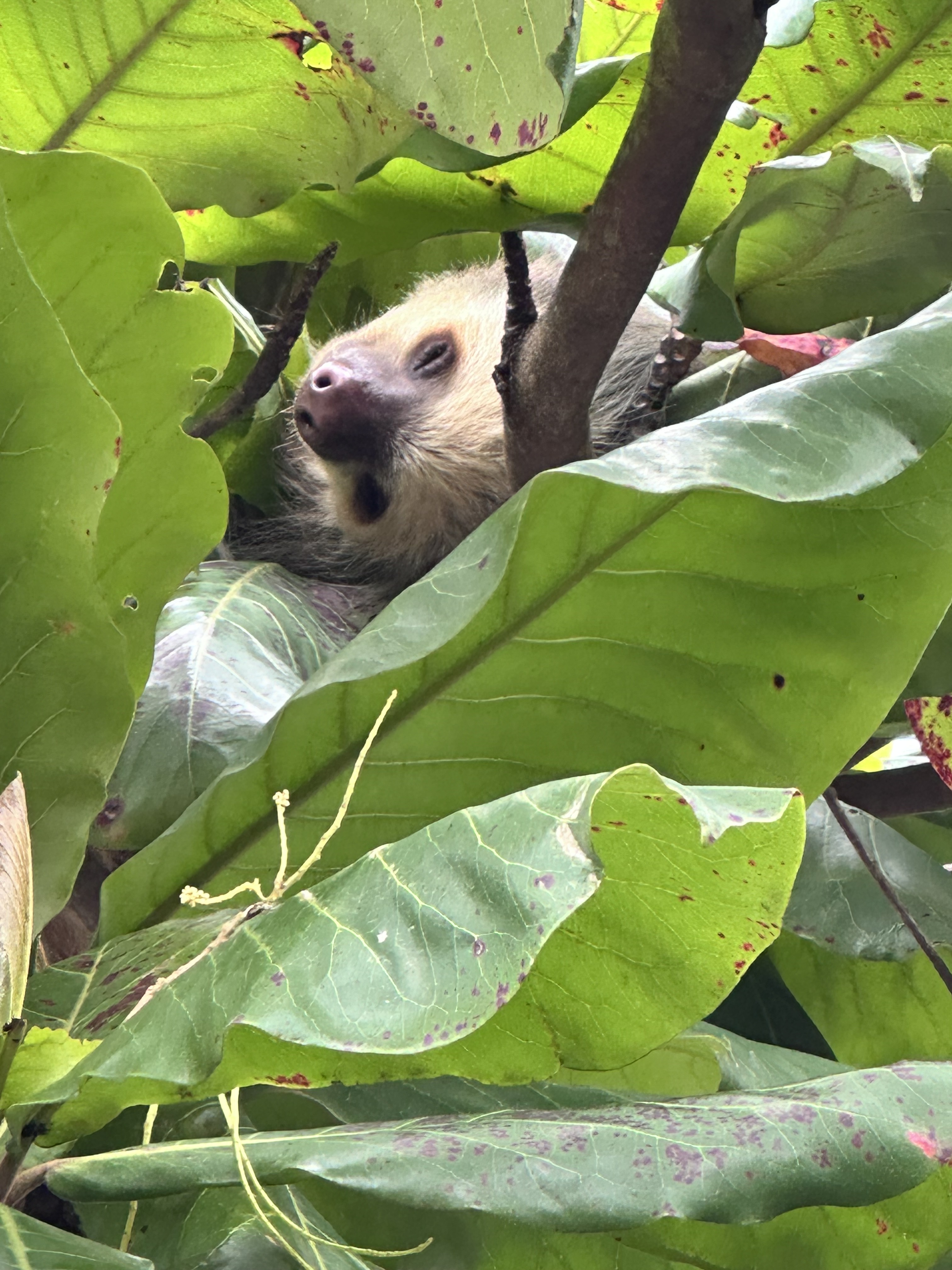
The 3-hour drive is surprisingly populated with small towns along the entire route. I guess the 2½ million that don’t live in San Jose all live pretty close to the roads through the country. Our driver fashions himself to be a protégé of Parnelli Jones, but maybe this is just the “Pura Vida” way as the roads constantly look like a giant-scale pinball machine. Amazingly, we saw no collisions, but lots of high beams flashing as our driver overtook other cars, trucks, bicyclists and even pedestrians walking double wide on the side of the road. Along the way our driver pulled off the side near a fruit stand and in his “sufficient” English waved us over to a tree where a mother and baby sloth were sleeping.

This is the momma sloth, soundly sleeping with her “resting happy face”. Her baby was nearby, also asleep but not too visible

Sloths are a national icon of Costa Rica, and we expected to see them everywhere, but we are very fortunate for our driver pointing them out as it would turn out to be a several days-long sloth-free streak for us. We spoke to lots of people who had been here for a week or longer that had yet to see one “in the wild” (there are “sloth parks” where you can go to see them).

There are farms as far as you can see, and they look to be small family affairs. We are told that rather than fences, the families mark their boundaries with rows of madero negro trees, also called Quick Stick because you can break off a branch, stick it in the ground, and in a week or so a new tree is growing. They grow quickly and need no care, and we see tens of thousands of them planted close together in straight lines to mark the fields. Some are planted so close together they act like a fence to keep the dairy cows corralled.

There is a stark difference between the city and country. The cities, more densely populated and also more attractive to those without housing or very much income, have lots of slum-like areas with small shacks with tin roofs. These tend to be in cheap land areas close to highways, so they are very visible while you are traveling about in the ciudád. In the country, things are clean and orderly. The houses look well cared for, the small markets are cheerful and colorful, there is much more greenery. The country feels much more like the Costa Rica we imagined, and the pace of life feels much less stressful. There is a lesson lurking in there for us gringos.

Next up is our stay at the Arenal Volcano! Pura Vida!

Posted in Costa Rica | Tagged , , , , , , , , | Leave a comment

HAIKU TO A POWER POLE

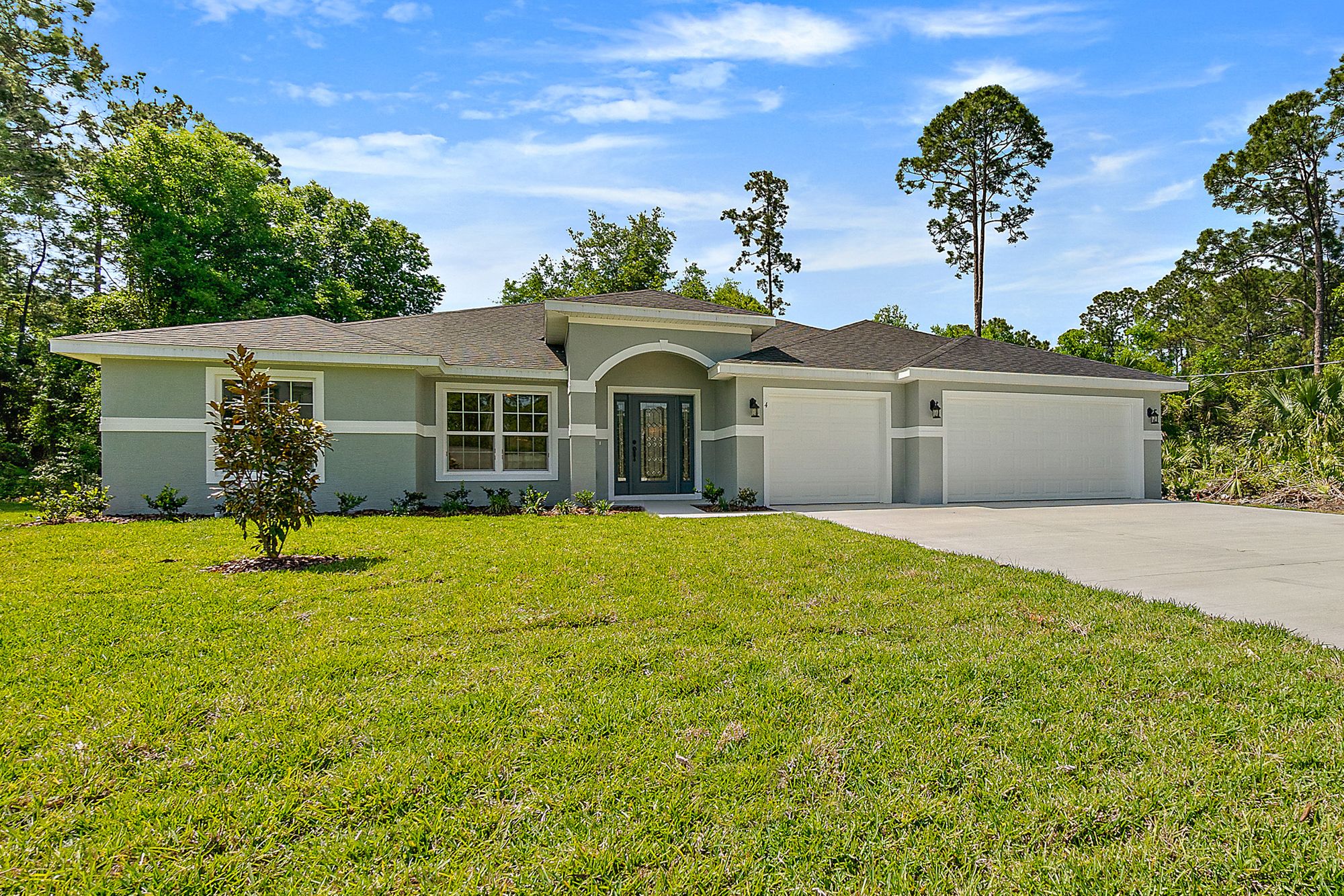
It’s been a while since we posted anything about the progress of the new Mudd Abode, the house we are building in Palm Coast. This isn’t by design, it’s more by laziness + lots of other stuff going on + lack of large amounts of progress on the build. The desired end result when it’s finished will look almost exactly like the sales brochure.

Building a house takes a lot of materials, a lot of labor, and a lot of time. On the part of the homeowner, it also takes a lot of patience. We already knew at the outset that there would be delays when they piled on the schedule caveats (“supply chain difficulties”, “labor shortage”, “permitting and inspection issues”), things they “had no control over”. The initial calendar provided by our builder was 16 months from the signing of a build contract (which happened on October 7, 2021) to final occupancy. This gave us an initial move-in target date of February 7, 2023. We generously added 3 months to that and set our expectations on mid-May 2023.

Then inflation ramped up and the Consumer Price Index headed for the moon, which triggered a clause in our build contract that required us to pony up an additional $40,000 to cover the increased cost of materials, primarily lumber but also virtually everything else needed to build our new nest. Then a tornado hit the large factory in Georgia that supplied about a dozen southeastern state contractors with their HVAC components. This turned out to be the only factory supplying these components, and it was damaged bad enough to put it out of business for at least 2 years. All home-building in Florida, and many surrounding states, took an immediate schedule hit. Our hopes faded for the May date, and our checkbook balance faded with the CPI hit. But we kept our spirits high.

While many times it looked like our project was hopelessly stalled, our builder, Seagate Homes of Palm Coast Florida, managed to scrape together enough labor and materials to keep their projects moving. They build about 250 homes a year (5 a week if you need the math done for you), and we supposed that they must have some serious clout. The start-stop-start progression kept us on a roller coaster and kept Wendy diligently texting our Construction Manager to let him know we were watching, and please don’t forget that we know the squeaky wheel usually does get the grease.

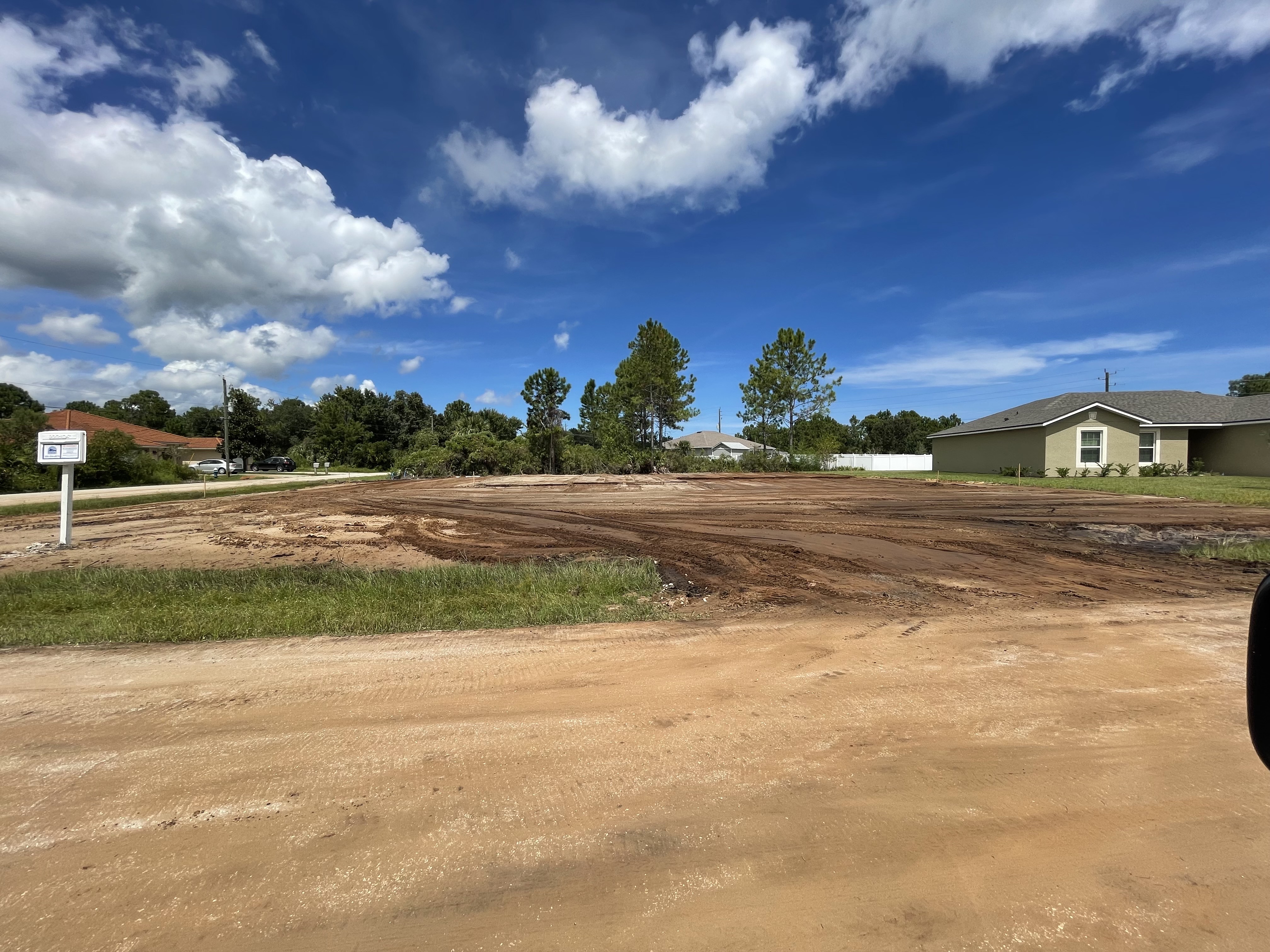
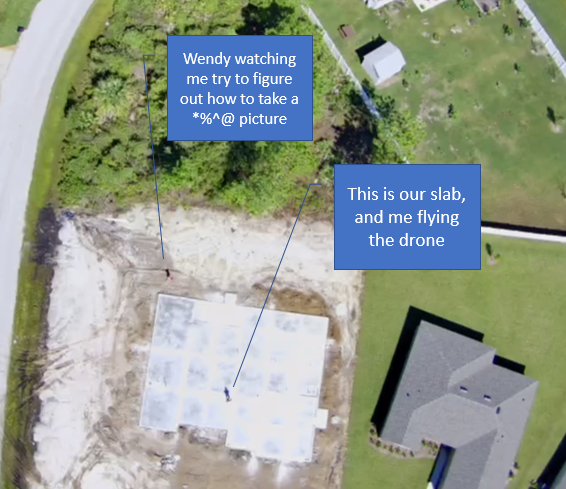
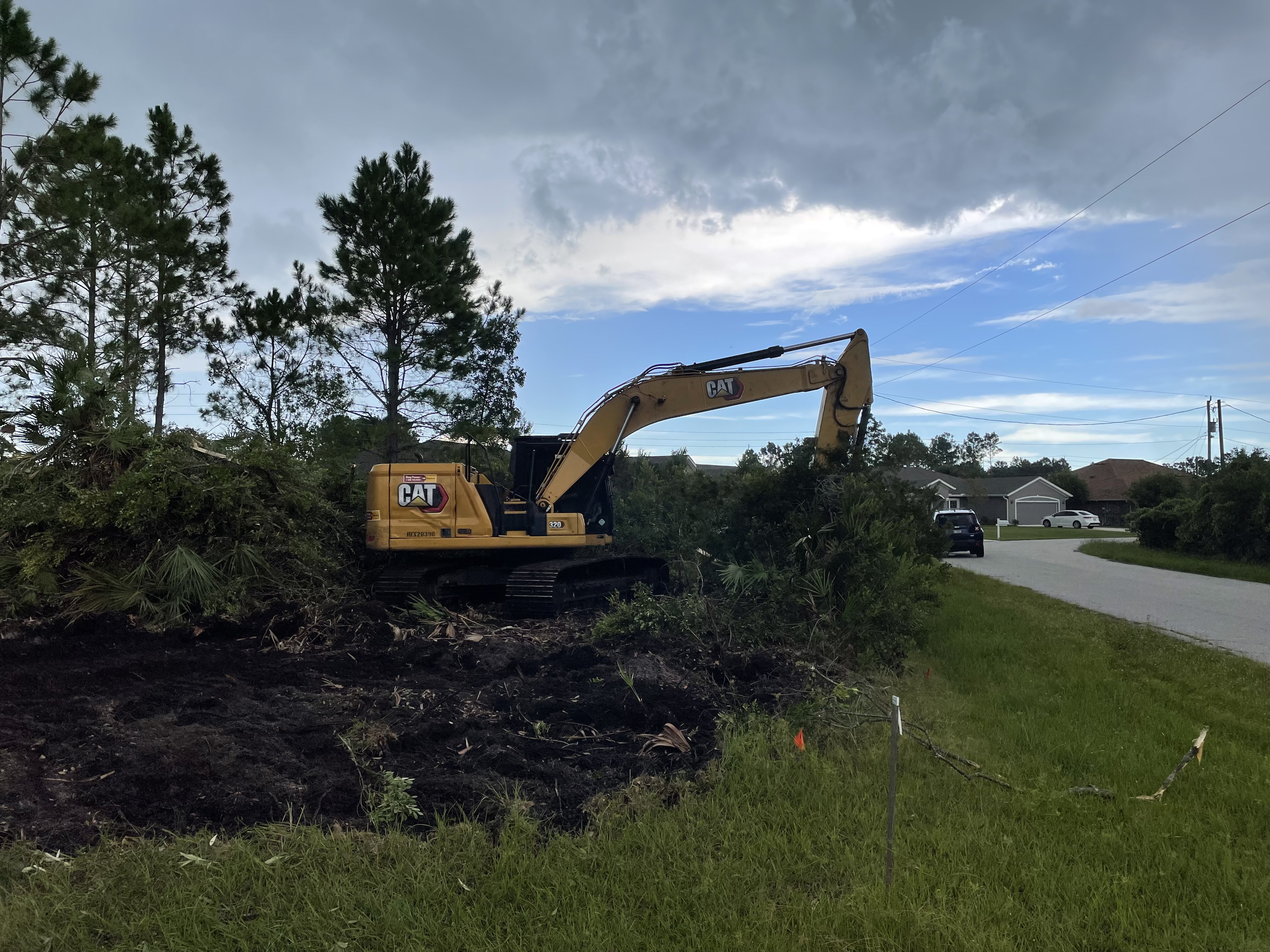
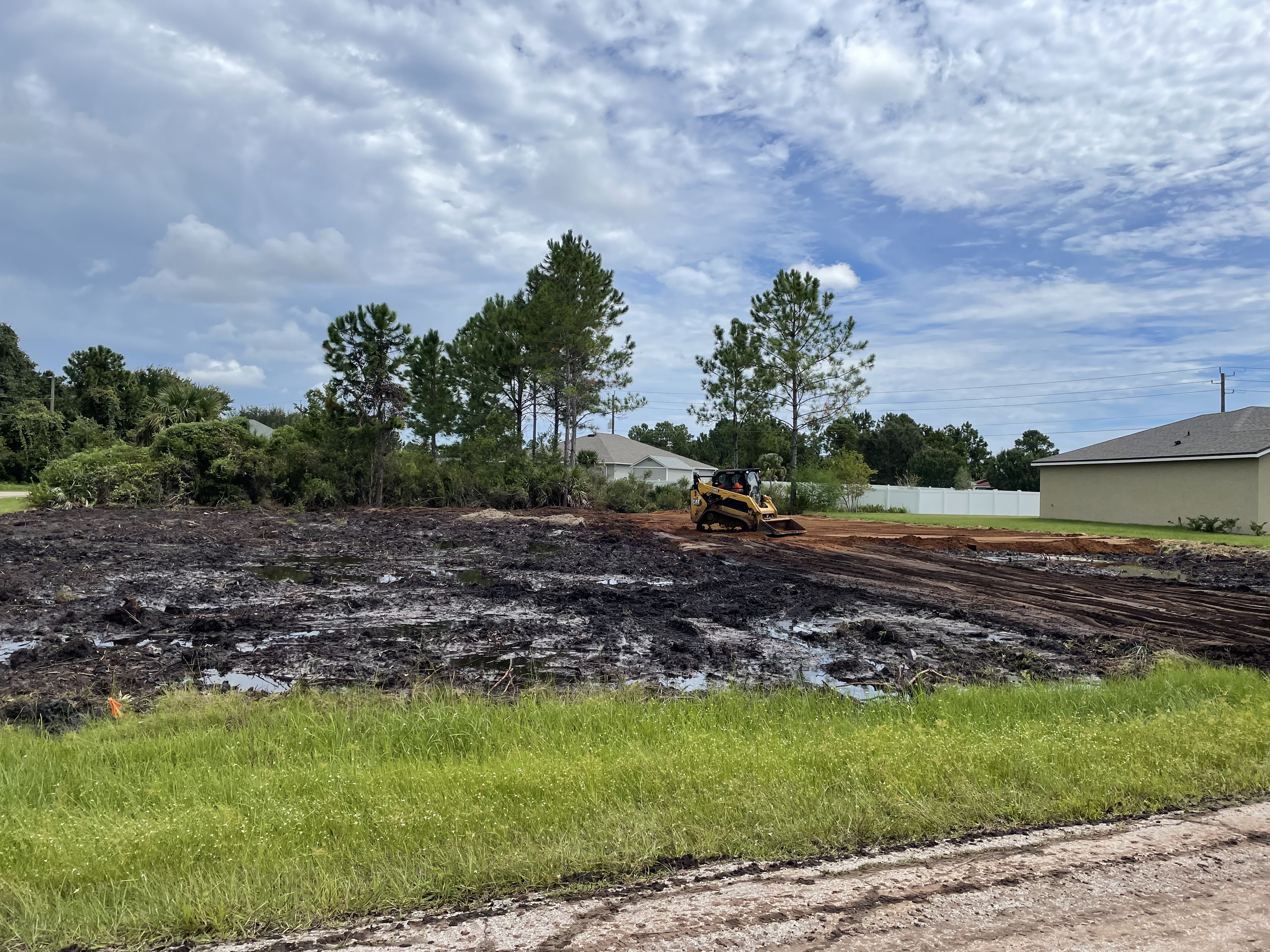
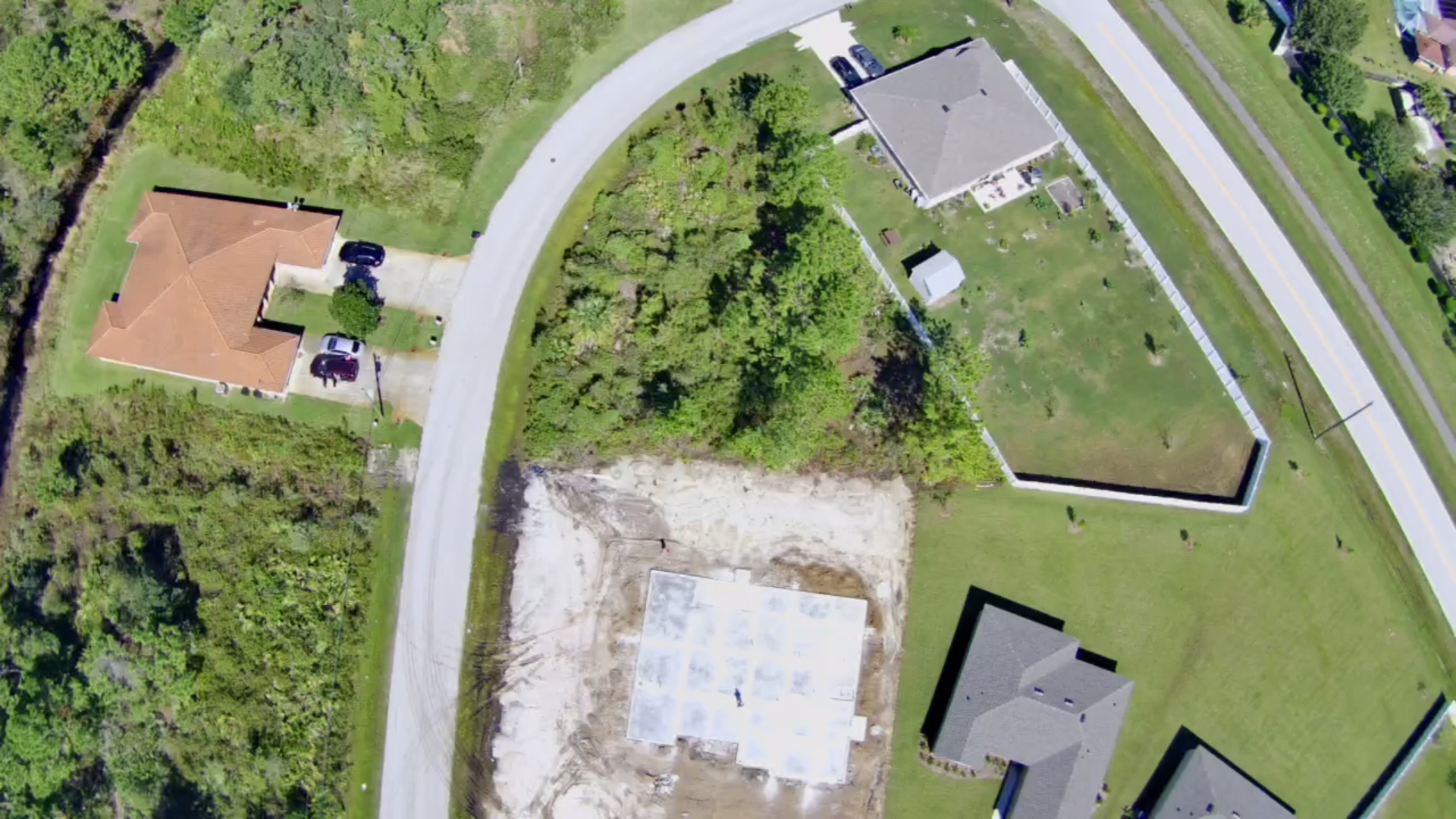
Weeks would pass without so much as a new footprint in the soil on our lot. They initially scraped the jungle off the lot in July of 2022, and the visual impact was stunning. Wow! We’re finally off to the races. This was followed pretty quickly by a guy with a Bobcat tractor and many truckloads of clean topsoil that rendered a flat, elevated building pad like we had specified in our contract.

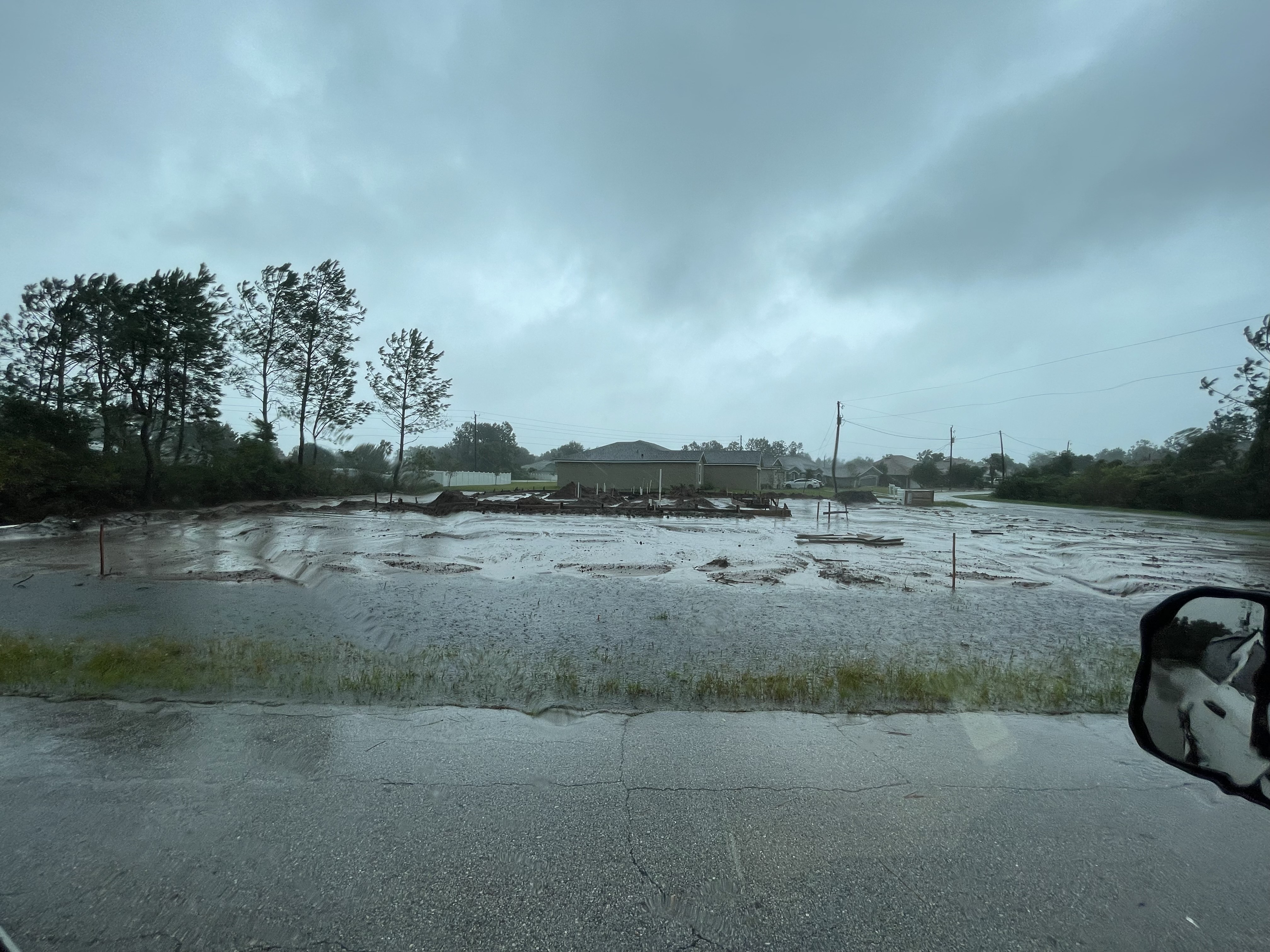
Then hurricane Ian hit, and we got 17 inches of rain in 24 hours. Bummer, we thought, we’ll have to start all over again. Our building pad didn’t flood, in fact our neighborhood came through it pretty high and dry. But the pad that had been graded and compacted didn’t like all that rain, and it looked sad.

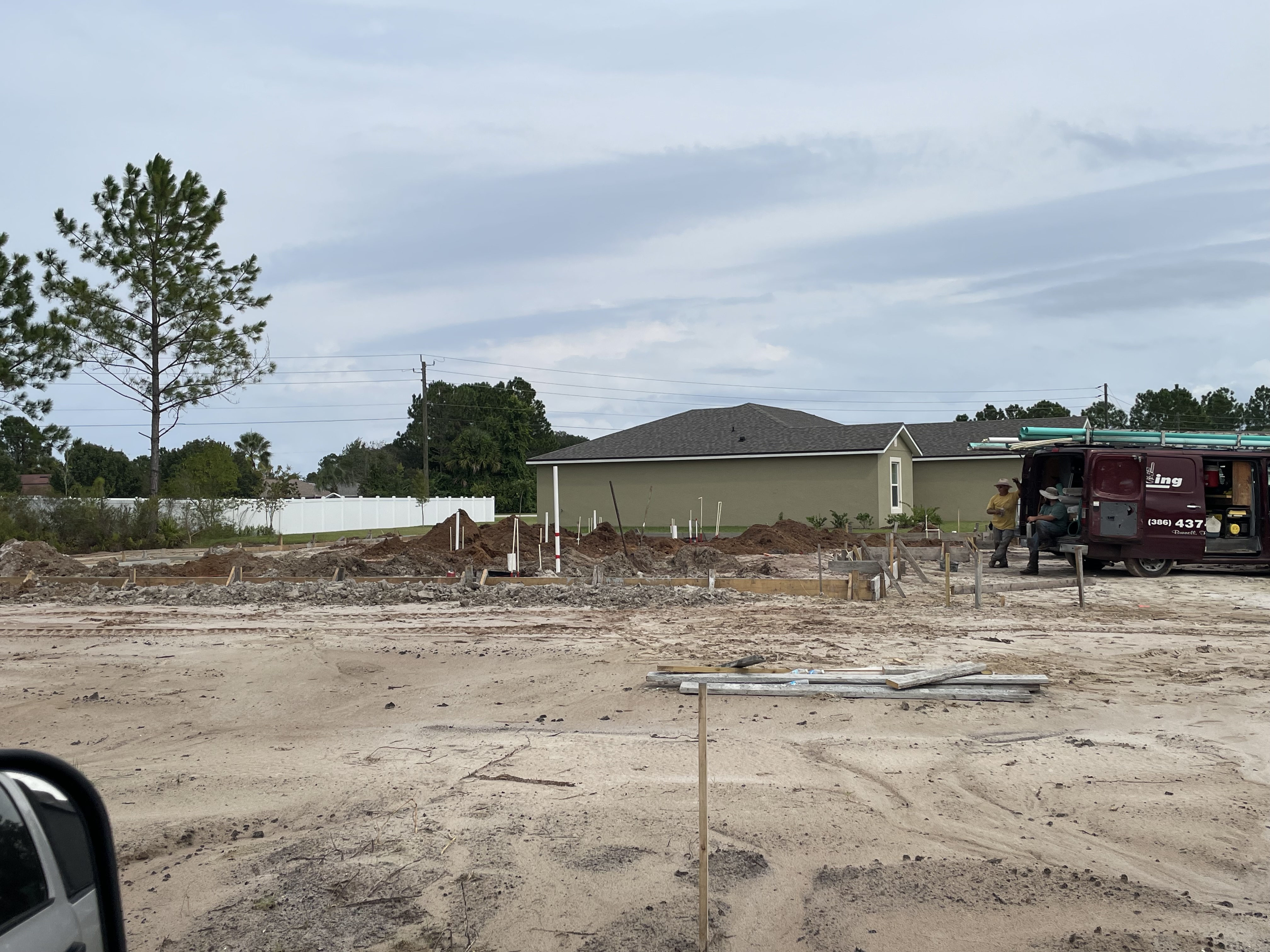
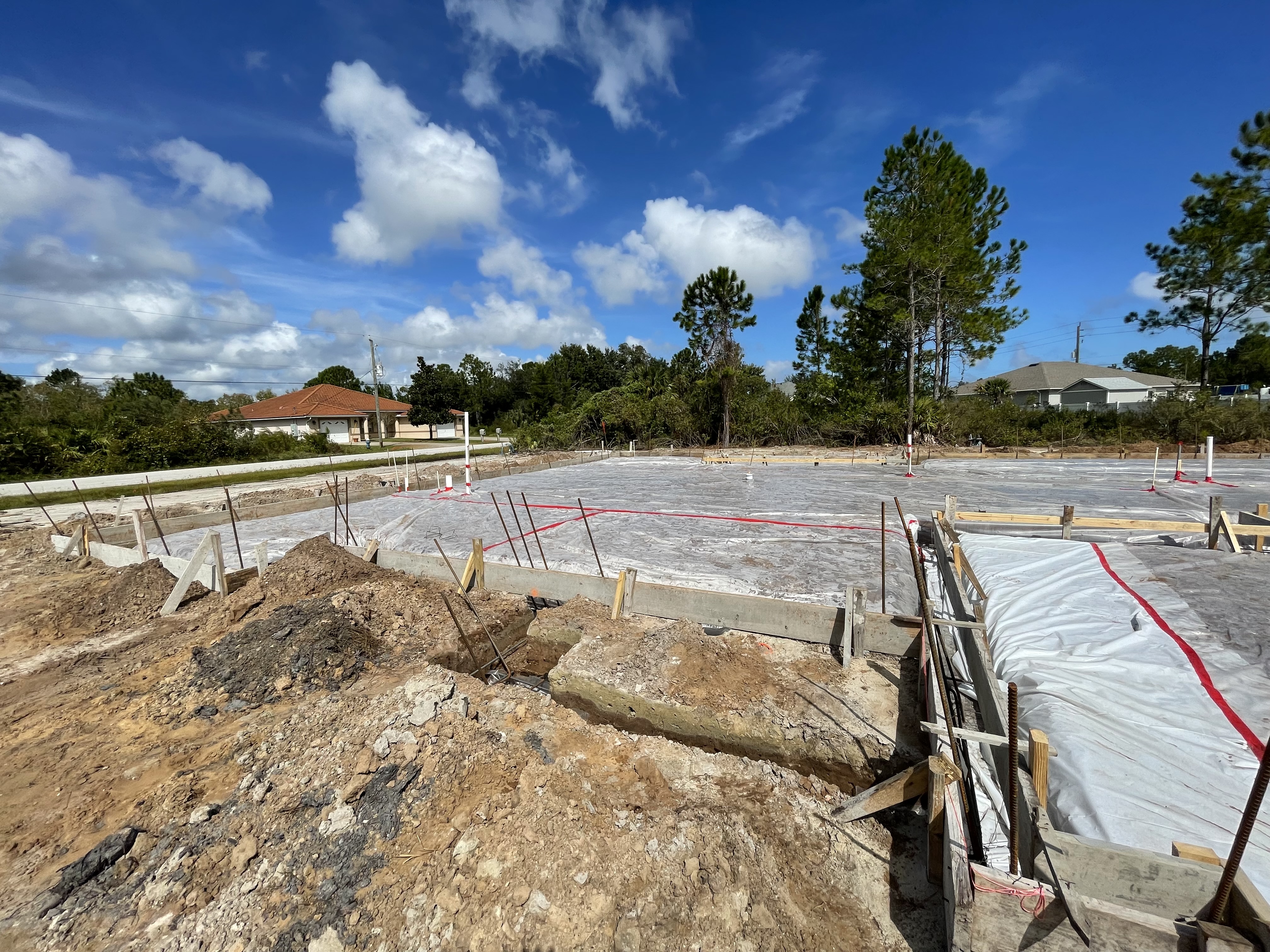
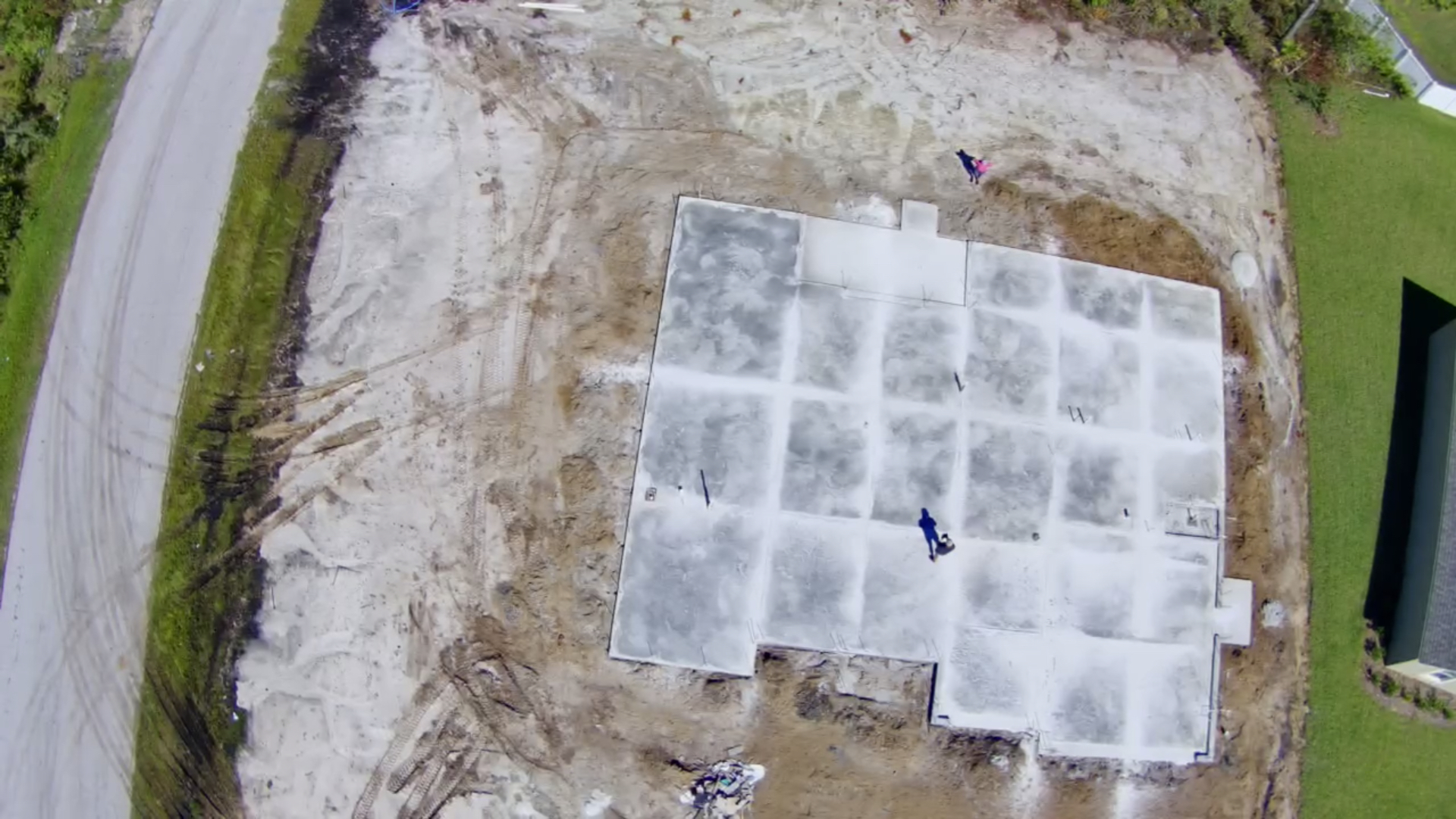
Our spirits soared however when a few days later, Bobcat Dude was back, and the pad was quickly resurrected so that an army of workers could attack it and place all the concrete forms for the foundation slab. The pace seemed dizzying as the forms went in, the plumbers got in to put all the under-slab plumbing and conduits in, the pad was re-graded and ready for concrete. Life was good again.

When the building is going fast, life is good. When Hurricane Nicole hit a few weeks after Ian, life was not good. Nothing puts a hit on your building schedule like back-to-back hurricanes. This is first-hand knowledge. Nicole, however, was not a Varsity team hurricane and didn’t produce the havoc that Ian did. She did, however, put a hit on our project.

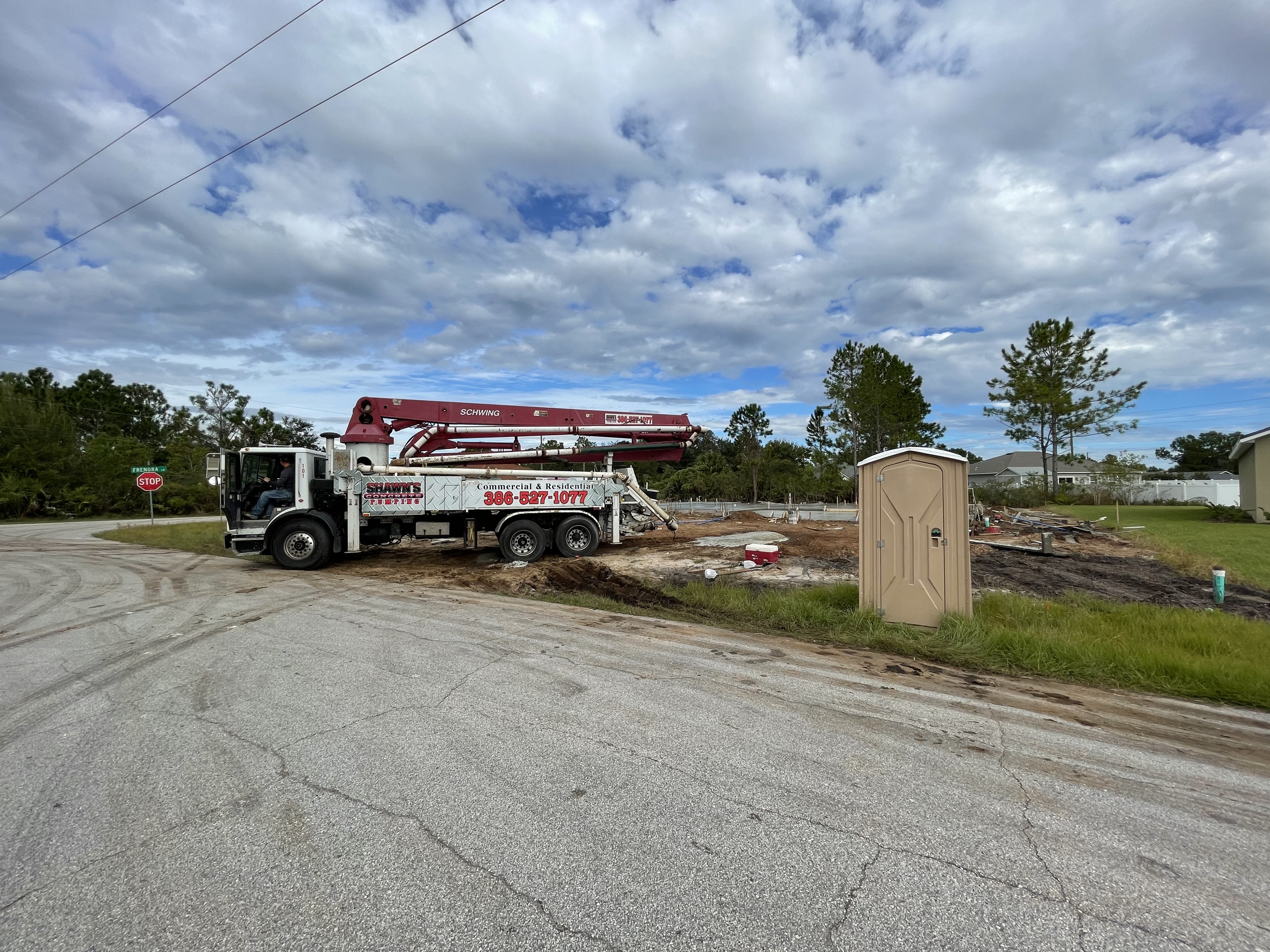
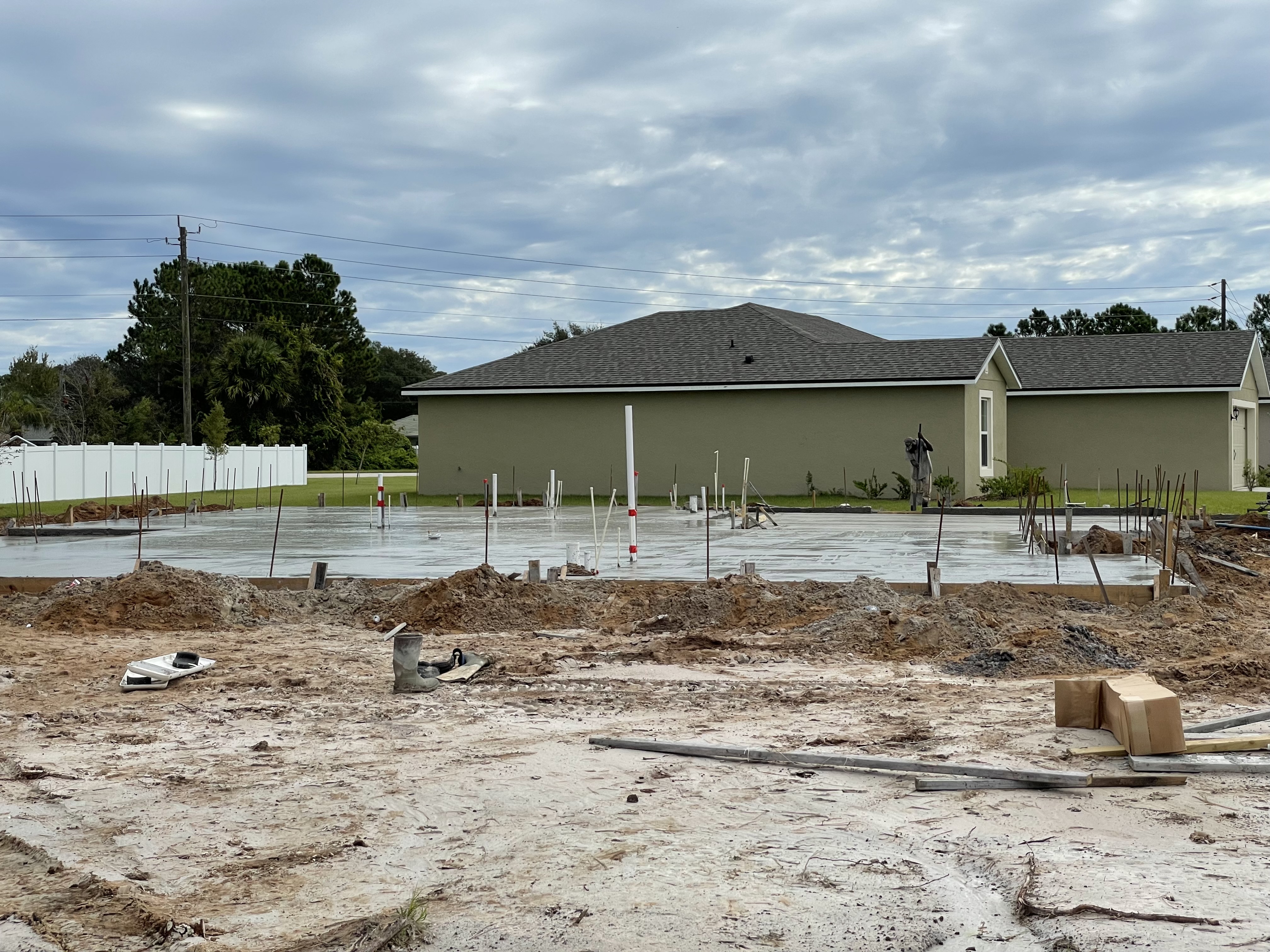
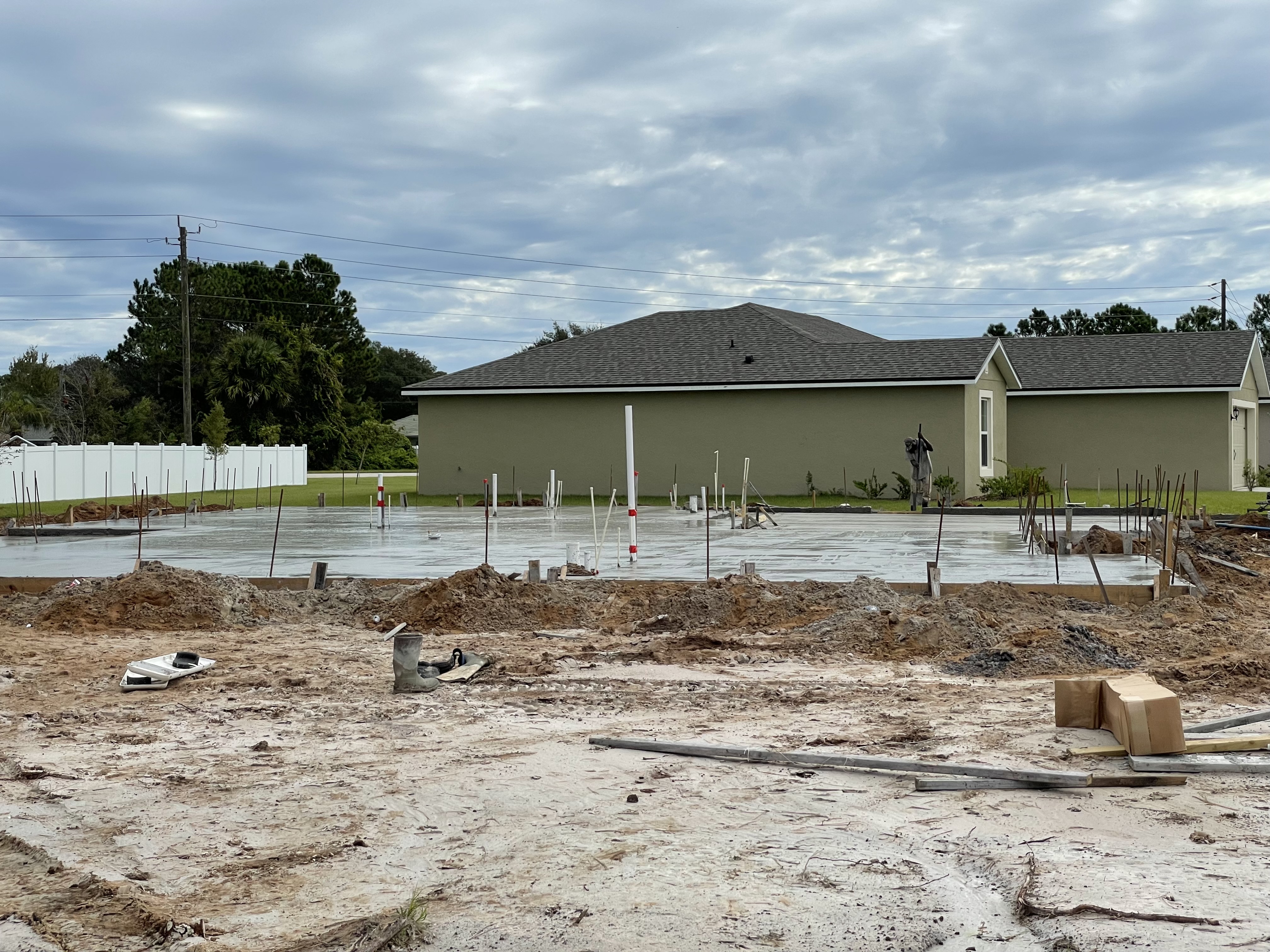
The concrete crew didn’t see it as gloomy as we did, though. And a week later they had cleaned it all up and regraded, and before long the big concrete pump truck appeared along with another army of workers in black dairy boots that produced an absolutely beautiful foundation in no time at all.

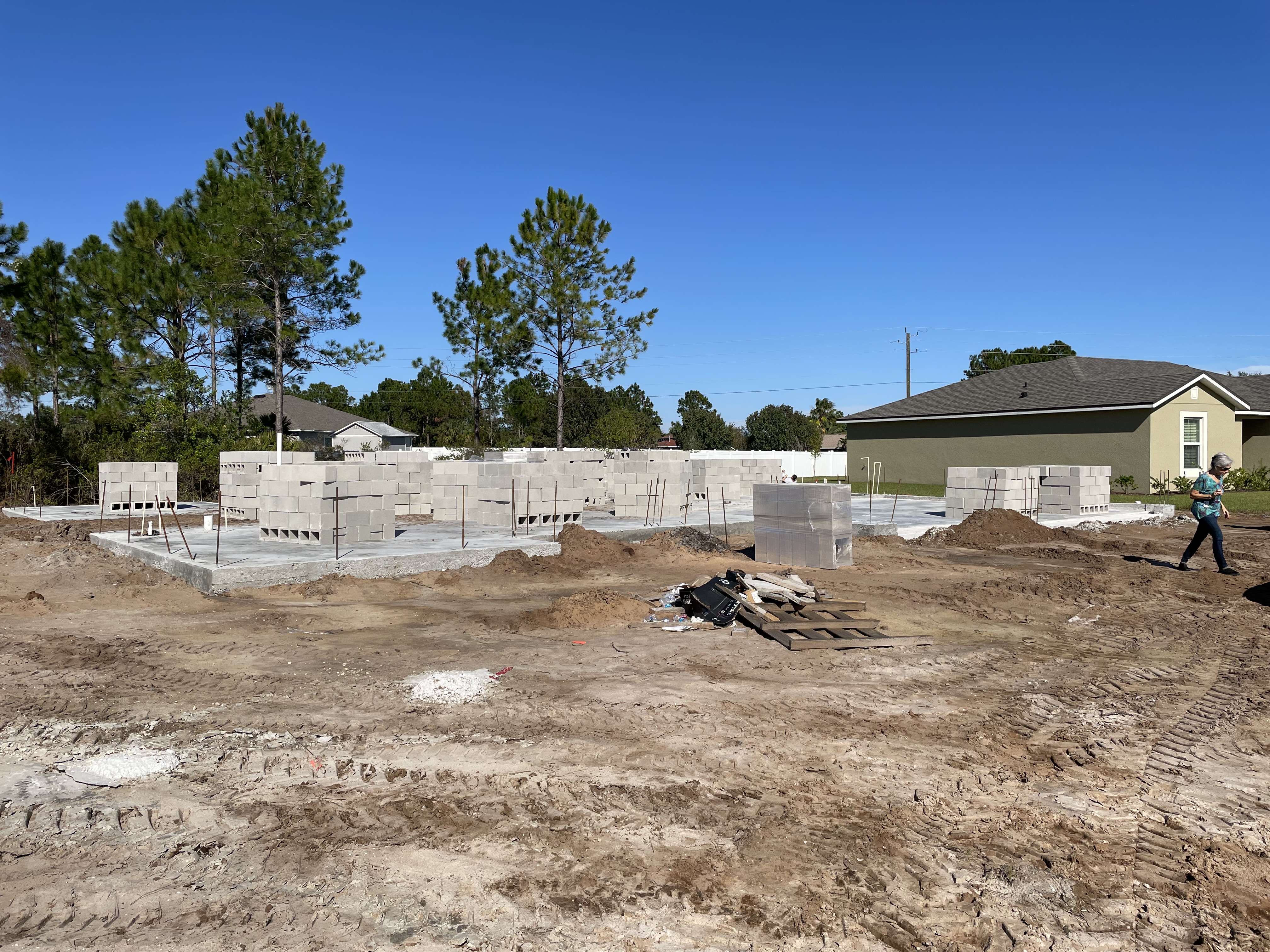
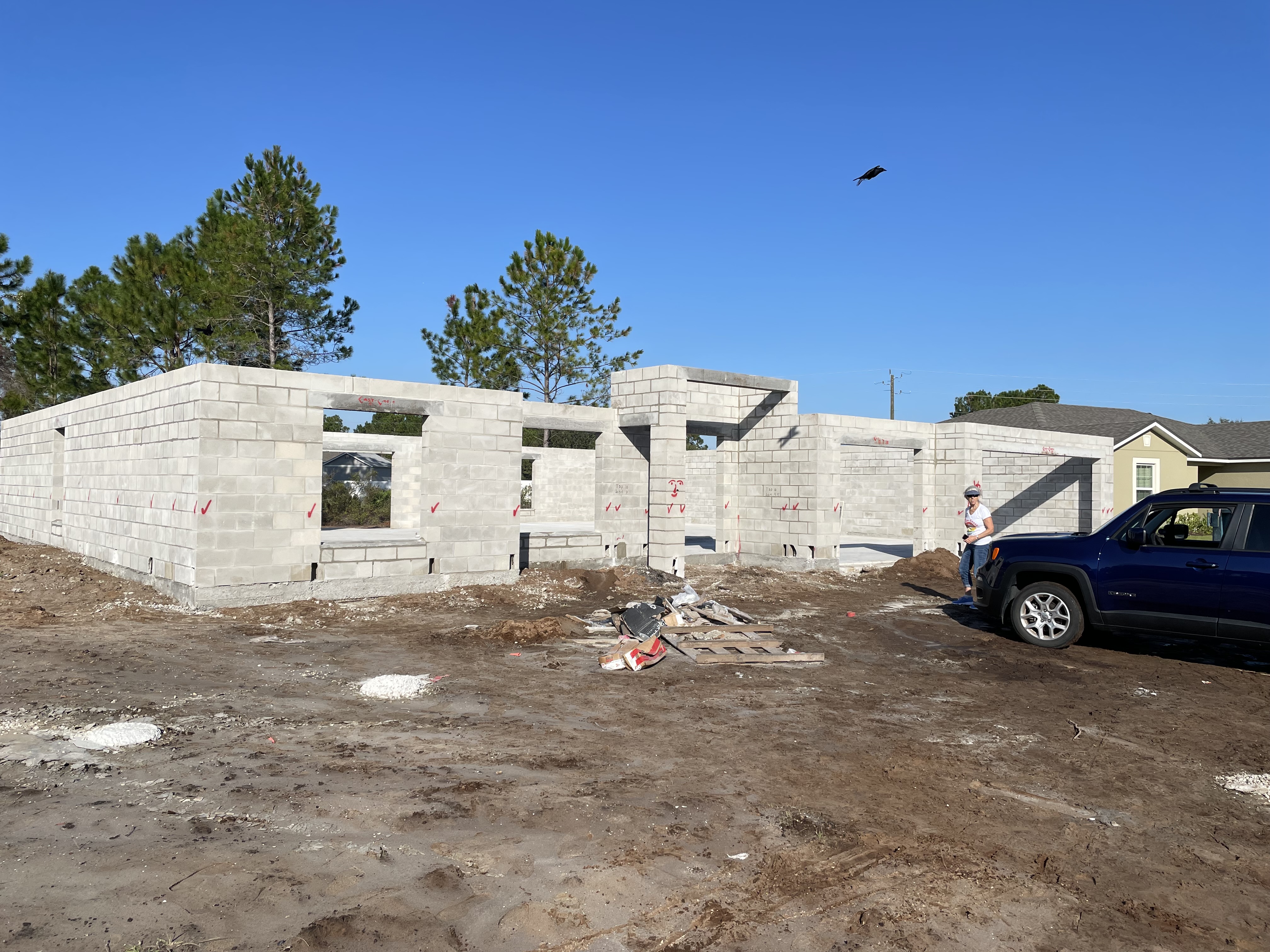
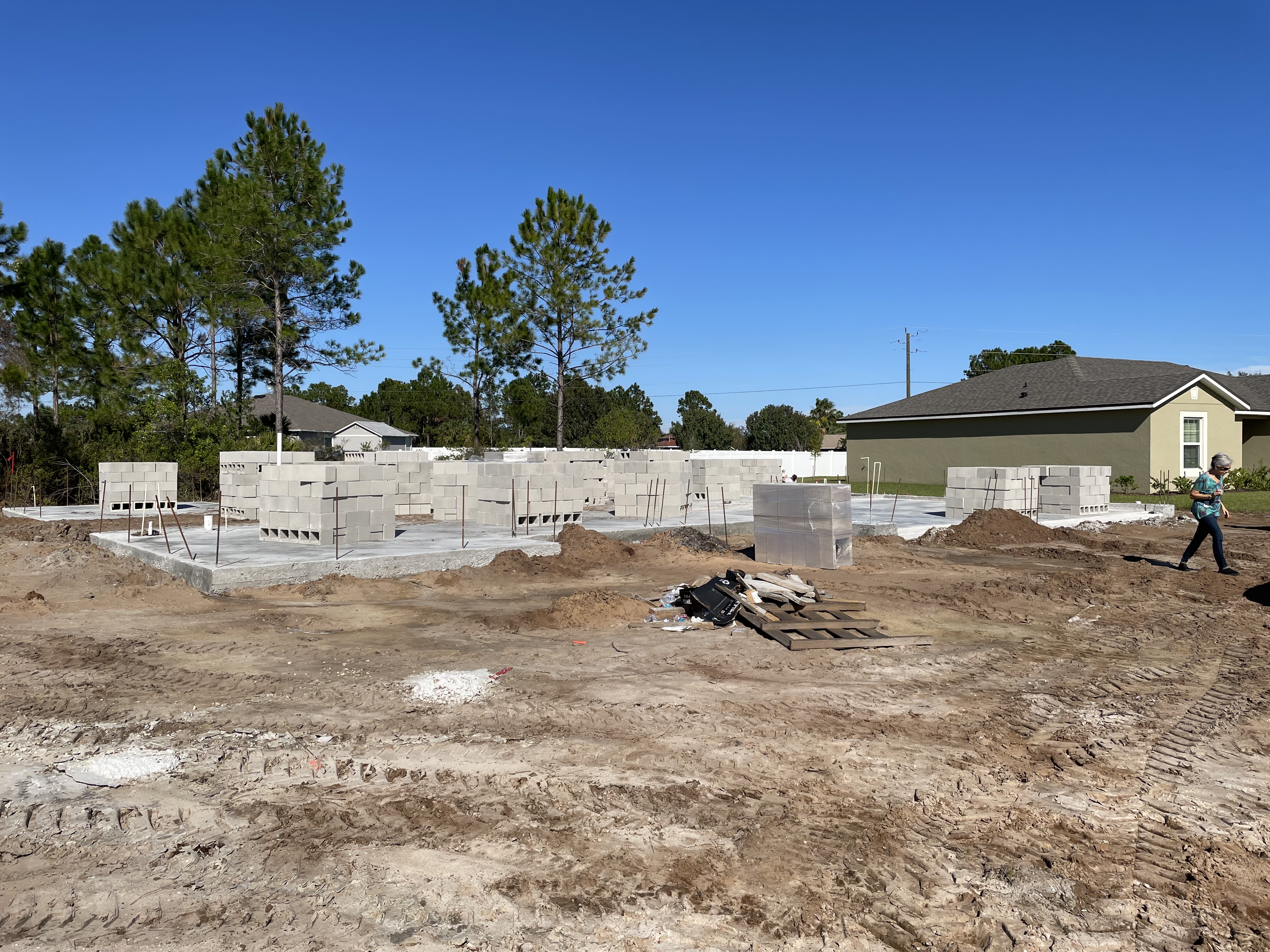
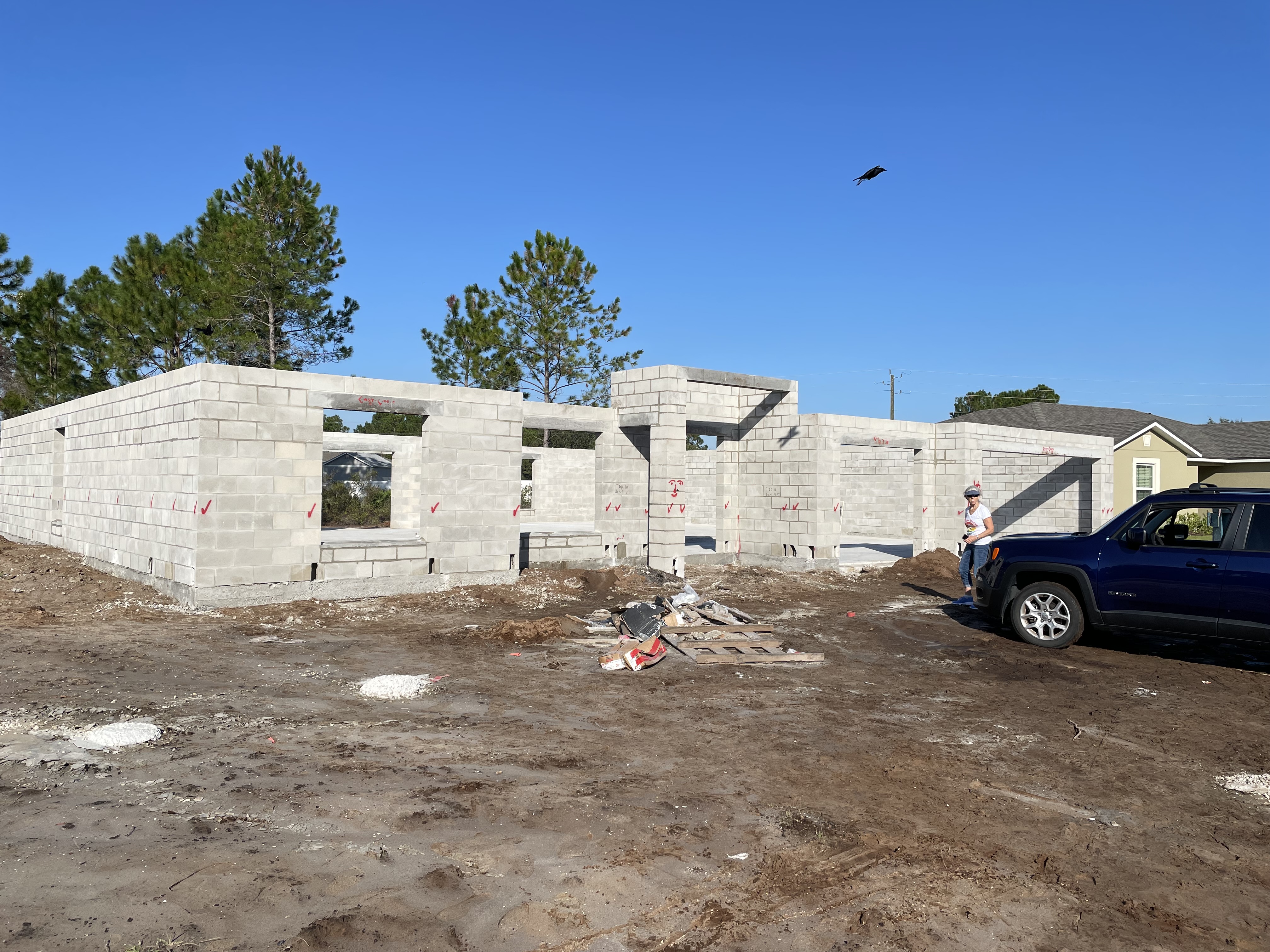
Things got back to normal pretty quickly. It wasn’t long before big stacks of cinder blocks appeared on our slab, and then they too sat waiting for some labor. We eventually “went vertical” when a small army of brick layers descended and turned the cinder blocks into exterior (and hurricane-proof) walls.

And it wasn’t too long after when a truck full of roof trusses (also hurricane-resistant) and framing lumber showed up and dropped it all in our eventual front yard. Then, more waiting. And more waiting.

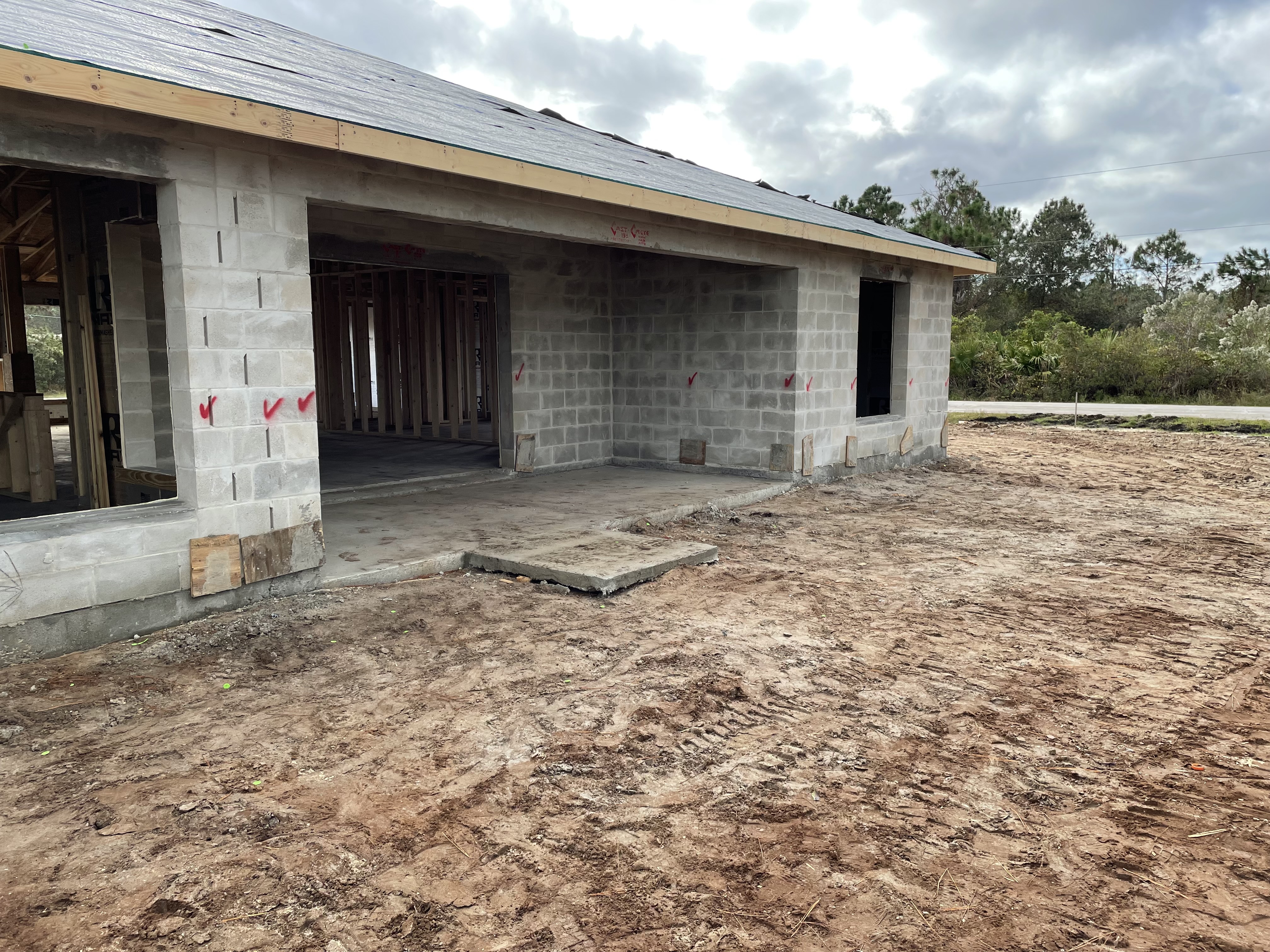
And then one day we drove by to take a look, and the lumber pile had been magically transformed into interior wall framing and trusses ready for plywood sheeting and shingles. It shocks your system to see that much apparent progress at one time. Your brain begins to think “wow, they’re really pouring on the coal and sprinting to the finish line!” “I should start getting ready to move!”. This is not logical thinking, and Murphy’s Law of Building Houses will be imposed to put those thoughts to rest. Murphy will send you to the House Building Waiting Lounge and impose a 4 week pause in any perceived activity to punish you. But, in reality, there are lots of things happening behind the scenes that we are never privy to. I have to believe that.

Over time you get a little used to the pace of the build process. A flurry of activity followed by dead silence, followed by a small, barely noticeable thing like a plumbing fixture being installed, then dead silence, followed again by a huge pulse of activity. It’s like doing emotional calisthenics, without any apparent beneficial aftereffects. Seagate has diligently plowed ahead over the last few months, and we are now at a state where the list of things our Construction Manager has to tell us “we are waiting on” is getting small.

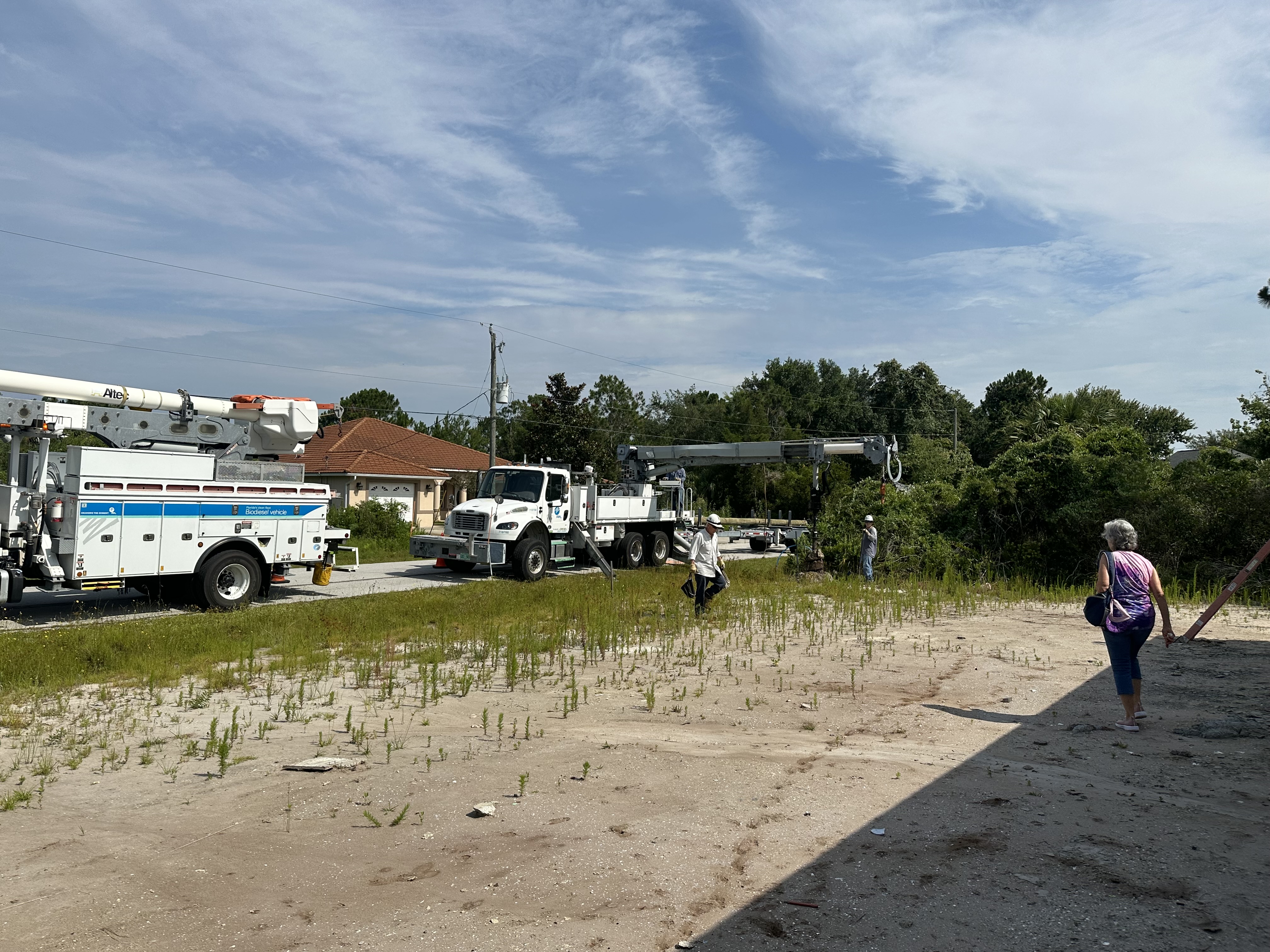
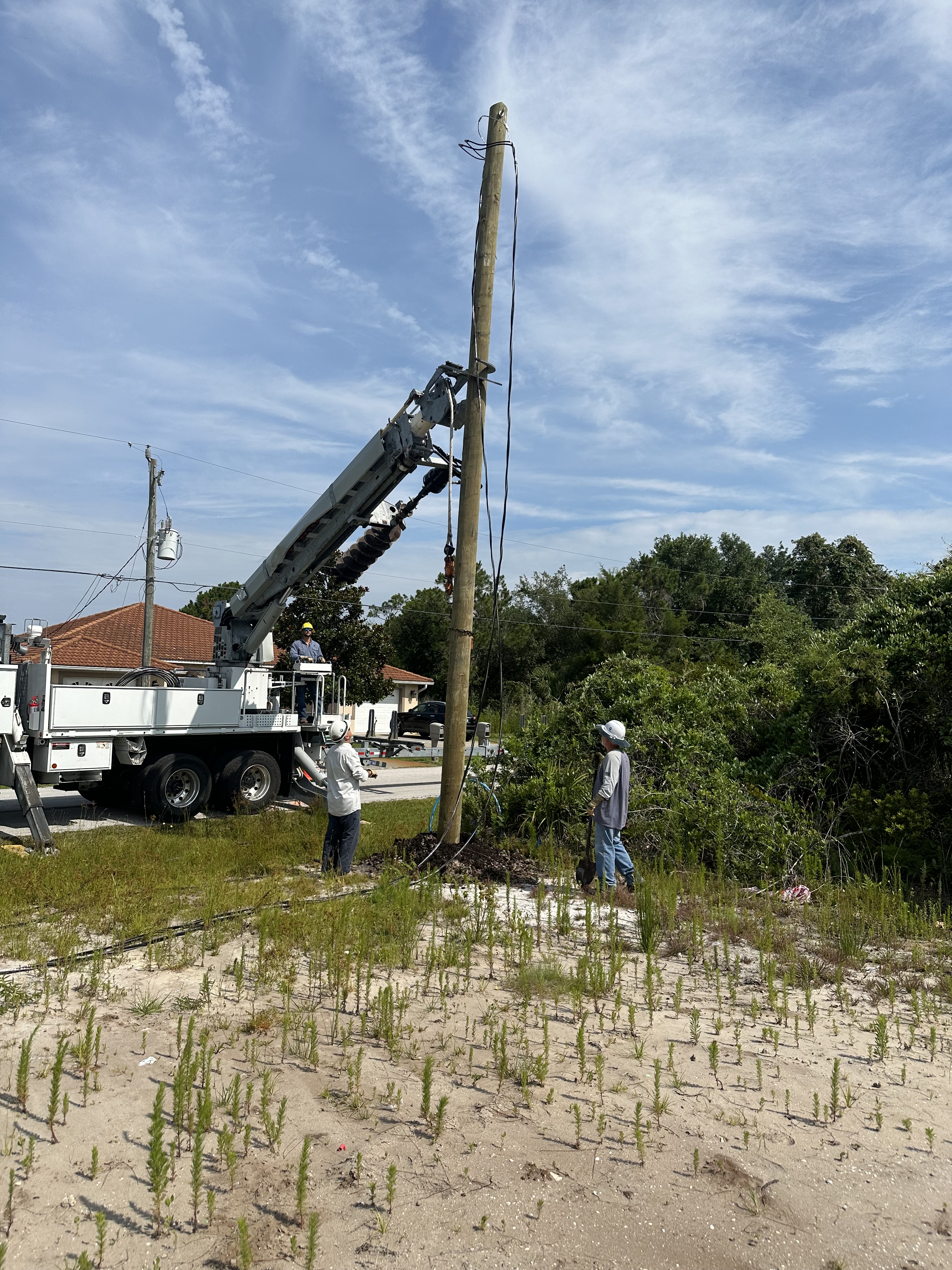
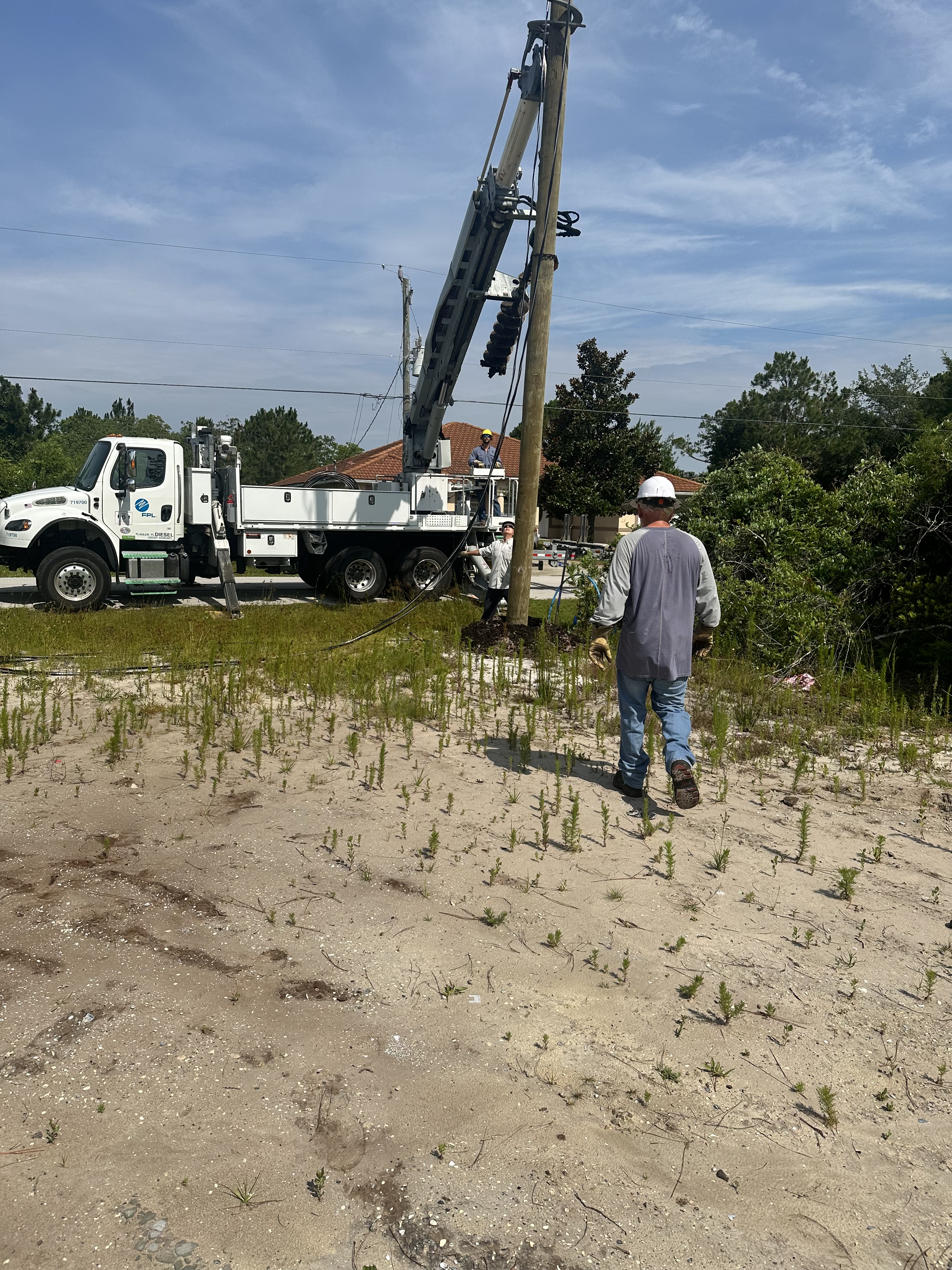
We were waiting on a power pole recently, waiting for Florida Power and Light (FPL) to come and put in a pole so that the wires that are across the street can be brought over to our lot, and then down to our power panel. Because of the aforementioned 2 hurricanes, FPL has been very busy replacing power poles in south Florida, and they have become hard to get, along with the labor to install them. We took a weeklong trip to Seattle and Portland for a family wedding, and the day after we returned, not even a week ago, we drove over to have a look and ran right into an FPL crew with 6 guys and 3 big trucks installing a brand new power pole. I never thought something as mundane and ordinary as a wooden pole soaked in creosote would look so beautiful.

My creative muse was inspired by this, and I commissioned ChatGPT, the generative artificial intelligence engine, to draft a Haiku to it. (You may have caught a few others cleverly inserted as captions).

Fresh power surges dance, new pole stands, electric might, Illuminating.

Strangely, I think the AI nailed it. I then immediately thought how cool it would be to have ChatGPT write this whole blog, but quite frankly I’m not that well-versed in how to prompt a robot to do my work, and that it would likely be much more time efficient to just write it than to figure out how to get the robot to write it. Who knows, someday I might just become a customer to my own blog, and frequently wonder when the robot might put out another post.

We are now down to 2 major build steps and one appliance on the wait list. The landscaping is scheduled to go in this coming week (11,000 square feet of grass!), and the carpeting will be done about the same time. But our electric range is hung up somewhere in the supply chain. Even our house number has been installed on the front, something that usually happens just days before we close the contract and take possession. So, we are on the edge of our seats, thinking more positively about a late June move-in (maybe a little earlier, please?). Stay tuned.

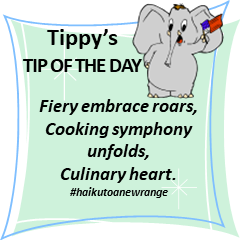
Tippy is just as excited as we are and wrote a Haiku of his own while humming a variation of “Home, Home on the Range” but with words like “Range, Range in the Home”.

Posted in Uncategorized | 6 Comments

IMMORTALITY, PHOOEY!

No travel this time, not on this shift. Today is a muse on immortality, something you are not guaranteed, even if you go camping every weekend. We camp a lot (especially lately!) and it provides us plenty of fresh air, sunshine, and happiness. (For those of you old enough to remember The Carpenters, you can imagine them humming a tune in the background as you read this). But immortal we are definitely not, and we think that’s just fine. I couldn’t bear the thought of the ScreenTime app on my smartphone going into a Y2K tizzy because I overflowed the total hours counter many decades into the future. Not gonna happen.

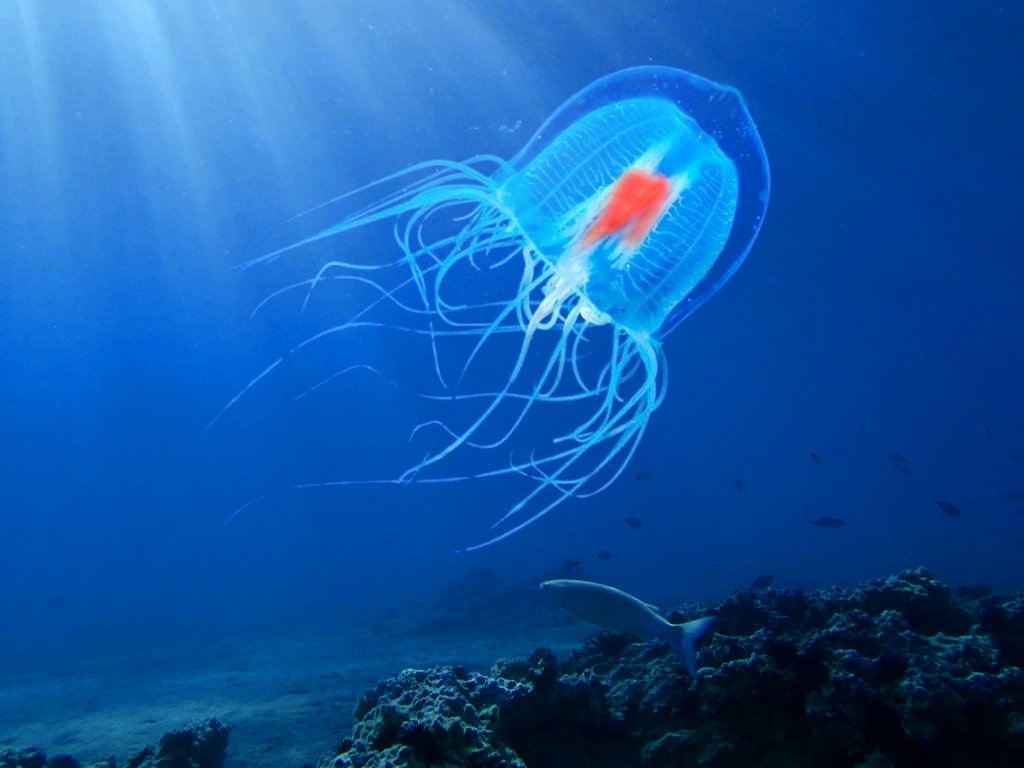
I recently read an article in the Wall Street Journal on the Immortal Jellyfish. Scientists are studying this briny Houdini in a quest to discover why we age and how they might stop that process or even reverse it. Be careful what you wish for, we say, be very careful.

The normal jellyfish life cycle looks like so many others: an egg is created and the parent dies; the egg hatches; a larval stage ensues; the larva advances to an adult and produces more eggs before it dies. This cycle churns the DNA with constant recombination providing the path for a Darwinian upgrade to the species.

The Immortal Jellyfish, found in the waters of Spain, has somehow rewired the adult phase of the life cycle to short-change the grim jellyfish reaper. After producing eggs, the adult begins a “decay” process wherein the body cells revert to juvenile stem cells resulting in a sort of faux zygote that then “rebirths” itself back into the pupal stage, a metaphysical rinse-and-repeat. Voila, immortality!

This one could be its own Grandpa!

You can’t fight the Second Law of Thermodynamics, as I was recently reminded by yet another WSJ article, which describes entropy, the inevitable onset of discord and chaos in our physical world. Eventually the Universe will die from it in something called “heat death”, where everything that is hot warms everything that is cold until a static peace results. That Second Law constantly reminds us that there is a never-ending battle between gravity (producing nuclear reaction fueled star growth) and entropy (degrading stars back to raw elements) that will eventually combine all the forces and energy of the Universe into a big, flat pool of lukewarm nothingness. At least until Elon Musk or some other bright nerdy entrepreneur figures out how to turn the entropy switch off. I’m not waiting for that. In the long haul (much greater than 10 or 12 years [fact-checkers agree]), the end game of total physical annihilation appears predictable, even if we can easily hide heads in the sand about it for thousands of millennia to come.

In the much, much, much shorter term, we have so many other things that threaten our existence to worry about, reasons not to want to live so long as to see them all play out to their ultimate conclusions. For instance, we’re very aware of climate change, it would be foolish not to be. Climate change has been constant for the entire history of Earth’s existence, as evidenced by countless ice ages and evolution itself. It isn’t a stretch to understand that virtually every living thing on Earth contributes to climate change in small or large ways, humans included. We’re old enough to remember being held inside during elementary school recess because the air pollution in LA was so bad you couldn’t see or breath outside. In those days the climate hysterians (aka activists) were assuring us that we would all choke to death in less than 10 years if we didn’t abolish cars. But clear heads prevailed, and a semi-disciplined open discussion ensued, and reasonable politicians enacted reasonable regulations, and clever engineers developed clever technologies that resulted in the fairly clean air we breathe today, even with an order of magnitude more cars on the road. That was, in my opinion, a well-played-out conclusion and we applaud our generation for rising to the challenge and quashing the predicted demise of humanity.

If the present generation fails to study previous generations enough to see that problems can be solved without hysterics and drum-beating, I’ll bet my bottom dollar (if inflation doesn’t take it first!) that Climate Hysteria, which has been so in vogue for 50 years or more, will hasten the end of humankind as we once knew it far faster and with greater efficiency than Climate Change ever could hope to. Just take a look at the collapse of agriculture and the economy in Sri Lanka, recently victimized by UN and World Economic Forum policies for a sustainable planet forced upon them to receive financial support. To better understand what happened to that country, watch what is happening right now to Denmark, in the throes of completely re-regulating their entire world-class agricultural industry, apparently to the point of potential complete failure, all in the name of saving the planet from cow farts. The march to the end of humanity (as we used to know it) is fully underway, and that march is producing unintended consequences in a much shorter timespan than the classic “12 years to Armageddon” we’ve become familiar with many times in our short lifetimes. I’ve no desire to stick around long enough to see this march conclude, or if it’s stopped to see another inevitable march sneak through to the finish line.

We’re pretty content to try and reach the goal of blowing out 100 candles, maybe even stretching that a bit. Seeing family grow, and more family added. Making new friends, and thoroughly enjoying the ones we’ve made and kept already. We’re placing our faith in everyday people recovering the rational and sane processes to successfully engineer the way forward on the coat tails of climate change. We think that faith might see us through another 30 years or so, and we plan to make the best of them. Even if I couldn’t muster the right stuff to pass the Grandma Test, and had to settle for the title of Grandpa, it’s gonna be a good ride!

Tippy wants to stick around with us.

Posted in Uncategorized | 1 Comment

THIS OLD HOUSE

We went from being “homeless”, as in we-didn’t-own-a-home, to owning 2 homes within a few months after our transplant to Florida. The first, a new home under construction, was by design, and a result of our decision to retire to Florida in the first place. We’ve been posting updates on the build, but not a lot has happened lately since the job (and many others) is being held up waiting for a critical part of the HVAC system, the air handler. Apparently the factory in Georgia that makes most of these was wiped out by a tornado not too long ago, and it is taking time to get the work done by other companies. We’re told that will be remedied soon and things will get back on track, and then the update posts can resume.

The second house was purchased as a result of a long and arduous search for a home for the Ricker family, comprised of our grandson Daniel, his mom Kristen, and his other grandparents Donna and Glen. They currently rent a little over an hour south of Palm Coast, where we are building, and wanted to be closer once we finally get the keys to the new pad. The date to get the keys has moved considerably in the last year or so and is now mid to late spring which dovetails nicely into the end of the school year for Daniel. Given plenty of time we decided to do some searching on their behalf for a reasonable rental, or even better, a house they could afford to buy.

We went through several iterations and strategies in our search. An existing rental quickly went off the list because the red hot housing market has driven rents through the roof. But high rents gave us another idea, buying a duplex and renting the other half of it out. This looked good on paper, and there were plenty of duplexes for sale, but the cold fact is that many of them are occupied by Section 8 tenants, which makes it really difficult to adjust rents to cover our expenses of the purchase. Weeks of canvassing the town and walk-throughs with no good results led us to abandon that strategy. In that process, however, we discovered that it might be just as viable to find an older fixer-upper home that would fit the bill for affordability and practicality. We had a great agent (Scott at Take Action Properties), who was invaluable in helping us locate homes that were either just fresh on the market, or even better not yet formally listed. Thanks Scott! He led us to the very first original neighborhood in Palm Coast, Country Club Cove. These houses were built in the early 70’s shortly after ITT/Levitt Corporation bought the old Graham swamp and began clearing and building on it to create what was, at the time, the largest planned community in the state of Florida (that honor now goes to The Villages). The development featured a golf course, raised up out of the swamp, and 200 ranch style homes on winding roads built within the golf course. The original model homes still have plaques in front of them commemorating this birth of Palm Coast over 50 years ago.

The Cooper House, as we are calling it, jumped out at us the first time we saw it. A wonderful, quiet neighborhood with little to no traffic, surrounded by a beautifully manicured golf course, and cleanly kept and neat yards was exactly what we were looking for. An expansive front yard and a very ample back yard surround the house, which is about 1900 square feet of living space, 3 bedrooms and 2 baths. It was a little long-in-the-tooth as they say, with the original bathrooms, done up in 70’s yellow and blue tile, still intact and in amazing condition. This house definitely has “good bones” and the few remodels done to it during the last 40 or so years have given it character as well. But, along with the character, there was plenty of “deferred maintenance” (to be polite).

The day we closed on it, Halloween 2022, we made our plans to move out of the RV and into the house and get to work. Inside and out, we have scraped and scrubbed, sanded and filled, patched and painted, ripped out and replaced, until it is nearly ready for the Ricker fam to move in come summer. For those of you who may be as masochistic as we are, or perhaps intrigued by the thought of resurrecting an old home, here’s a summary. Disclaimer: if you are in your 70’s and considering this, make sure you are faithfully going to the gym 3 times a week for several years before you start. It’s never as straight forward or easy as it first looks!

The “popcorn” ceilings were the first to go. These were ubiquitous in the 70’s, obviously well before anybody had an idea about how well they would (or wouldn’t) age. We had these professionally stripped and re-textured before we moved in, because frankly it creates a huge mess and we hate overhead work.

Wendy also painted the master bedroom while I tended to a few upgrades before we moved in, like kitchen appliances and a new garage door opener, figuring we could paint the rest of the interior while we lived there.

Everyone knows the story of Murphy. The guy that wrote the law “if it can go wrong, it will go wrong”. This especially applies to home renovation, just like it does to Little British Car restoration (see the way previous blog about Eddie the MG coming to life). Two weeks or so after moving in, on the day before Thanksgiving, we were busy touching stuff up and cleaning because we had invited some friends over to dinner. The vacuum cleaner became possessed by Murphy’s spirit and decided to blow a circuit that took out half of the lighting and outlets in the house. No amount of breaker resets or cursing would remedy it, so we turned to our best source for help, Tony the ice cream guy. Don’t laugh! Tony, who runs Twisters Hand Made Ice Cream in Palm Coast, was the first person we met and became friendly with locally, and he knows everyone, including an electrician named Joe. We still don’t know Joe’s last name (definitely not “The Electrician”), but Tony made a call and Joe appeared at 3PM on Thanksgiving Eve, discovering (with me as his assistant) that the previous owner had done some pretty shoddy rewiring in the attic for his stereo system closet and a few wires had melted together. Joe got that (and a few other things) cleaned up by 5:30 and tried to only take $70 for the repairs. We tipped him very well as he had just literally saved our turkey bacon. Tip: when moving to a new town, meet the local ice cream shop owner FIRST. You will be surprised how much this can improve your future prospects. In fact, it was Tony that led us to Scott at Take Action Properties, bonded by a mutual love of homemade ice cream. Tip #2: when a tradesman does you a big solid on a holiday Eve, pay in cash. You’re welcome.

There were lots of small plumbing jobs, mostly upgrading old fixtures or fixing leaks or bad electrical outlets and switches. Of the two largest plumbing tasks, one was planned and the other was not. The toilet in Bathroom #2 had a broken tank lid, so we replaced the whole thing. But, alas, the new lid wouldn’t fit under the existing cabinetry, so we fabricated a new lid out of polystyrene plastic (hats off to YouTube). In retrospect, we could have done this for the old toilet as well, but then we would be left with the likelihood that the old crapper would eventually bite the dust anyway.

In addition to that, a hose bibb on the front of the house was leaking, and when Warren tried to replace the worn seat in it, the whole thing broke off inside the concrete block wall. This, of course, happened at another optimum Murphy Moment, New Year’s Eve. Tip: don’t start any plumbing jobs, or any jobs for that matter, that might require a professional to fix if you can’t complete it. Plumbers, go figure, are as rare as hen’s teeth on New Year’s Eve. It took some creative imagination but tapping the inside of the broken pipe and threading a new coupler into it did the trick and a new bibb was installed as a permanent fix.

The kitchen cabinetry is solid and in excellent shape but painted with a God-awful stenciling that came from some of the darker regions of the previous owner’s memories.

We got the feeling that we were in a WWII troop ship kitchen. Truly creepy, but very fixable.

The paint scheme seems to have sprung from a World War II theme, and we think the 81 year old previous owner must surely have been one of the Greatest Generation and felt at home with that motif. We are not of that generation (go Boomers!), so a long weekend of stripping the cabinets down, sanding, and painting restored some sanity. Disappearing all that military stenciling left us with an eerie sense of having erased some important history, just not important to us.

Speaking of cabinets, when we took possession of the house there was a small “orphan” cabinet just sitting on top of the fridge. We initially thought to put it out for the bulk trash, but then realized there was an inoperable vent fan over the stove in a very large space and no microwave. We refitted and repurposed the small orphan cabinet to fit the gap, installed it, and also installed a new over-stove microwave/vent. Two new doors had to be fabricated to match the rest of the kitchen, and it was subsequently painted to match.

The kitchen ceiling had some hideous track lighting that we just tore out before the ceilings were done (I detest track lighting). We installed a new drop ceiling and an integrated LED light panel, along with a new LED fixture over the sink. While we were at it a garbage disposal was installed. Who can live without a garbage disposal? Luckily there was a nearby switched electric circuit that was repurposed as the power source. It’s likely that there was once a disposer, but for some strange reason someone removed it. Go figure.

The bulk of the interior was classic 70’s décor, from the yellow and green paint down to the alpine gingerbread chair rails on the walls (even where no chairs would ever be found). While the ceiling guys were doing their job, we stripped all that off, and Dan’s crew was nice enough to patch all the holes up while they were doing the ceiling patching. Thanks! After lots of sanding and painting, the house has a completely new look inside. It even feels bigger.

While the inside needed lots of love, the exterior was just as demanding. There were extremely overgrown Aloe Vera cactus plants at every corner of the house. We hated those, so out they came. These would be easy to extract if we had a backhoe. Instead, we had a shovel and our hands. Wendy figured out the magic formula for extracting the stumps, chopping away with an axe at the root ball until the stump can be ripped out of the ground.

We wish we had known before we started that there was a fair amount of irrigation plumbing that had been grown over by the Aloes as well. Plastic sprinkler plumbing is no match for an axe: see the later paragraph on irrigation repairs and renovation. We also met a few new local friends while we worked, like this little guy here.

Meet Sammy McSnakeface, the Corn Snake. Ubiquitous in Florida, harmless unless you are a mole or other rodent. We love this guy!

There were 2 lamp posts in the front yard that were so dilapidated it was amazing that they still stood upright. We stripped all of the structure off (a hollow wooden post constructed of badly warped fence boards, wiring, and some large carriage lamps that were bolted on). We fabricated new hollow posts, sorted and cleaned up all the wiring, and installed new motion sensor LED lamps that are fully automatic, providing subdued lighting starting at dusk, with motion sensors that ramp the lights up to a brighter mode to illuminate the walkway for anyone visiting at night. We painted them in the trim paint we have selected for the rest of the house. Cast aluminum post caps finished them off and provide a little weather protection.

All of the flower beds and gardens adjacent to walkways also needed to be regraded because they were “bleeding” mud and sand all over the hardscape every time it rained. Our solution was to tear the beds out, remove a bunch of dirt and sand, establish a nice border using brick pavers, repair any irrigation in the beds, and re-grade the bed with a 2” cedar mulch cover. We’ll let the Ricker’s decide on any planting since they are going to care for it. And I’m well aware that it looks like Wendy is doing all the work, but who do you think is taking the pictures?

The property has an extensive sprinkler system that is nearly as old as the house itself, I think. There was a rat’s nest of wiring coming into the garage, with an old valve timer system, and a strange bank of wall switches that were assembled as a manual operating system for the 4 zones. It looks like a previous owner, rather than fixing the original valve and timer system, just patched on the manual switch system because they couldn’t figure out how to program the ancient timer. In addition to the weird valve/timer/switch system, the sprinkler heads themselves weren’t too pretty. We fiddled around with the wiring and old timer a bit, and after hooking up a 12 volt power supply and setting the switch to “Manual” operation, we were able to get 3 of the 4 zones to at least spray water. Progress! But it became obvious that we would have to locate the valve bank to renovate all 4 zones. We started at the “root” of the system and followed the rat’s nest wiring to a point where it just disappeared into the ground. Then we dug, and dug, and dug, finally uncovering 5 valves under about a foot of dirt. All the valves were cleaned up, the wiring sorted and cleaned up, some pavers were used to construct a “vault” for all of this that would be out of the dirt and protected from the environment, and the timer was relocated to a better wall in the garage for accessibility. At last all 4 zones would spout water, and one by one the sprinkler heads were either cleaned up or replaced, leaving us with a fully functional irrigation system. We even added a drip zone in the front where some new landscaping replaced 2 of the old massive Aloe Vera plants. This process also required us to dig up and patch some of the underground feed lines, thanks to the sharp axe that was used to extract the aloes.

The back yard has 2 landscaping “zones”, the closest to the house being the lawn, and the rear of the lot had been taken over by palmettos, vines, weeds, bushes and overhanging tree branches that were grossly overgrown. Our solution was to hack and trim it back, and to rip out anything that had taken over territory through years of neglect. We ended up with 4 massive piles of yard waste and ended up calling a trash removal service who brought a large dump truck and a couple of workers and hauled it all away.

After a couple of months of chipping away at the renovation, we are to a point where we can see the final result. The next 2 (and perhaps final) projects: a new roof goes on in February, and then we will get busy pressure washing, stucco patching, and painting the outside. Until then, we are going to resume our retirement life!

Tippy has the last say, always.

Posted in Uncategorized | 6 Comments

BREAKING NEWS: HOUSE PASSES ANOTHER INSPECTION

It’s time for another House Build Update! We have hit a milestone on our build, called “Being Vertical”. This refers to the perimeter walls of the structure finally being put in place to give a third dimension to what was up-to-now a very flat structure. Being Vertical also refers to our preferred human state during waking hours, something every septuagenarian+ can appreciate! (If you haven’t yet reached septuagenarian status, you will have to take our word for it).

Rather than just a brief update with a nice photo, here’s a progression of nice photos that show the progress to date.

The first real evidence of activity on the project was Clearing the Lot. What was once a jungle of bushes, trees, and brambles was transformed into an open, buildable lot.

It sat like that for much longer than we had hoped, but finally along came some more men and equipment, and a bunch of dump trucks full of fill dirt, and Grading commenced.

Wade, the magician with the small (and very nimble) Bobcat tractor, built a beautiful pad on which our house would eventually stand. And very soon after that Hurricane Ian came along and washed down all the sharp, beautiful edges until we could hardly see where the house would stand. But not to worry! More men and equipment arrived after the skies cleared and the winds died, and out of the flat pile of dirt emerged trenches into which wooden concrete pad forms were placed.

The forming work stopped at about 90% completion to allow yet another crew of workers to place all the under-slab piping and conduits, and the Rough Plumbing milestone was nailed.

With all the under-slab stuff installed, the foundation slab crew returned and finished all the wood forms installation, then placed all the steel footing and wall tie-downs and the plastic vapor barrier that will keep the notoriously high Florida water table out of our house!

A few days later the gloriously beautiful Concrete Pump arrived, and in no time a small army of men and equipment had a few concrete trucks worth of product poured and finished up to slab grade.

At this point I wanted to have an aerial shot of the property, as well as the adjacent lot that we are considering buying to add to our “back yard”. So we sent up the drone to do the job.

We were led to believe that it might be a few weeks before anything else happened because it would take 7 days for the slab to “cure” to the state where more construction could be done. But, in exactly 7 days a few truckloads of concrete blocks appeared and were distributed across the slab, ready to become the exterior perimeter walls of our hurricane-proof house.

A couple of days later another shipment of materials arrived, the mortar and other parts that are needed to complete the “Going Vertical” milestone. And a few days after that, bingo! We blinked and it was done!

Now that we’re all vertical, we eagerly await the next big milestone: roof trusses and interior framing!

And even Tippy is excited to be Vertical!

Posted in Uncategorized | 5 Comments

HURRICANE IAN

There are very few in Florida who weren’t affected by Hurricane Ian, one of “the most powerful hurricanes to hit Florida in history”, either directly or indirectly. We sincerely hope that those affected are getting all the help they deserve from local, state, and the federal government. This is sometimes a sketchy proposition with FEMA as we have all seen over the last decade or so. But, at least initially, it looks like Florida and the Feds are making nice and having good results. Certainly, our Governor, Ron DeSantis, is getting very high marks for his leadership with extensive preparation for, and execution of recovery efforts.

Camping in an RV is always a dicey situation in any kind of significant storm but having a Category 4 hurricane barreling down on you when all you see is that you are “in the path” is especially unnerving. Although the county emergency services recommended evacuation for all RV’s and mobile homes, we made the informed decision to stay based on 3 criteria: we would not be negatively impacted by a power outage, having the ability to “boondock” as a self-contained rig; we were on high ground in the campground, at the same level as the other two permanent structures, which historically have never been inundated by flooding; we were also situated adjacent to and downwind from one of those permanent structures, which made a good windbreak from at least the steady winds. We did some pre-storm preparation, removing all the outside stuff in our site away to our storage facility, filling our fresh water tank, emptying our waste tanks, charging our emergency cell phone power pack, and moving our truck and Jeep out from under our shade tree (a magnificent several hundred-year-old oak, who has doubtless survived many large storms).

Viewing the National Hurricane Center report as the center of the not-even-cat-1 degraded Ian brushed past us here in Palm Coast, we can tell you that being inside the “high winds” green zone brought considerably more nervousness than a summer thunderstorm would produce.

We luckily ended up to the West of the storm center, the “easy side”

Our concern was justified with the steady winds (about 35-40 mph) and gusts (to 75 mph) blasting through the campground. The windbreak provided by the structure next to us helped, but it didn’t stop us getting rocked frequently by gusts that felt like they slammed into the side of the rig hard enough to dent something. Nothing dented, by the way. I shudder to wonder what it would have been like without the windbreak, and whether we would still be standing upright.

One big concern was a tornado. It’s no fun imagining what a tornado could do to our rig, although we did have a concrete block shelter (actually the campground bathroom and shower building) nearby that could have saved our lives. Here is a “before” and “after” shot, showing that building.

Tornados spun off by hurricanes are overwhelmingly “east and southeast” phenomena, meaning that they occur most frequently in the southeast quadrant of the storm. We felt a very small hint of hope in that we would be to the west of the center as it passed, and therefore less likely to experience one. But statistics aren’t certainties, so we added that to the top of the worry pile. We are happy to report that we haven’t seen a report of any confirmed tornados in our area at all, so pile that bit of data onto the statistical heap.

Water is the biggest threat from a hurricane. Storm surge is the big villain as is totally evident by the horrific pictures and videos coming out of Southwest Florida. Fort Myers, Sanibel Island, and Naples were hammered by 150mph winds, but it was the 15-foot storm surge that did 95% of the damage. There was one guy that had just taken delivery of 2 new vehicles, a Bentley and a $1M McLaren P1 sports car. They were both swept from his garage and ended up blocks away, with the P1 resting atop a toilet that had been deposited in a front yard after the house it was once in was obliterated by the surge.

I will probably never again see a sports car sitting on a toilet

With all the real suffering going on in that part of the state, it’s hard to feel sorry for the guy who watched $2M worth of cars wash away. I would have gladly driven the P1 to safety before the fact, all he had to do was ask.

Even though downgraded to a tropical storm by the time Ian hit the east coast of Florida, the storm surge pushed up the coast in front clobbered Flagler Beach, just 2 miles east of us. 15-foot waves tore 100 feet off of the iconic Flagler Pier and washed it away.

It’s 15 feet to the bottom of the pier deck, what’s left of it.

Flagler Beach includes the long barrier island on our stretch of the Atlantic Coast, and the entire island was evacuated along with the communities that front the river. That area completely flooded as the Atlantic surge of +5 feet on one side got matched by the same surge on the Intercoastal Waterway, in this area the Matanzas River. We ventured out on Thursday late afternoon when the storm had passed to take a look, and it was astonishing.

The storm surge contributed to our drainage canals backing up just when they are needed the most to move 12” of rainfall away to the ocean. But the canal system here is extensive and capable, and handled the volume well, even though the water rose up to and slightly over the banks, about a 4’ increase overall.

Right in the center there is a beady pair of eyes

If you look closely, there is a pair of eyes peeking out of the water at you. That’s Eddie, a local gator who gets kind of aggressive about following you because many of the campers here stupidly feed him, and he thinks you might have something for him. We steer clear and have never seen anyone walking small dogs near the canal. Once in a while someone just carrying a leash, but no small dogs. We kid.

Meet Eddie, about 5 feet long, who followed me as I walked off the bridge, quickly.

On our Thursday expedition (the right word for the trip as there were downed trees, flooded areas and debris covering all the roads) we were primarily interested in surveying our 2 properties. We have a house under construction, and at peak flood it came through just like it was planned. You can see that the “swales” (streetside drainage ditches) are full to the top, but where the slab soon will be is easily 2 feet above that level. The swales were draining a full volume as the drainage system around our neighborhood is robust, and our property is near enough to the Interstate to be classified as high ground (one of the reasons we are building there). We were horrified to see the Palace of Poop, our magnificent Port-A-Potty vanquished by the storm and lying pitifully on its side, only to discover later that the service company had come around pre-storm to pump them all out and put them on their sides to avoid that horrible fate.

Our other property, recently purchased as a temporary home, also came through high and dry. It is built in a golf course, one of the original areas that was “raised out of the swamp” that became Palm Coast 50 years ago. The smart planners built the golf course, the signature feature of the new city, high enough to avoid all floods, and our neighborhood sits right in the center of it, also one of the reasons why we bought it there.

Maximum flood in the swale at Cooper House, a good sign!

The storm broke Wednesday night, and Thursday dawned as a beautiful cool fall day. We went for a walk to survey the damage in the campground, remarking that if we had a rake (which we didn’t) we could do some cleanup and try to get back to normal. Along our path we met a young woman who was raking, but her rake (that she had just purchased) only had ½ a handle. It had broken under the strain, and she remarked that she was throwing it away after she was done. We patiently waited for her to finish (2 minutes), and she gifted it to us. The Universe had, once again, provided for our wish.

We will pay it forward, and gift this to someone else.

Our cleanup was pretty straightforward, raking huge clumps of Spanish Moss into piles and getting them to street-side for eventual pickup. We swept the globs of moss off our vehicles, and I got up on top of the rig to sweep it off there as well. We won’t be reinstalling the screened tent since we will be moving in a month or so into Cooper, our golf course house, where we will spend the next several months doing some rehab on it to ready it for rental to our grandson Daniel’s family. They will relocate to here in June (after the school year is up) once we move into our new house.

The rest of the campground had considerable damage, mostly caused by trees that had either broken or fallen over. We’ve had a ton of rain over the summer, and much of the ground was already wet before we got our 12” of rain during the storm.

Given the severity of Ian, and especially considering the vast damage done in the southwest, we got off pretty easy and escaped with no damage at all. We made some educated judgements about staying vs. leaving, even though there really was nowhere to go if we left except Georgia or Tennessee to avoid all the possible paths predicted for Ian. One plus: we got to survey what our future home(s) will look like in a big storm and feel pretty good that they both survived nicely. And we got to experience at least one silver lining, a beautiful sunset.

Tippy, too, is happy to come through unscathed!

Posted in Uncategorized | 6 Comments

FLATLANDERS

We honestly haven’t been twiddling our thumbs all this time! We did spend almost 3 weeks back in the Northwest, which will get sufficient posting all on its own soon. But there has been progress on the “home” front, and it’s time to post out the progress.

We have been waiting out the start of our construction as we got initially settled (see “The Eagle has Landed”) and then re-settled into a new RV campground. We relocated from 4 Lakes Campground in Hastings to our new digs at the Bulow Plantation in Flagler Beach, mostly to get us closer to town and because Bulow has a pool! There is much more social life going on, and we’ve already met folks to hang with. A huge plus: we got Spectrum cable internet right at our site. We went from near-zero connectivity at 4 Lakes to 400 mb/sec screaming broadband, and it has dramatically improved our moods. It’s not such a great testament to how dependent we have become on the Internet and our cell phones, but when you are living a nomadic lifestyle with daily involvement in city building codes and properties, it’s a real mood enhancer.

On the building front, we were finally notified by the builder that we have been assigned a Construction Manager (hi Rick!), and that means that they are finally commencing with the build. That was a very good day, and Wendy has formed a strong texting bond with him for updates. He kept us well-informed as to the date for Step One: to bring in the heavy equipment to mow down and remove all the vegetation on our small parcel of jungle, called “clearing the lot”. The date inched closer and closer over a week or so until Rick texted that our lot was next, and we could expect work to start the next day, August 22. We took one last look at our little patch of jungle, woefully recalling that we had ventured onto this frontier many months ago, armed with a roll of fluorescent pink plastic flagging tape to mark all the trees we wanted to keep, only to be later informed that their lot-clearing contractor was no longer allowing that due to so many lot owners mis-marking trees that interfered with the building or utilities, requiring the contractor to return to remove them. Although we were well aware of the need to keep clear of the build (I had personally done the lot placement diagram that the builder submitted to the city for permitting), we couldn’t convince them to spare the few nice trees we had already tagged.

The lot clearing happened over 2 days, ending on August 23. It was very exciting to see, with the big excavator taking huge bites out of the landscape and tearing trees out like they were weeds. Big dump trucks came and hauled it all off, turning us into Flatlanders virtually overnight.

From the standard build calendar the builder had provided us, I was expecting a couple of weeks to elapse before anything else happened, but the very next day the city notified us that an inspection for water meter installation had been not only been ordered but was already done and signed off. This is quick progress, indicating that another stage has begun. And lo and behold, when we took a drive by to check again the next day another astounding milestone was met. I never in my life thought I would admit that the sight of a Port-a-Potty would be an earth-shaking event, but there it stood in all its majestic glory.

The mighty Port-a-Jon stands guard over the Flatland. The treed lot in the background is our next target to buy. We’ll definitely save the trees on that one!

Don’t underestimate the power and utility of the Port-a-Potty. This magnificent device delivers the ability to sustain workers at our property for entire days at a time, and that’s a good sign that the builder intends to do just that. This notion is augmented by the fact that the same builder is putting up two other homes in the same neighborhood, one is slightly ahead of ours on the calendar and the other is a week or so behind. We can use the first one as an indicator of when to expect a similar stage of building on our lot. True to that assumption, just a day later appears a small bobcat tractor and a trail of dump trucks with topsoil that will be used to grade out our lot and to construct the building pad so the concrete crew can get to work on the utilities and foundation.

We’re over the moon, at least for a short while, at the pace of building. Especially after waiting 9 long months from writing the first check to a shovel full of dirt being turned. But at least we’re “on the board”, and hoping the fast pace keeps us on our toes.

Tippy has a little to offer on this, as usual.

Posted in Uncategorized | 2 Comments